I am writing this column from my now socially distant home on the ancestral lands of the Osage, Miami, Sioux, and Haudenosauneega people.
That is what’s known as a land acknowledgement statement. They are common in Canada, Australia, and New Zealand, but are increasingly being adopted at meetings and convenings in the U.S. as a small but powerful step toward addressing the violence and erasure experienced by Indigenous people across the continent.
Saying their tribal names out loud is the very least we can do.
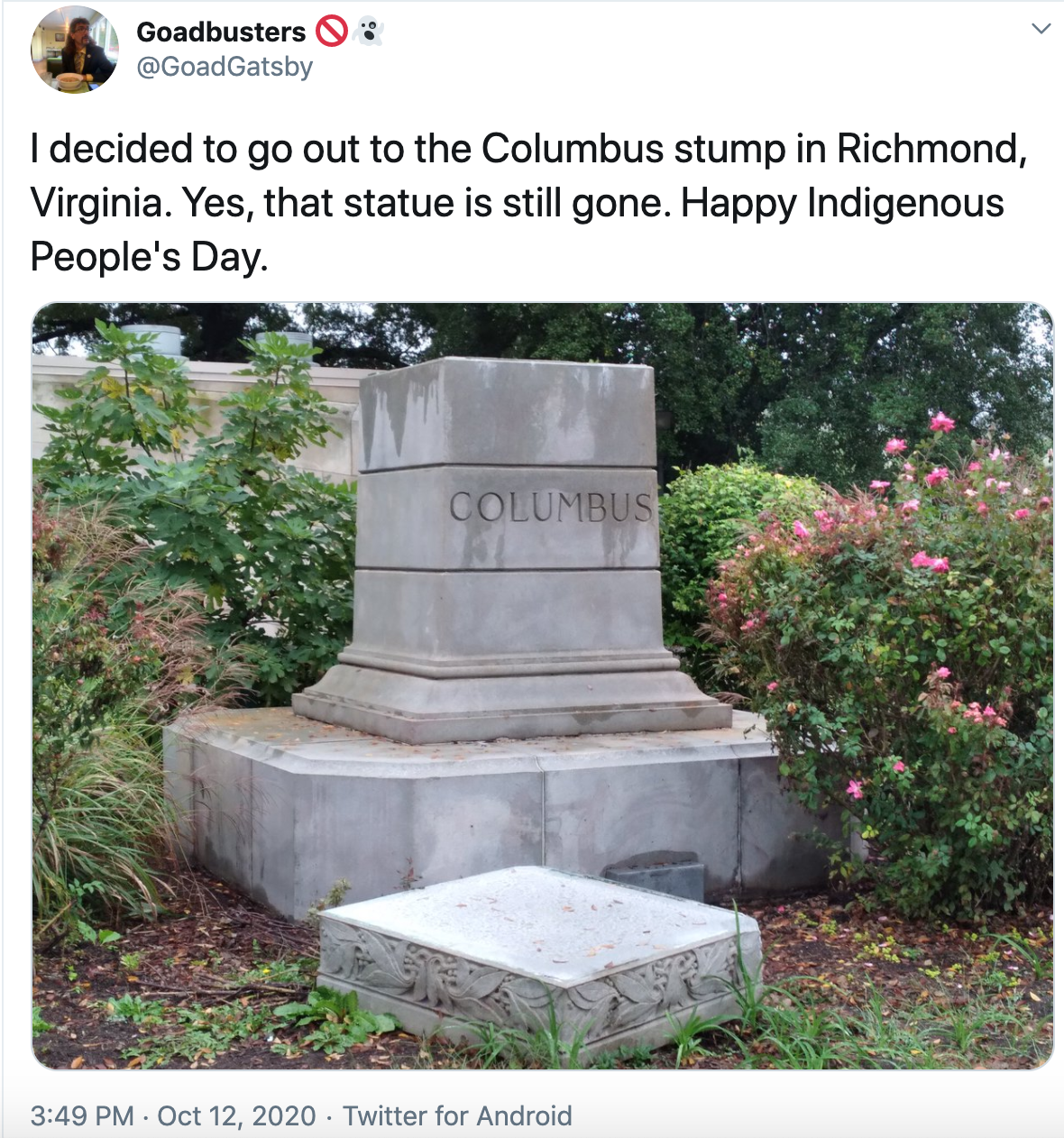
Questions of what more should be done are raised the second Monday of every October, as colleges, towns, cities and states are increasingly choosing not to mark the arrival of Christopher Columbus, a violent colonizer, and instead embrace Indigenous Peoples’ Day as a chance to deepen the work.
“Today we understand that while [Columbus] was an explorer and is credited with being one of the first Europeans to arrive in the Americas, we now know a great deal about the history and the way that he and his people behaved when they came to this continent,” Shannon Speed, a citizen of the Chickasaw Nation and director of the UCLA American Indian Studies Center told NPR. “Which included pillaging, raping and generally setting in motion a genocide of the people who were already here. That’s not something we want to celebrate. That’s not something anyone wants to celebrate.”
It feels like a takeaway for plenty of Italian Americans who still believe that the holiday was a way for their broader contributions to be appreciated. But it’s worth noting that the appreciation came at a steep price. Columbus Day became a holiday after President Franklin D. Roosevelt signed a 1934 decree in the wake of a concerted campaign by the Knights of Columbus, a charity which provides services to Catholic immigrants.
“When Italians first arrived in the United States, they were targets of marginalization and discrimination,” notes UNC history professor Malinda Maynor Lowery, who is both a a scholar of Native American history and a member of the Lumbee Tribe of North Carolina.
“Officially celebrating Christopher Columbus—an Italian Catholic—became one way to affirm the new racial order that would emerge in the U.S. in the 20th century, one in which the descendants of diverse ethnic European immigrants became ‘white’ Americans.”
But the unfortunately binary fight over which holiday to celebrate erases the terrible acts of violence, including terror lynchings—at least 50 have been documented — experienced by Italian immigrants. This history also deserves to be known, even if a retreat to whiteness makes it feel unnecessary.
But it’s all necessary.
This particular day falls at a time when Indigenous communities are under siege due to the coronavirus pandemic. The degree to which we will ever be able to understand exactly how devastating the impact will have been is not clear, because they are being literally erased from the conversation.
Rudolph Rÿser (Cree/Oneida), the executive director of the Indigenous rights think tank, the Center for World Indigenous Studies, is a leading expert on the impact of the pandemic on global Indigenous communities. He recently published a grim COVID-19 risk assessment study, and followed up with an in-depth interview with High Country News.
“Our first finding was that almost none of the U.S. government or state or county or municipality data relating to any tribal community, whether on a reservation or adjacent to a reservation in urban centers, was even remotely accurate,” he says. Part of the issue is that the U.N. only recently called for the disaggregation of public health data to identify Indigenous populations around the world. But it largely hasn’t happened in the U.S. Now, tribal communities, already grossly under-resourced, are on their own. “What the hell is Indian Country going to do with hundreds of thousands of people who are disabled from having been infected?” he asks.
Someday, when we meet in person again, I’ll make a land acknowledgement statement at a corporate event. Based on my experience, it was already highly unlikely that a Native American executive would be there to hear it. Now, it’s time to worry whether or not there will ever be.
It makes the statement that much more urgent. Once we understand our past, what role do we play in reinventing the future?
*this essay draws on observations from last year’s Indigenous Day column.
Ellen McGirt
@ellmcgirt
Ellen.McGirt@fortune.com
raceAhead is edited by Aric Jenkins.
Today's mood board