
At the U.S. presidential debate on Tuesday, Democratic candidate Joe Biden and U.S. President Donald Trump squared off over just about everything, including Trump’s trade deal with China.
“[Trump] talks about these great trade deals. He talks about the art of the deal; China’s perfected the art of the steal,” Biden said, criticizing Trump’s approach to trade with China. “We have a higher deficit with China than we did before [Trump was elected].”
“China ate your lunch, Joe,” Trump said in response, referring to Biden’s time as Vice President under President Barack Obama.
Subscribe to Eastworld for weekly insight on what’s dominating business in Asia, delivered free to your inbox.
Like much of the debate, the barbs over the trade deal devolved into a shouting match, as Trump pivoted to unproven claims that Biden’s son Hunter Biden has made billions off his father’s dealings in China. But the brief exchange over trade highlighted an important question: Has Trump’s years-long trade war with China rebalanced the U.S.’s trade deficit with the world’s second-largest economy?
Data show that the U.S. trade deficit with China ballooned under both the Obama and Trump administrations. Trump’s trade war, however, did plug the growing deficit, even as the U.S. shipped fewer goods to China. Trump’s January “phase 1” trade deal with China was supposed to see China import more American products this year, but China is far behind on fulfilling those targets.
Deficit
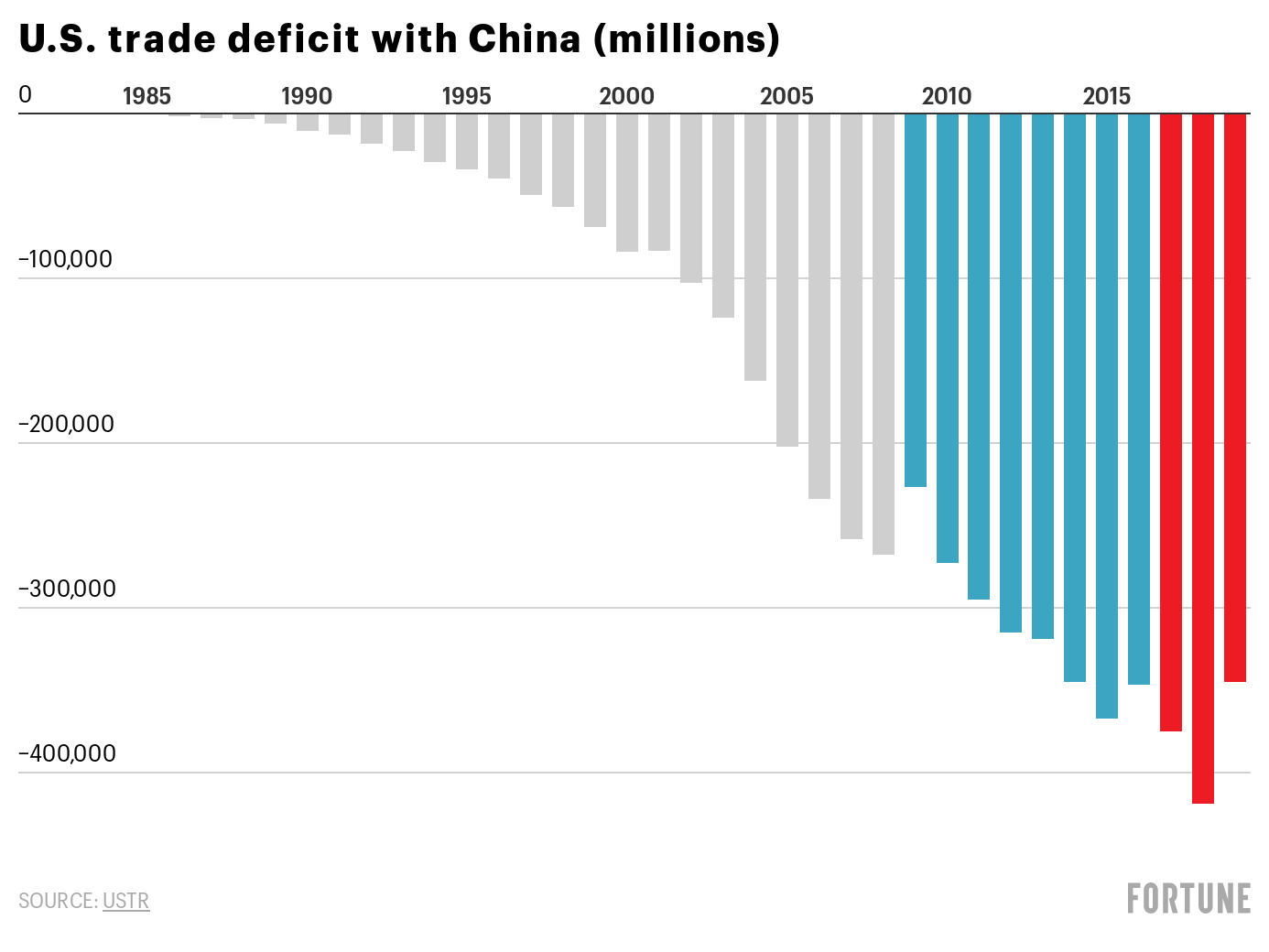
Biden’s claim that Trump has overseen a higher trade deficit—meaning the amount by which the value of Chinese imports to the U.S. exceeds the value of U.S. exports to China—is partially true, according to the office of the U.S. Trade Representative (USTR). In the first years of Trump’s presidency, the U.S.’s trade deficit with China reached record highs, but it has since fallen to Obama-era levels.
From a low of $6 million in 1985, the U.S.’s trade deficit with China climbed to $83 billion in 2000 and skyrocketed to $268 billion in 2008, the year American voters elected the Obama-Biden presidential ticket. The deficit grew over the course of Obama’s presidency, reaching $375 billion at the end of 2016.
During Trump’s presidency, the deficit ballooned to an all-time high of $418 billion in 2018.
In July 2018, Trump ignited the U.S.-China trade war, levying tariffs on $34 billion worth of Chinese goods. China retaliated, imposing tariffs on $34 billion worth of U.S. goods. Several rounds of tit-for-tat measures followed, until both sides had slapped tariffs on hundreds of billions of dollars’ worth of each other’s goods.
As the trade war raged in 2019, the U.S.’s trade deficit with China shrank to $345 billion, down from the 2018 high and roughly equal to its size when Trump took office. But the shrinking deficit wasn’t due to China importing more U.S. goods. In fact, U.S. exports to China totaled $106 billion in 2019, down from $130 billion in 2017, before the trade war began.
The USTR expects the 2020 trade deficit to fall to roughly $280 billion, its lowest point since 2010. The figure reflects the overall slowdown in trade amid the pandemic; both Chinese exports to the U.S. and U.S. exports to China are poised to steeply decline this year.
The trade deal?
After the U.S. and China agreed to the phase 1 trade deal in January, the White House touted it as a “historic agreement [that] will begin to rebalance our vital trade partnership with China and benefit both of our countries.” Indeed, the deal was supposed to result in China increasing its purchases of U.S.-made goods by $200 billion over a 2017 baseline this year and next. China agreed to make purchases worth $172.7 billion in 2020 alone, including of manufactured goods, energy exports, and agricultural products. In exchange, the U.S. dropped some of its trade war tariffs.
But through the first three quarters of 2020, China’s purchases lag significantly in nearly every category, according to the Peterson Institute trade deal tracker. Through August, China had imported $56.1 billion worth of American products, less than half of the $115 billion it should have purchased at that point to be on pace to meet its 2020 pledge.
Now, as the political battle between Trump and Biden heats up ahead of November’s presidential election, factions in the White House are considering whether the U.S. should remain in the deal at all.
After representatives from the U.S. and China met in August to review the deal, the USTR said in a statement that “both sides” saw progress toward the trade deal targets and are “committed to taking the steps necessary to ensure the success of the agreement.”
White House observers appear less certain that the U.S. will stick with the deal.
“Naysayers in the White House…are challenging this deal,” Wendy Cutler, a former top trade official now at the Asia Society Policy Institute, told the Financial Times on Sept. 1. They’re “questioning whether we should remain in it, particularly in the lead-up to November.”
More must-read international coverage from Fortune:
- Scientists say a gap in COVID vaccine research may keep us from returning to “normal”
- There’s an ulterior motive to China’s carbon neutral pledge: Cornering the green tech market
- How data helped keep Red Bull’s F1 team on track during the pandemic
- Check out Airbus’s concepts for the world’s first “zero-emission commercial aircraft”
- Researchers find a “druggable pocket” in coronavirus that could lead to new antivirals