Country A is home to one of the oldest stock exchanges in the world where the rule of law is rock solid, and investors are afforded rigorous protections.
Country B is essentially a petrol state that ranks low on various financial freedom indexes. Its relatively recent transition to a market-based economy has been bumpy, and its embrace of democratic processes and norms has been widely criticized by human rights groups. Country B’s President, for example, recently changed the constitution to extend his rule by decades and is widely suspected of routinely poisoning his political foes.
And yet to investors, the two countries are widely indistinguishable. They’re both seen as a lousy place to sink your spare cash.
You’ve probably guessed Country B is Russia. And Country A? That’s the United Kingdom.
Investors who are long U.K. equities watched incredulously in March as their portfolios sank precipitously and have watched with just as much surprise as it’s failed to recover to the levels of its European peers.
Down roughly 23% year to date, the once mighty FTSE 100 is underperforming just about every major European exchange and is miles behind the major U.S. indexes.
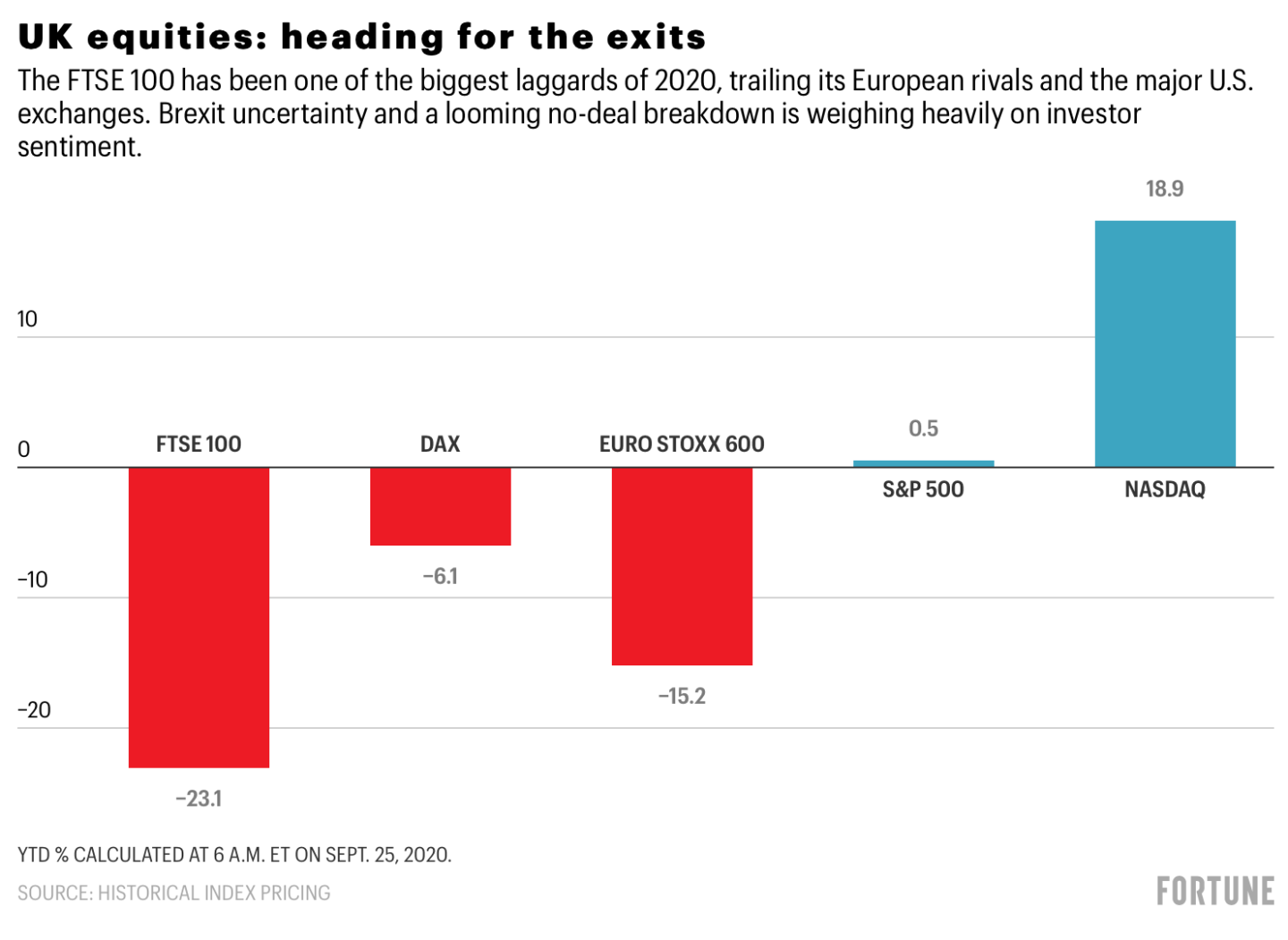
In fact, you have to head to emerging markets to find a comparable performance match. The FTSE 100 (negative 23.1%) sits between Brazil (-16%) and Chile’s Santiago IPSA (-26%) in YTD performance for 2020.
But Dewi John, head of research, United Kingdom & Ireland, at Refinitiv Lipper, sees troubling parallels with another index—that of the MSCI Russia.
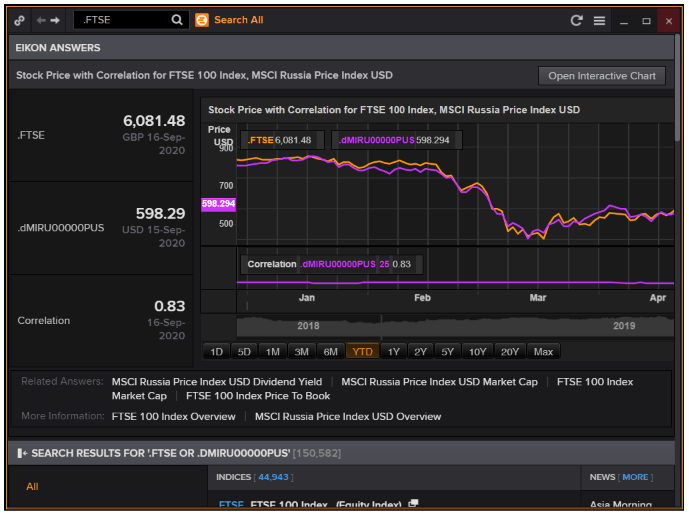
“The FTSE 100 performance’s closest match is to MSCI Russia, an .83 correlation, which is tight,” he notes.
He shared this stock chart, which shows the London and Moscow shares in near lockstep since the start of the year. Note: The FTSE 100 index is in orange; the MSCI Russia index is in purple.
The matchup astounded John, adding that the two countries, as investment options, couldn’t be any more different.
Russian stocks are more volatile, the Moscow exchange “more illiquid, and the breadth of stocks is more shallow,” he said. Roughly 50% of Moscow-listed companies are energy companies, which as a global asset class has been one of the worst performers since the start of the COVID-19 outbreak.
Meanwhile, “the U.K. is home to one of the largest, most liquid exchanges. It has incredible breadth and has a really strong rule of law. Investors’ protection is regarded as one of the highest in the world. You certainly wouldn’t say the same thing about Russia.”
Where Moscow is strong in energy, London is strongly weighted to financials and health care. Financials have been a dud this year, but health care stocks are well off their March lows.
The one area where the two exchanges are woefully similar: They are both light on high-growth tech stocks.
All-time low
Investing in emerging markets, such as the BRIC countries, can bring huge returns if timed correctly. The risk is higher, of course, but so too is the potential return.
Few market pros sees such an EM-style return coming from British stocks. In fact, they see just the opposite.
Judging by this year’s performance, the FTSE has a risk-off cloud hanging over it. Earlier this month, the FTSE hit an all-time low against the MSCI World, a humiliating underachievement for an economy that not long ago was seen as an engine of the European economy. That distinction today goes to Germany. In fact, the blue-chip Dax had been outperforming all three major U.S. indexes over the past month.
Down-on-their-luck U.K. equities, meanwhile, are attracting few outside bidders. According to Goldman Sachs, investors pulled a combined $645 million out of U.K. stocks over the past four weeks, ending Sept. 16. Where did they put their money? In continental European and U.S. equities, for starters.
“We see the U.K. as a value trap,” Seema Shah, chief strategist at Principal Global Investors, told Bloomberg. “Valuations might be attractive, but fundamentals are not.”
U.K. stocks are clearly at a disadvantage to other value plays. Investors see in them a triple whammy of risks: the uncertainty of a pandemic, a double-dip recession, and, on the horizon, a calamitous divorce with its European trading partners.
All of it points to trouble ahead for the U.K. economy and for U.K. stocks. “Uncertainties linked to the pandemic, as well as the difficult ongoing U.K.-EU trade talks and the threat of a disorderly hard exit from the EU single market on 31 December 2020, point to a challenging year end for the U.K.,” wrote Berenberg Bank senior economist Kallum Pickering in an investor note today. “In the worst-case scenario, a second nationwide lockdown, combined with a messy exit from the single market, could tip the U.K. economy back into recession. We view this as a tail risk, not as our base case.”
As economists and analysts up the odds of a Brexit break from Europe sans trade deal, the worse U.K. assets perform. The pound sterling, another proxy for investor demand, has lost more than 5% of its value against the dollar this month as COVID and Brexit fears intensify.
Meanwhile Downing Street politicians continue to dial up the volume on their pledge of “getting Brexit done, and hang the consequences.”
At the same time, investors have already pulled off a Brexit of their own.
“The U.K. government is speaking in a bullish fashion. Markets don’t seem to agree,” says John of Refinitiv Lipper.