Our mission to help you navigate the new normal is fueled by subscribers. To enjoy unlimited access to our journalism, subscribe today.
The spectacular performance of Apple stock over the past half-decade created a problem for folks pondering whether to board this seemingly unstoppable express right now. Put simply, America’s greatest enterprise has gotten so expensive that for the next five years, investors will be lucky to make plodding, mid-single-digit returns.
Just over three months ago, it appeared that the Apple phenomenon was faltering when the COVID-19 selloff drove its shares down 30% from their all-time high of $325 in mid-February to $224. Next came a rebound that had fans believing that Apple’s big price is no immovable object when confronted with the irresistible force of its runaway momentum. From March 23 to June 20, the iPhone maker climbed 62% to $362, beating the previous record and adding $600 billion to its valuation, approximately equal to the combined market caps of Netflix, Tesla, and Adobe. That jump must mark the biggest value spike in the annals of world capitalism.
Given that Apple’s share price now stands far above its levels for most of the past five years, it’s reasonable to ask whether it’s still a bargain. To answer that question, let’s examine the factors that enabled Apple to deliver such stupendous returns over the past half-decade, and handicap whether those levers can conceivably provide the same lift in the years ahead.
From the end of March 2015 (the second quarter of its fiscal year) to March of this year, Apple delivered total annual returns of roughly 20%: 18% from capital gains and 2% from dividends. It was able provide such sumptuous rewards not because the basics––its earnings––expanded rapidly, but because its shares were extremely cheap, giving its stock repurchases lots of bang-for-the-buck and leaving plenty of runway for growth in its P/E multiple, the share price investors are willing to pay for each dollar in profits.
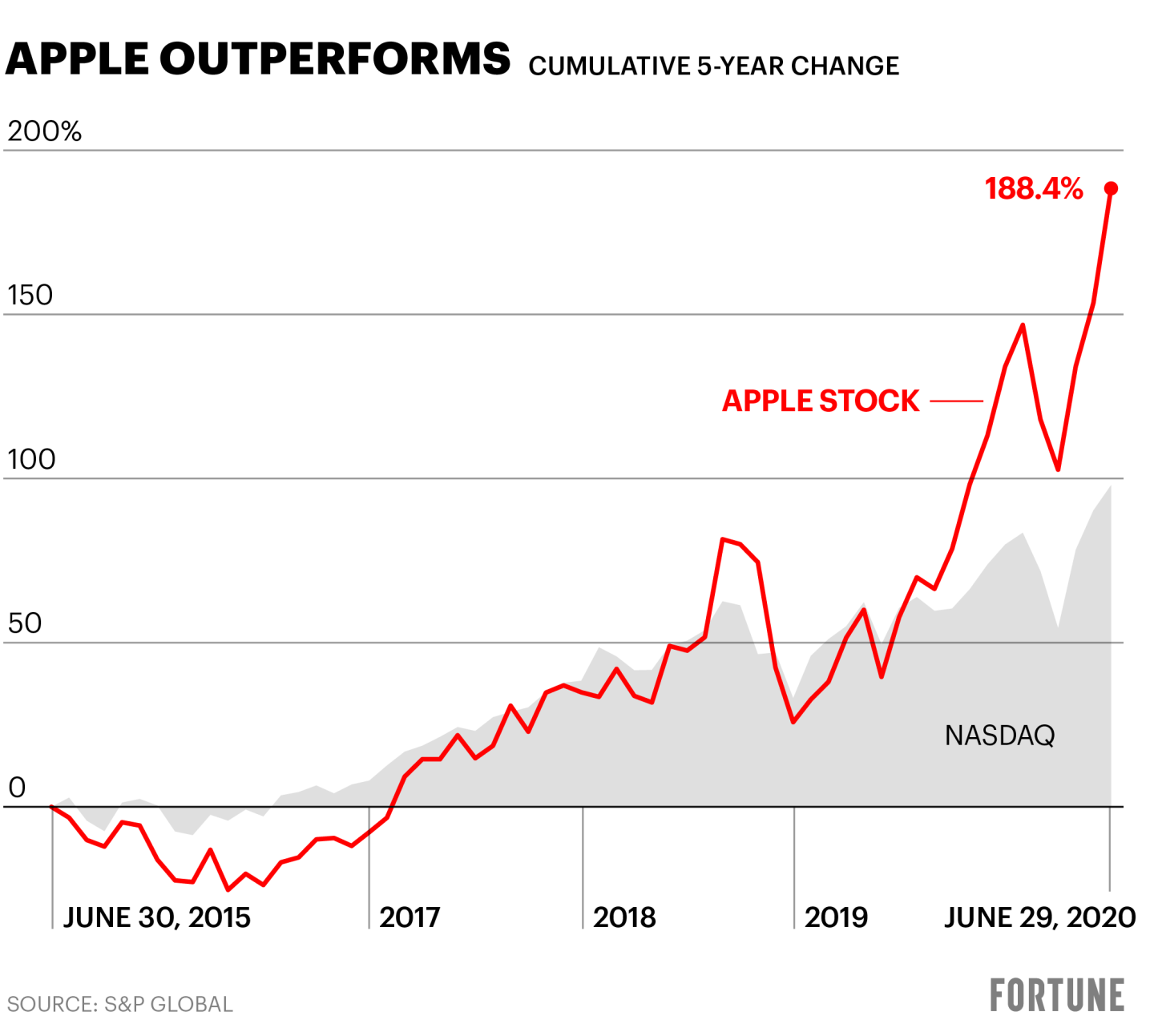
In March of 2015, Apple had earned $50.4 billion over the previous four quarters, and its market cap stood at $758 billion. Hence, its multiple was just 15. A figure that low implies that investors viewed its total dollar earnings as staying flat for a long time, or even declining. In fact, Apple’s net profits only rose to $57.24 billion through March of 2020 based on the most recent four quarters, or 13.6%. That’s a gain of just 2.5% a year, beating inflation by around a point. A growth juggernaut Apple was not.
But Apple had a powerful tool for lifting its earnings per share. This matchless cash machine requires so little capital investment that it can, and still does, plow all of its earnings into dividends and buybacks, the latter being by far its biggest driver. At that P/E of 15, every dollar in repurchases raised Apple’s EPS by 6.7¢ because its shares were so inexpensive in comparison to its profits. And its average P/E remained in the 15 bargain range, based on average earnings of around $50 billion a year, until the moonshot in its stock price started in mid-2019.
During most of those five years, Apple was spending three-quarters of its earnings on buybacks. From 2015 to 2020, that campaign lowered its count 24.5% from 5.834 billion to 4.4 billion shares. The big shrink raised EPS by around one-third over that period. So buybacks alone increased EPS by an average of 5.5% annually, over twice the contribution from earnings.
All told, buybacks and earnings growth combined to swell earnings per share around 48%, or 8% a year, from $8.60 to $12.73. Of course, repurchases packed by far the greater firepower.
But Apple’s share price jumped by far more, by 176% from $130 to $362. The additional juice came from an almost doubling of Apple’s P/E multiple from 15 to 28. It was that explosion in investors’ sudden willingness to pay more and more for each dollar in earnings that proved the biggest factor in delivering those big five-year returns.
Let’s add it up. Of Apple’s total returns from March 2015 through March 2020 of 20%, earnings gains contributed 2.5 points, repurchases 5.5, and dividends 2, for a total of 10%. Multiple expansion alone provided a 10-point boost, matching the other three factors combined.
Of course, those same four drivers will also determine how Apple’s shares perform over the next half-decade. But this time, investors don’t start with the edge of buying in cheap. Let’s posit that Apple’s P/E remains steady at 28. That’s an optimistic projection since that multiple is well above today’s not modest 22. That lofty valuation takes multiple expansion pretty much off the table as a long-run driver, although the P/E could spike temporarily if we enter bubble land, always a possibility.
Assuming the P/E remains flat at 28, all gains need to come from the other three components: earnings growth, buybacks, and dividends. We’ll assume that earnings continue on their five-year trend by advancing 2.5% a year. If that sounds like a low bar, consider that to generate 2.5% profit growth, Apple needs to add around $7 billion in new sales every year, and keep doing it year in and year out.
If Apple spends its usual 75% of earnings on buybacks, repurchases will raise EPS another 2.6%. That’s less than half the kick they supplied for most of the past five years. The third contributor is the dividend of around 1%. Stack the building blocks, and earnings add 2.5%, buybacks 2.6%, and dividends 1%, for a total of 6.1%. Hence, the new Apple math, dictated by its current high price that makes a higher P/E unlikely and buybacks less potent, points to future returns that are about one-third of its 20% gains over the past five years.
Of course, it’s possible that Apple will expand profits a lot faster than 2.5% a year. Its champions cite strong growth in its wearables and services franchises. On the negative side, sales in its flagship iPhones, and total profits, declined in the March quarter. No, Apple was so appealing a few years ago because it was a slow-growth stalwart that was dirt cheap. It’s still a slow-growth stalwart, but now it’s premium priced. As an enterprise, Apple’’s as superb as its fans claim. The only thing mediocre about Apple is the outlook for its stock.
More must-read finance coverage from Fortune:
- Why black-owned businesses were hit the hardest by the pandemic
- George Floyd protests force Britain to reckon with its role in slavery, leading some companies to pay reparations
- This influential crypto CEO warns that hyperinflation will be “the next big problem”
- Looking to invest in companies that care about equality? This NAACP-backed ETF may be the answer
- 6 reasons Boeing’s financial picture may be brighter than most assume