
• Home
  • Latest
  • Fortune 500
  • Finance
  • Tech
  • Leadership
  • Lifestyle
  • Rankings
  • Multimedia
TechBrainstorm Tech

Why economists, hedge funds, and health officials are using this startup’s data to understand the pandemic

Robert Hackett
By
Robert Hackett
Robert Hackett
Down Arrow Button Icon
Robert Hackett
By
Robert Hackett
Robert Hackett
Down Arrow Button Icon
June 15, 2020, 6:00 PM ET

In the century since the Spanish flu gripped the globe, the extent of the disease’s economic destruction remains an enigma.

Good data about the influenza of 1918 simply does not exist. The pandemic took hold as World War I barreled toward its conclusion, making the two world-shaking events nearly impossible to disentangle.

The limitations have left historical analyses wanting. “The scope of research on the economic effects of the 1918 influenza pandemic is scant at best,” said a report from the St. Louis Federal Reserve in 2007, which relied on old newspaper clippings for most of its study.

Today, as the novel coronavirus and a related business slowdown exact a huge economic toll, the situation has changed. Modern technology, like smartphones and their location-tracking, are providing unprecedented details about a pandemic’s impact, down to the ebb and flow of foot traffic at a given store.

What’s your step count?

The precision and granularity of the data collected today, from the individual consumer to countrywide, is unmatched by any other point in human history. It’s as though the entire economy now wears a Fitbit at all times.
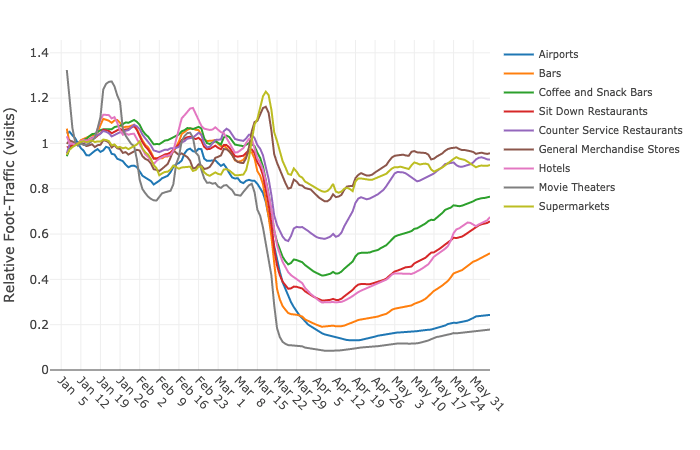
Chart showing foot traffic patterns across various industries in the U.S. “Normal” behavior is represented by “1” on the y-axis. (Courtesy of SafeGraph)

In mid-March, brick-and-mortar businesses lost the majority of their shoppers. Through April, foot traffic nationally fell 80% at bars, 70% at restaurants and hotels, and nearly 60% at cafés, according to SafeGraph, a startup that collates geolocation data collected from apps on 45 million devices in the U.S.

Some industries weathered the downturn better than others; a couple even received a boost, at least initially. In mid-March, activity at general merchandise stores leaped 30% and 40% at supermarkets, as people stockpiled supplies, according to SafeGraph’s data.

The comeback has already begun. By May, foot traffic at supermarkets and general merchandise stores had ticked back up to normal levels.

Other industries are recovering too. By June, counter-service restaurants were almost back to normal, operating at 95% of usual capacity. By that time, bars were seeing 60% of their usual customer inflows, sit-down restaurants were receiving 70%, and cafés 80%.

The recovery for other industries looks grimmer. Airports had only a quarter of their usual visitors, while attendance at movie theaters remained sparse at a fifth of normal activity.

Voting with your feet

“We predict the past,” says Auren Hoffman, SafeGraph’s cofounder and CEO, during a recent online presentation.

The company provides customers and research partners with data about what has happened, in other words, and leaves the analysis up to the others. “We let customers predict the future,” he says.
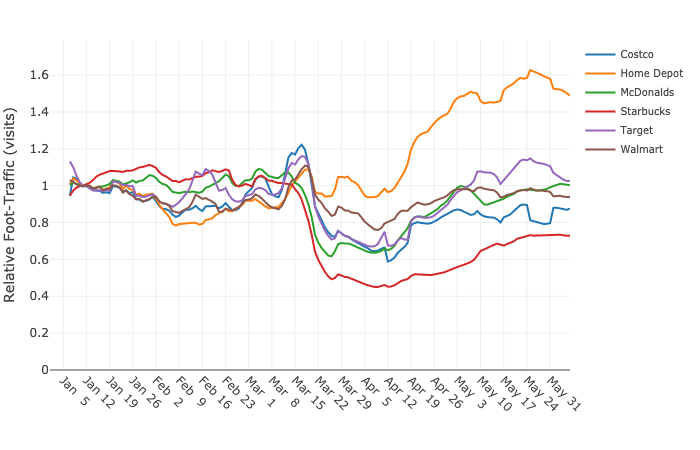
Chart showing foot traffic patterns across a selection of retail brands in the U.S. (Courtesy of SafeGraph)

On its publicly available dashboard of movement patterns, SafeGraph shows that, during the pandemic, some businesses bucked generally dismal trends.

Foot traffic at home improvement giant Home Depot surged as much as 60% between mid-March and the end of May, perhaps as homebound consumers began redecoration projects. After initially falling 40% between mid-March and mid-April, foot traffic at Target recovered more than 60% through mid-May.

Other businesses face more persistent drop-offs. Foot traffic to Starbucks stores fell by half between mid-March and mid-April, and fewer people—only three-quarters of the usual clientele—appear to be lingering there today for macchiatos and lattes.

McDonald’s, on the other hand, appeared to be all but back to normal as of the end of May.

Location, location, location

SafeGraph says it buys its geolocation information from well-known consumer apps involving health, safety, navigation, and transportation. The resulting data sets are anonymized and aggregated to protect people’s privacy, says Nick Singh, the company’s marketing lead.

While Singh declines to disclose the exact sources of SafeGraph’s data, he claims the company does not use sketchy sources that hoover up information without people’s knowledge. The origins are, generally, well-known apps that users have granted permission to monitor their whereabouts.

Privacy advocates will find such pervasive tracking troubling, of course. Many people do not realize how far and wide their geolocation travels as it changes hands through little-regulated marketplaces. Experts may call into question the ability of data scientists to fully anonymize their data sets too.

SafeGraph’s customers include hedge funds, which use the data to inform their investments, and hotels and other chains, which use them to determine where to open new retail locations. Of the 11,000 U.S. hedge funds, there are “probably only 50 hedge funds that buy alternative data” of the sort SafeGraph sells, CEO Hoffman says, but he believes more businesses will become customers as they build up internal data science expertise and as better data-crunching tools become available.

SafeGraph provides data to academic researchers, policymakers, and journalists too. The Centers for Disease Control and Prevention used the data to determine the efficacy of stay-at-home orders. And the Brookings Institution, a Washington, D.C., think tank, used the data to show social distancing differences within black and white neighborhoods.

While even Hoffman admits his company’s data is imperfect—cleaning up raw data is a science all in itself—the information is better than anything researchers had access to in the past. “Every day the data is improving from the day before,” Hoffman says.

Feeding the Fed

In the depths of the pandemic, the Federal Reserve of Dallas acknowledged that the delays associated with gathering usual economic data, which tend to be published quarterly, “are crippling.” It cited “an acute need for real-time measurement” to scrutinize the wreckage of—and hoped for rebound from—COVID-19.

The Dallas Fed has been using SafeGraph’s data in its own economic modeling and forecasting. The resulting charts constitute “a key metric in forming our assessment of economic conditions and the outlook for future activity,” it says.

Since May the central bank branch has been publishing a continuously updated “mobility and engagement index,” which measures how much people are moving around. The gradual easing of government-mandated restrictions and the onset of summer shows how behavior is slowly but surely beginning to return to normal.

It’s a far cry from using century-old periodical archives.

More must-read tech coverage from Fortune:

  • Joe Biden makes Facebook’s lax moderation policy a campaign issue
  • Microsoft follows IBM and Amazon in barring police from using its facial-recognition technology
  • Buzzy research lab OpenAI debuts first product as it tries to live up to the hype
  • 5G won’t be a financial cash cow for wireless carriers, report says
  • WATCH: Ocado’s robots are out to change the grocery business
About the Author
Robert Hackett
By Robert Hackett
Instagram iconLinkedIn iconTwitter icon
See full bioRight Arrow Button Icon

Latest in Tech

Finance
Lorem ipsum dolor sit amet, consectetur adipiscing elit, sed do eiusmod tempor incididunt ut labore et dolore magna aliqua. Ut enim ad minim veniam
By Fortune Editors
October 20, 2025
Finance
Lorem ipsum dolor sit amet, consectetur adipiscing elit, sed do eiusmod tempor incididunt ut labore et dolore magna aliqua. Ut enim ad minim veniam
By Fortune Editors
October 20, 2025
Finance
Lorem ipsum dolor sit amet, consectetur adipiscing elit, sed do eiusmod tempor incididunt ut labore et dolore magna aliqua. Ut enim ad minim veniam
By Fortune Editors
October 20, 2025
Finance
Lorem ipsum dolor sit amet, consectetur adipiscing elit, sed do eiusmod tempor incididunt ut labore et dolore magna aliqua. Ut enim ad minim veniam
By Fortune Editors
October 20, 2025
Finance
Lorem ipsum dolor sit amet, consectetur adipiscing elit, sed do eiusmod tempor incididunt ut labore et dolore magna aliqua. Ut enim ad minim veniam
By Fortune Editors
October 20, 2025
Finance
Lorem ipsum dolor sit amet, consectetur adipiscing elit, sed do eiusmod tempor incididunt ut labore et dolore magna aliqua. Ut enim ad minim veniam
By Fortune Editors
October 20, 2025

Most Popular

Finance
Lorem ipsum dolor sit amet, consectetur adipiscing elit, sed do eiusmod tempor incididunt ut labore et dolore magna aliqua. Ut enim ad minim veniam
By Fortune Editors
October 20, 2025
Finance
Lorem ipsum dolor sit amet, consectetur adipiscing elit, sed do eiusmod tempor incididunt ut labore et dolore magna aliqua. Ut enim ad minim veniam
By Fortune Editors
October 20, 2025
Finance
Lorem ipsum dolor sit amet, consectetur adipiscing elit, sed do eiusmod tempor incididunt ut labore et dolore magna aliqua. Ut enim ad minim veniam
By Fortune Editors
October 20, 2025
Finance
Lorem ipsum dolor sit amet, consectetur adipiscing elit, sed do eiusmod tempor incididunt ut labore et dolore magna aliqua. Ut enim ad minim veniam
By Fortune Editors
October 20, 2025
Finance
Lorem ipsum dolor sit amet, consectetur adipiscing elit, sed do eiusmod tempor incididunt ut labore et dolore magna aliqua. Ut enim ad minim veniam
By Fortune Editors
October 20, 2025
Finance
Lorem ipsum dolor sit amet, consectetur adipiscing elit, sed do eiusmod tempor incididunt ut labore et dolore magna aliqua. Ut enim ad minim veniam
By Fortune Editors
October 20, 2025
Fortune Secondary Logo
Rankings
  • 100 Best Companies
  • Fortune 500
  • Global 500
  • Fortune 500 Europe
  • Most Powerful Women
  • World's Most Admired Companies
  • See All Rankings
  • Lists Calendar
Sections
  • Finance
  • Fortune Crypto
  • Features
  • Leadership
  • Health
  • Commentary
  • Success
  • Retail
  • Mpw
  • Tech
  • Lifestyle
  • CEO Initiative
  • Asia
  • Politics
  • Conferences
  • Europe
  • Newsletters
  • Personal Finance
  • Environment
  • Magazine
  • Education
Customer Support
  • Frequently Asked Questions
  • Customer Service Portal
  • Privacy Policy
  • Terms Of Use
  • Single Issues For Purchase
  • International Print
Commercial Services
  • Advertising
  • Fortune Brand Studio
  • Fortune Analytics
  • Fortune Conferences
  • Business Development
  • Group Subscriptions
About Us
  • About Us
  • Press Center
  • Work At Fortune
  • Terms And Conditions
  • Site Map
  • About Us
  • Press Center
  • Work At Fortune
  • Terms And Conditions
  • Site Map
  • Facebook icon
  • Twitter icon
  • LinkedIn icon
  • Instagram icon
  • Pinterest icon

Latest in Tech

vegan cheese
AITech
A Mark Cuban-backed vegan cheese company trained AI to scrutinize cardboard boxes. It’s saved $400,000
By Jake AngeloMay 1, 2026
2 hours ago
Young trade worker learning on job
SuccessHiring
Forget Big Tech: Small businesses will hire nearly 1 million grads in 2026—and some of the hottest roles are gloriously AI-proof
By Emma BurleighMay 1, 2026
3 hours ago
Andrew McAfee
SuccessCareers
MIT AI expert warns automating Gen Z entry-level jobs could backfire—and cost companies their future workforce
By Preston ForeMay 1, 2026
4 hours ago
duke
Big TechAmazon
Amazon Prime Video reaches deal with Duke Blue Devils to air 3 games per season
By The Associated PressMay 1, 2026
6 hours ago
valerie
CommentaryLayoffs
Tesla’s former HR chief: the AI layoff panic Is built on a false premise—here’s what most workers need to know
By Valerie Capers WorkmanMay 1, 2026
6 hours ago
AI
AIdisruption
Meet the Americans dismissing AI hype and using it with ingenuity: ‘The efficiencies gained out of it have been tremendous’
By Cathy Bussewitz and The Associated PressMay 1, 2026
6 hours ago

Most Popular

China dominates the world's lithium supply. The U.S. just found 328 years' worth in its own backyard
North America
China dominates the world's lithium supply. The U.S. just found 328 years' worth in its own backyard
By Jake AngeloApril 30, 2026
1 day ago
Scott Bessent on financial literacy: 'it drives me crazy' to see young men in blue-collar construction jobs playing the lottery
Personal Finance
Scott Bessent on financial literacy: 'it drives me crazy' to see young men in blue-collar construction jobs playing the lottery
By Fatima Hussein and The Associated PressMay 1, 2026
6 hours ago
Accenture's Julie Sweet blew up 50 years of company history. She says the hardest part is still ahead
Conferences
Accenture's Julie Sweet blew up 50 years of company history. She says the hardest part is still ahead
By Nick LichtenbergApril 29, 2026
2 days ago
The U.S. economy is booming — just not where 50 million Americans live
Commentary
The U.S. economy is booming — just not where 50 million Americans live
By Derek KilmerMay 1, 2026
10 hours ago
Apple cofounder Ronald Wayne—whose stake would be worth up to $400 billion had he not sold it in 1976—says that at 91, he has no regrets
Success
Apple cofounder Ronald Wayne—whose stake would be worth up to $400 billion had he not sold it in 1976—says that at 91, he has no regrets
By Preston ForeApril 27, 2026
4 days ago
Exclusive: America's largest Black-owned bank launches podcast with mission to unlock hidden shame holding back generational wealth
Banking
Exclusive: America's largest Black-owned bank launches podcast with mission to unlock hidden shame holding back generational wealth
By Nick LichtenbergApril 29, 2026
2 days ago

© 2026 Fortune Media IP Limited. All Rights Reserved. Use of this site constitutes acceptance of our Terms of Use and Privacy Policy | CA Notice at Collection and Privacy Notice | Do Not Sell/Share My Personal Information
FORTUNE is a trademark of Fortune Media IP Limited, registered in the U.S. and other countries. FORTUNE may receive compensation for some links to products and services on this website. Offers may be subject to change without notice.