In February, before the current global lockdown to curb the spread of COVID-19, the Khachapuri Index hit an all-time high.
The index, an unofficial economic marker for the country of Georgia, doesn’t have to do with popularity: It monitors the cost of making the country’s staple food—khachapuri literally means “cheese bread”—at home and uses it as an economic indicator—not unlike similar annual calculations done in the U.S. for Thanksgiving dinner, or the Big Mac Index, an informal comparison by The Economist on purchasing power parity using the price of McDonald’s flagship burger.
But with restaurants closed indefinitely, and going to the grocery store solely to analyze prices no longer acceptable, the International School of Economics at Tbilisi State University couldn’t monitor the price of yeast, eggs, flour, butter, milk, and cheese (along with energy costs) to make its monthly calculation for March. Instead, the index has been conducted through crowdsourcing the information, asking residents to tell economists what they paid in order to analyze the prices. Because while restaurants might not be able to welcome diners, the khachapuri goes on: After all, it is the perfect food for staying home and craving comfort.
Georgians already knew that, but there’s no time like the pandemic for Americans to learn it. The same things that make khachapuri so essential to daily life in Georgia have made it appealing to Americans—though mostly in restaurants, so far.
“It’s bread, cheese, egg, butter; all the most beautiful things put together,” says Rose Previte of Washington D.C.’s Compass Rose. “There’s nothing not to like.”
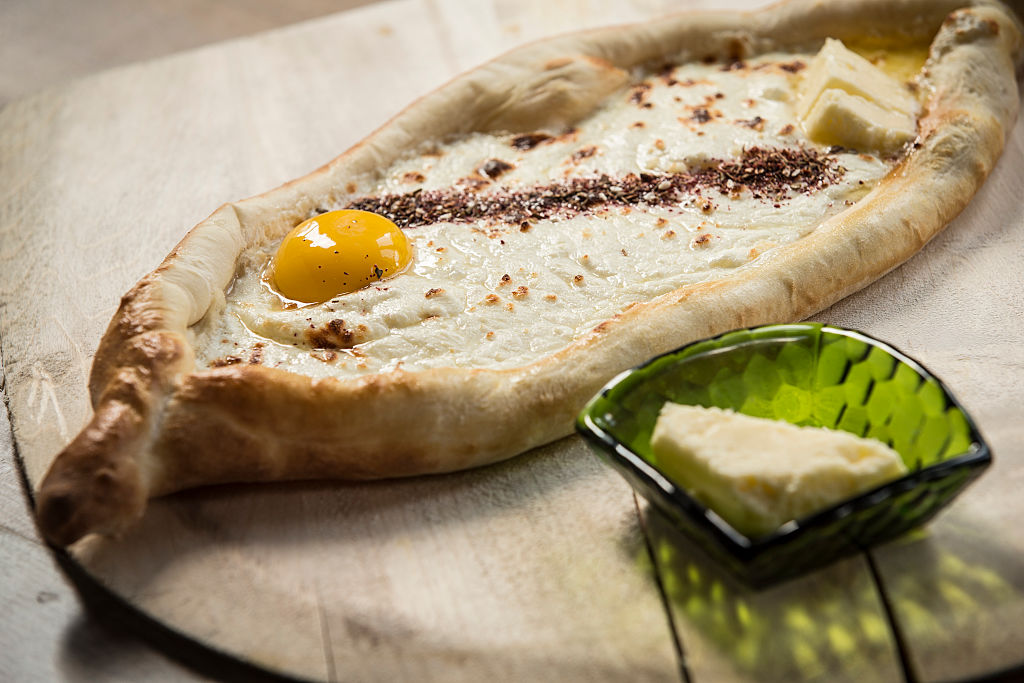
Google searches for the Georgian staple khachapuri are 50% more common now than they were two years ago and twice as popular as four years ago. Instagram brims with photos of the eye-catching Adjaruli version, and prior to the shelter-in-place orders, Georgian restaurants sprang up like wildflowers around the country.
Food writer Polina Chesnakova—whose cookbook, Hot Cheese: Over 50 Gooey, Oozy, Melty Recipes, comes out in September (with a khachapuri recipe, naturally), notes the universal appeal of the ingredients, particularly the melty, gooey filling: “It gives a moment of suspense, a setting of the stage, when a big Adjaruli khachapuri comes out of the oven.”
The khachapuri style with the big pizza-like crust and sunshine yellow yolk in the center—originating from Batumi, on the Black Sea—is the type most commonly served in the United States. But the more common version served daily on tables in Tbilisi—and used in the index—is the simple stuffed pita-like kind called Imeruli. “Georgia has a rich dairy culture,” explains Chesnakova of her homeland, “and it shows its love for cheese with khachapuri.” Megruli khachapuri adds a layer of cheese on top of the Imeruli, while the Achma variation is layered like lasagna, and, an easy version, Penovani, uses puff pastry for the bread portion.
Any conversation with a Georgian or restaurateur making Georgian food eventually comes back to this huge variety: While the eye-catching Adjaruli khachapuri owns Instagram and draws diners in the U.S., the food is less about a special occasion and more a simple, no-frills, everyday staple dish. “It’s not pizza,” says Sergey Zdorodetstkiy, a partner in a recently opened Georgian café in Seattle called Skalka. “You can’t open the fridge and see what else can go on top, it’s just two ingredients.”
That minimalism speaks to people. “Georgian cuisine is to Russia is as Mexican food is in the U.S.,” Previte says—an adopted favorite served at neighborhood restaurants and considered a quintessential comfort food. Though Skalka usually serves a variety of breakfast foods, the downtown café has focused on Georgian cuisine while limited to takeout and delivery, particularly khachapuri, which it started offering via drive-thru after it had to shutter its seating. While logistics have stymied Skalka for the moment, it was wildly popular. “We want to do what we love and make what people love,” says Zdorodetstkiy.
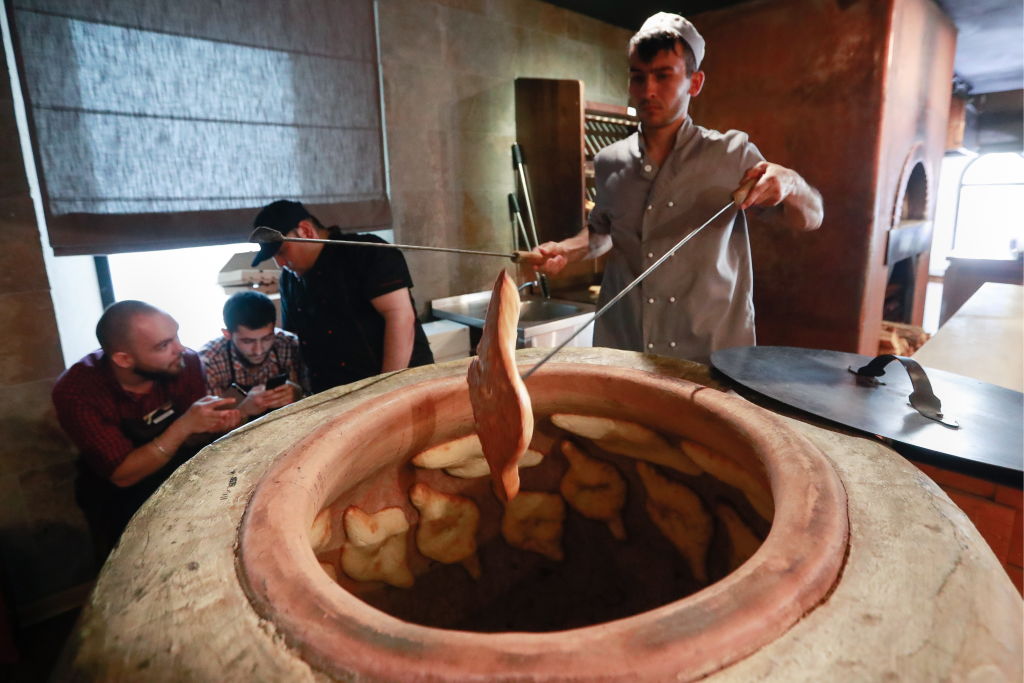
That attitude embodies what makes khachapuri so much more than an everyday staple. When Previte first moved to Moscow with her journalist husband, she says, “Western food was expensive, and Russian food not great.” It wasn’t until a neighbor cooked her a Georgian meal that she finally felt at home. “The experience of living in Moscow was of loving Georgian food,” in part because of the nature of the country’s cuisine, she says. “Georgia is so welcoming.” It’s what inspired her to feature the cuisine and its star dish at her restaurant. But she also highlighted Georgian culture: “The food,” she says, “goes hand in hand with hospitality.”
Though it’s unlikely you’re hosting anyone else right now, you can show that same welcome to yourself by making khachapuri at home. “In Batumi, people wait two hours in line for their khachapuri,” says Zdorodetstkiy. But the simplicity of the dish means that in the same amount of time, you could cook it yourself.
“We’ve got more time than ever to stretch our culinary muscles and try out new recipes and kitchen projects,” Chesnakova says, underscoring a comfort food “whose novelty takes you out of your kitchen and transports you to a different world—even if just for a few bites.”
More must-read lifestyle coverage from Fortune:
—How Global 500 companies are responding to the coronavirus
—What closed cruise lines and hotels mean for the mezcal industry
—Flower vendors still hold out hope for regrowth amid the coronavirus pandemic
—Listen to Leadership Next, a Fortune podcast examining the evolving role of CEOs
—What happens to your frequent-flier status and miles during the pandemic
—WATCH: Can San Francisco Be Saved?
Follow Fortune on Flipboard to stay up-to-date on the latest news and analysis.