Subscribe to Fortune’s Outbreak newsletter for a daily roundup of stories on the coronavirus outbreak and its impact on global business.
Today, markets did something historic. They turned back the hands of time.
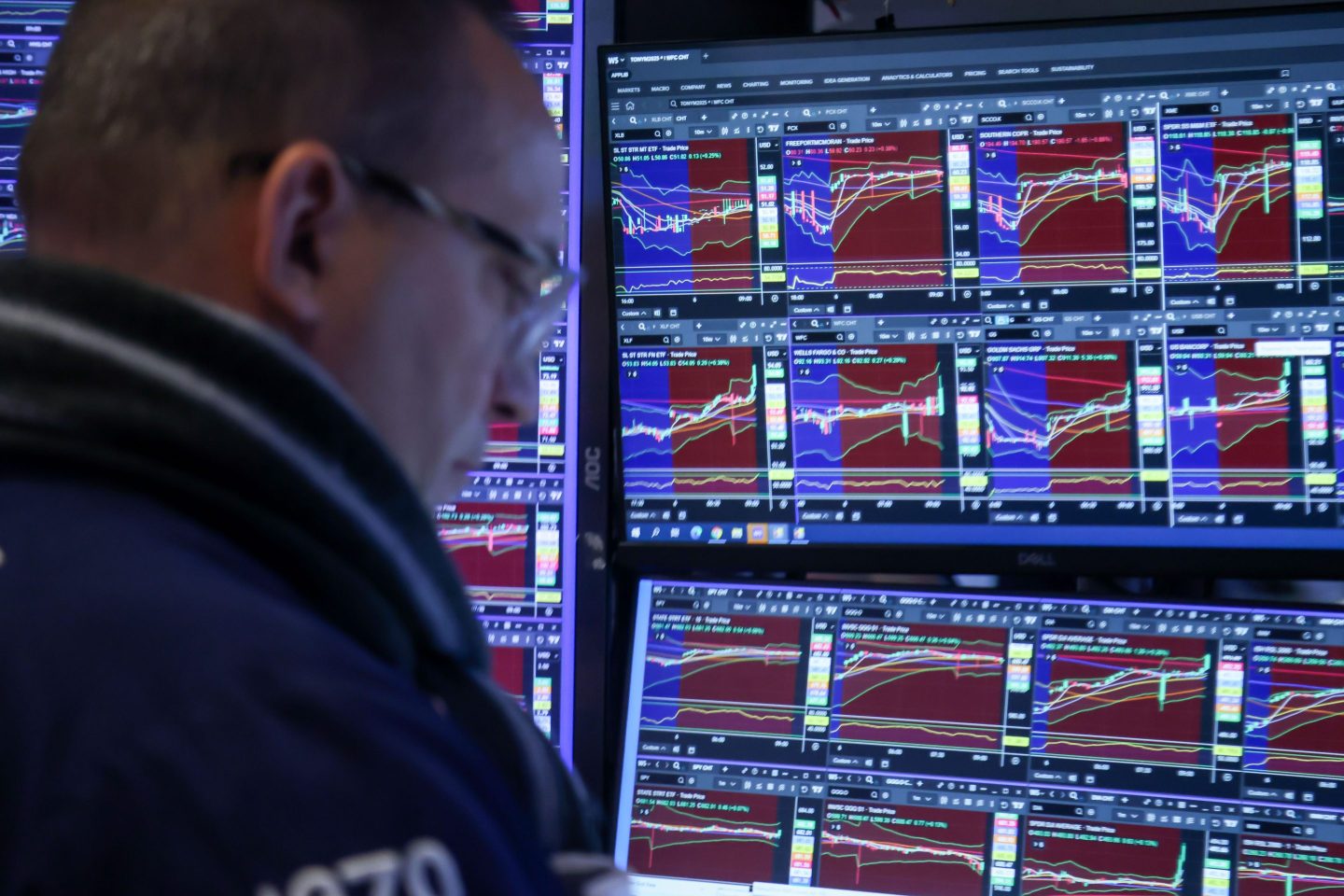
The Dow Jones Industrials Average at 2:30 was down more than 2,200 points, or 10.5%, to barely over 19,100. The index’s value at Donald Trump’s inauguration was 19827.25. The index has given up all the gains of the last three years and two months and effectively landed back in 2016. By the time the market closed, the Dow had recovered slightly to 19,898.92.
The market will surely continue to swing in the coming days and weeks, but the evaporation of three years of gains in a matter of weeks has been swift and sharp. The Russell 2000 has been back at pre-Trump values for days now, while the S&P 500 and Nasdaq are nearing—but have not yet touched—their values on the date of Trump’s inauguration.
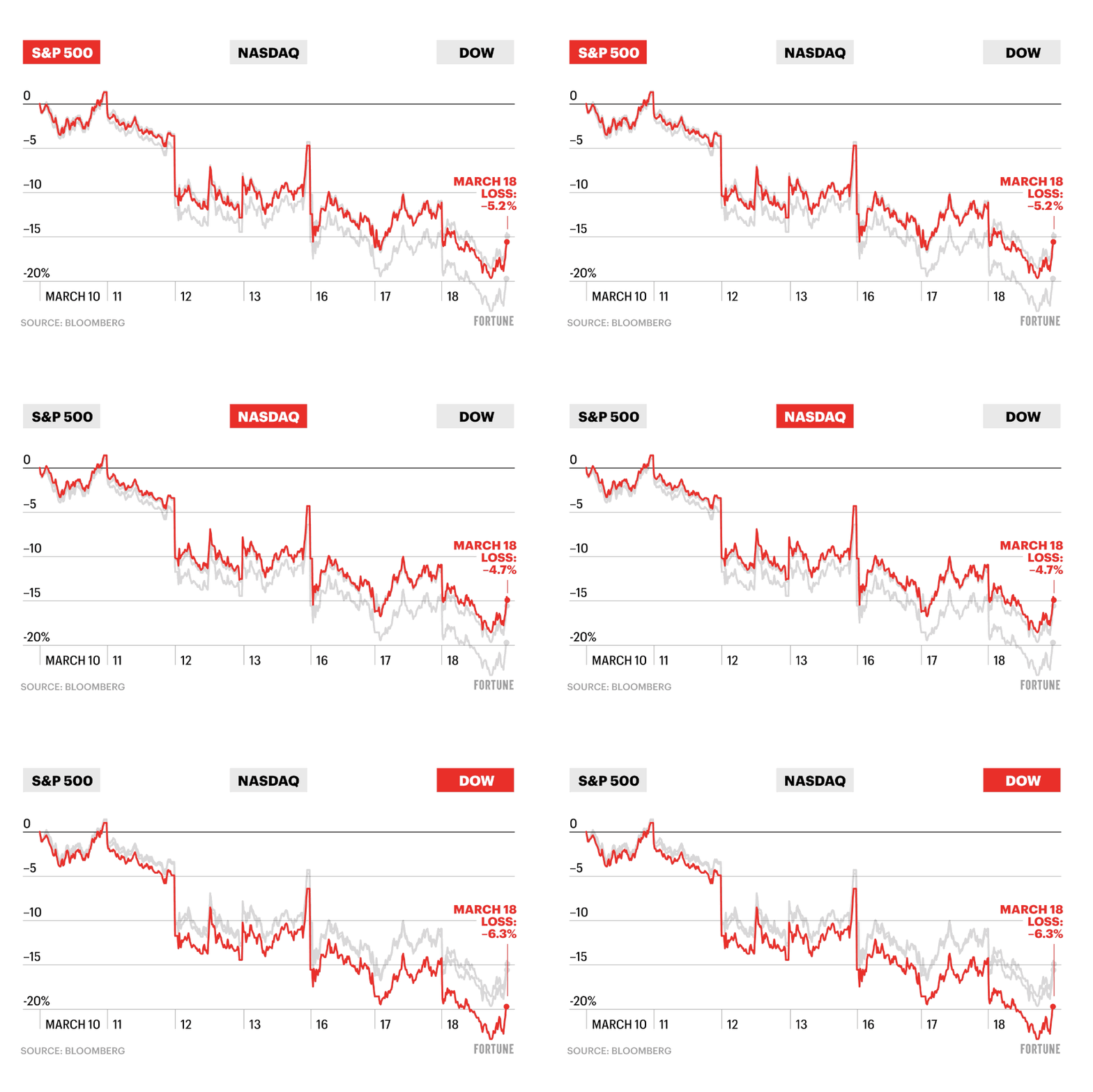
Trump himself has frequently pointed to market successes and claimed credit for them.
But this appears to be an entirely new era. “We had the fastest 10% drop in the S&P 500 ever,” said Lauren Goodwin, an economist and multi-portfolio strategist at New York Life Investments. “We had the fastest move from bull to bear market ever. Compared to previous time periods, this is volatility and a pace of volatility that we’ve never seen.
Given the way stocks are weighted in indexes, a big change in one stock can mean an outsized impact on the overall index value. As of 1:10 p.m., UnitedHealth Group, which makes up 7.8% of the Dow, had lost 15.4% Tuesday. Home Depot, 5.6% of the index, was off by 9.7%. The two represented 1.6 percentage points of fall for the Dow.
“One of the phrases that I hate is ‘this time is different.’ But I think it’s accurate with respect to [the market drop],” said Robert Johnson, a professor of finance at Creighton University’s Heider College of Business.
What started the huge selloff were the impacts of the coronavirus, the oil price war being waged by Saudi Arabia and Russia, and all the uncertainty accompanying them.
“Presidents and parties in power get way too much credit when economies are good and way too much blame when economies are bad,” Johnson said. “Trump had the wind at his back when he took office. Now he has a gale wind in his face.”
“There is no model that exists that says an entire industry would be closed down,” noted Marty Wolf, president and founder of martinwolf M&A advisors. No matter how diversified a company is within its industry, “you can’t have a business that can have that much self-insurance,” he said. “Coronavirus is much worse than 9/11. I don’t think there’s anything meaningful to comparing the stock market to Obama.”
That said, the Administration’s slow initial response, or at least mixed signals and unclear communication, have arguably made things worse.
Investors may also be expecting too much. “In a little over three years we’re treading water. Is that cataclysmic?” asked Johnson. “The decade of the 2000s—they call it the ‘lost decade’ in the market—the whole decade had negative returns. Three years of a flat market isn’t cataclysmic.”
“There are plenty of people doing plenty of freaking out. We don’t need to add to it,” notes Goodwin. She suggests focusing on companies that continue to pay dividends because that way there is still some financial gain.
“For the average investor, having a plan and sticking to it is your best bet,” said Goodwin. “The advice we have for most investors is not to look at your 401(k).”
Because if you do, you might think that you’ve traveled back in time.
More must-read stories from Fortune:
—How to prepare your personal finances for a coronavirus recession
—The Fed made a bold move to calm shaky markets. But is it enough?
—Why return CEOs are usually bad news for a company’s stock
—Dormant PayPal Credit accounts are coming back to hurt credit scores—Listen to Leadership Next, a Fortune podcast examining the evolving role of CEO
—WATCH: What’s causing the looming recession
Subscribe to Fortune’s Bull Sheet for no-nonsense finance news and analysis daily.