
• Home
  • Latest
  • Fortune 500
  • Finance
  • Tech
  • Leadership
  • Lifestyle
  • Rankings
  • Multimedia
Leadershipobituaries

For a time, Jack Welch was the most valuable CEO on earth

Geoff Colvin
By
Geoff Colvin
Geoff Colvin
Senior Editor-at-Large
Down Arrow Button Icon
Geoff Colvin
By
Geoff Colvin
Geoff Colvin
Senior Editor-at-Large
Down Arrow Button Icon
March 2, 2020, 7:09 PM ET

It’s a sign of Jack Welch’s revolutionary influence on business that when you tell people about the pre-Welch world, they don’t believe you.

When Welch became General Electric’s CEO in 1981, the CEOs of the Fortune 500 had just named General Electric the company they admired most. Yet this paragon was managed according to an antediluvian five-volume set of rules. In one division, computers printed out seven unreadable reports daily for managers to study; one of the reports routinely stood 12 feet high. Bureaucracy had become almost comical: The head of the computer lab in the medical equipment business couldn’t sign for deliveries without a superior’s approval. Not too surprisingly, in the preceding decade GE stock had lost half its value after inflation—and still Fortune 500 chiefs said this was the best business they knew.

That was the world Welch inherited, hated, and transformed. GE was worth $14 billion when he took over; it was worth some $400 billion when he stepped down 20 years later, and for a time it was the most valuable company on earth. Welch changed GE so radically and successfully that business leaders everywhere studied his methods and tried to emulate them. He was by far the most influential manager of his generation. Fortune named him the manager of the century in 1999, and in retrospect he still merits the title.

Welch understood a few fundamental truths that had been forgotten in the gigantic, self-absorbed bureaucracy that GE and many other companies had become. Success did not consist of making the company bigger; success was making the company more valuable. You didn’t get there by hiring strategists at headquarters to tell operating chiefs what to do, or by adopting new procedures for everyone to follow, or by holding more meetings or adding more layers of management, all of which had happened in the decade before Welch took over. You got there by freeing managers to create value. He viscerally despised bureaucracy—”Hate it, kill it!” he said—and never stopped trying to eliminate it. Those five volumes of management rules? He ceremonially burned them in a parking lot.

Turning a bloated institution into a lean and hungry one required firing employees, which was not universally popular. That’s where the infamous “Neutron Jack” label came from, referring to a bomb that leaves buildings standing but eliminates the people. Welch hated that name. He felt certain he was doing what had to be done, but in the 1980s it was shocking. In 1989 when a Fortune writer turned in an article stating that Welch had eliminated 100,000 GE employees, the editor ordered him to re-check the figure because it couldn’t possibly be right. But it was.
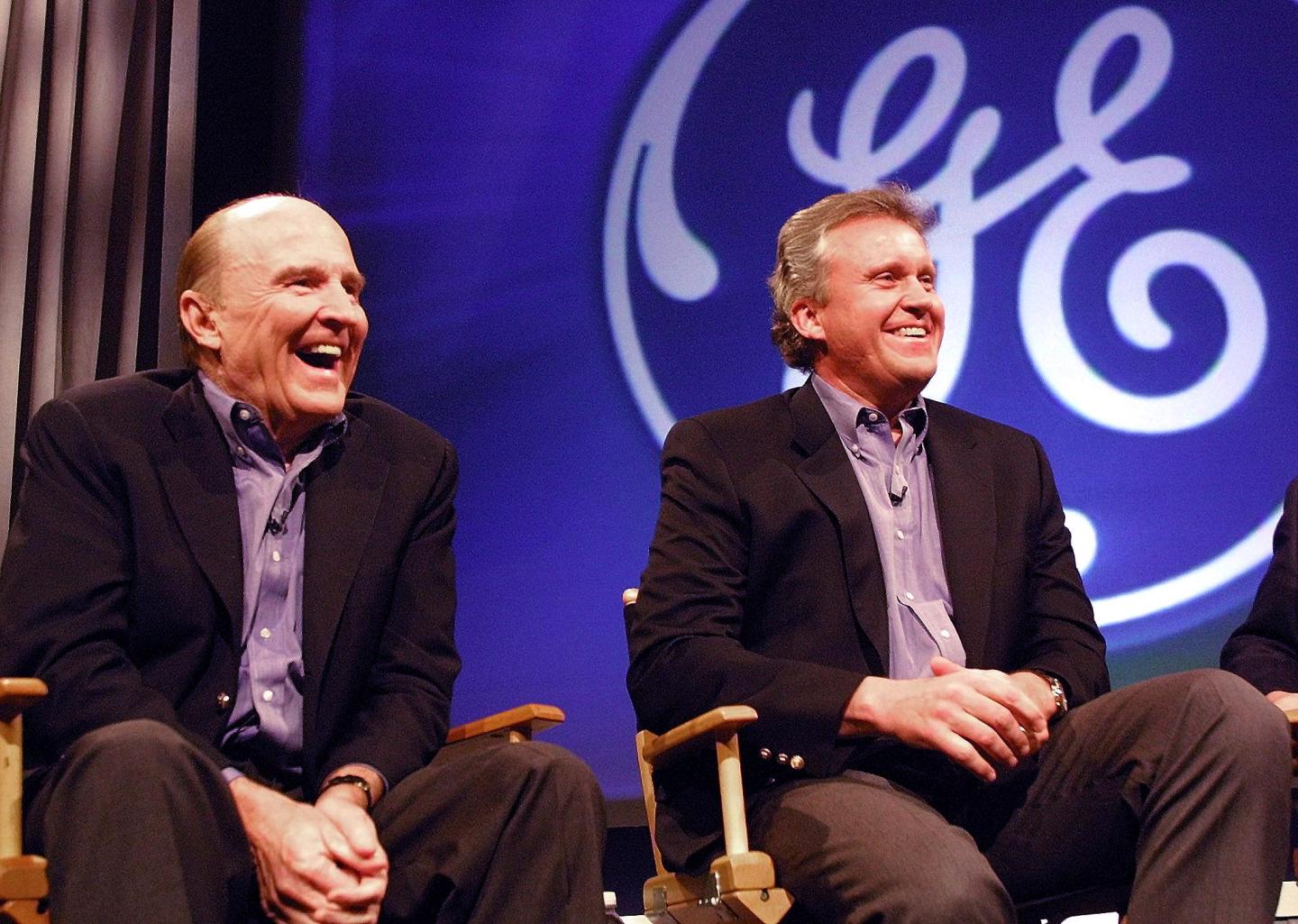
Jack Welch (L) and Jeffrey Immelt (R) at the November 2000 press conference announcing Immelt’s appointment as the new GE CEO following Welch’s retirement in 2001.
Doug Kanter—AFP/Getty Images

Even more disorienting was Welch’s introduction of the “vitality curve,” which others called the “rank and yank” system. It required managers to (among other things) rank employees by performance annually and identify the bottom 10%, who had to improve or leave—and as he acknowledged, they “generally had to go.” Plenty of critics loathed the system as inhumane, but Welch felt the opposite. He said the system’s goal was “to force a conversation” that most managers don’t want to have—telling underperformers where they stand. Failing to tell them, Welch said, was truly inhumane.

In fact Welch obsessed over GE’s people. He said that as CEO of a diversified conglomerate, “I have only two jobs, allocating capital and evaluating people.” (He later added a third job, transferring ideas between parts of the company.) His heart was in studying people; he claimed he spent more time on it than on everything else put together. He said he didn’t always know the CFOs of GE’s many far-flung operations, but he always knew the HR chiefs.

Yet it was as a judge of people that Welch committed what he considered his worst mistake, choosing Jeff Immelt as his successor. Welch and the board spent six-and-a-half years on succession and agreed unanimously that Immelt was the right choice, but GE collapsed spectacularly on his watch; he stepped down in 2017, and when he announced his departure, the stock notched its biggest gain in months. Welch criticized Immelt publicly just once, during the financial crisis, but in more recent years he was privately furious and distraught over GE’s meltdown. He was haunted by something he had said near the end of his own CEO tenure: “My success will be determined by how well my successor grows the company in the next 20 years.”

It has become fashionable to bash Welch on two counts: that his management practices didn’t always work when applied elsewhere and that he was somehow responsible for GE’s near-demise over the past few years. The evidence is not persuasive on either charge. On the first, remember that Welch did what needed doing at a particular company and a particular time, and it worked astoundingly well. He was happy to tell the world what he was doing and why because it built up GE (and him). But when other managers in other companies, industries, and decades failed to get the same results, blaming Welch’s techniques is a weak excuse.

On the second charge, one could fairly blast Welch for choosing Immelt as CEO, but today’s conventional criticism doesn’t do so. It holds instead that Welch bulked up GE Capital unsustainably, forcing Immelt to slim it down. SEC filings show the opposite. (For details, read “What the hell happened at GE?” from the June 1, 2018 issue of Fortune magazine.) In any case, blaming an ex-CEO for trouble 16 years after his departure surely violates some reputational statute of limitations.

Welch was by far GE’s most successful post-World War II CEO, but he will be remembered as something much more. He wrenched an entire generation of business leaders out of an old era of management and into a new one. He certainly wasn’t the only CEO who saw a need for urgent change, but as GE’s chief he stood on a huge stage and faced a brutal challenge. It took 20 years, but he transformed the conventional view of what it meant to succeed at the top of a great corporation.

More must-read stories from Fortune:

—What Beth Comstock learned from Jack Welch (2016)
—Where have you gone, Jack Welch? (2012)
—How Jack Welch and the GE board chose his successor (2001)
—Jack Welch: The ultimate manager (1999)
—Inside the mind of Jack Welch (1989)

Subscribe to Fortune’s RaceAhead newsletter for news and analysis on diversity in corporate America.


About the Author
Geoff Colvin
By Geoff ColvinSenior Editor-at-Large
LinkedIn iconTwitter icon

Geoff Colvin is a senior editor-at-large at Fortune, covering leadership, globalization, wealth creation, the infotech revolution, and related issues.

See full bioRight Arrow Button Icon

Latest in Leadership

Finance
Lorem ipsum dolor sit amet, consectetur adipiscing elit, sed do eiusmod tempor incididunt ut labore et dolore magna aliqua. Ut enim ad minim veniam
By Fortune Editors
October 20, 2025
Finance
Lorem ipsum dolor sit amet, consectetur adipiscing elit, sed do eiusmod tempor incididunt ut labore et dolore magna aliqua. Ut enim ad minim veniam
By Fortune Editors
October 20, 2025
Finance
Lorem ipsum dolor sit amet, consectetur adipiscing elit, sed do eiusmod tempor incididunt ut labore et dolore magna aliqua. Ut enim ad minim veniam
By Fortune Editors
October 20, 2025
Finance
Lorem ipsum dolor sit amet, consectetur adipiscing elit, sed do eiusmod tempor incididunt ut labore et dolore magna aliqua. Ut enim ad minim veniam
By Fortune Editors
October 20, 2025
Finance
Lorem ipsum dolor sit amet, consectetur adipiscing elit, sed do eiusmod tempor incididunt ut labore et dolore magna aliqua. Ut enim ad minim veniam
By Fortune Editors
October 20, 2025
Finance
Lorem ipsum dolor sit amet, consectetur adipiscing elit, sed do eiusmod tempor incididunt ut labore et dolore magna aliqua. Ut enim ad minim veniam
By Fortune Editors
October 20, 2025

Most Popular

Finance
Lorem ipsum dolor sit amet, consectetur adipiscing elit, sed do eiusmod tempor incididunt ut labore et dolore magna aliqua. Ut enim ad minim veniam
By Fortune Editors
October 20, 2025
Finance
Lorem ipsum dolor sit amet, consectetur adipiscing elit, sed do eiusmod tempor incididunt ut labore et dolore magna aliqua. Ut enim ad minim veniam
By Fortune Editors
October 20, 2025
Finance
Lorem ipsum dolor sit amet, consectetur adipiscing elit, sed do eiusmod tempor incididunt ut labore et dolore magna aliqua. Ut enim ad minim veniam
By Fortune Editors
October 20, 2025
Finance
Lorem ipsum dolor sit amet, consectetur adipiscing elit, sed do eiusmod tempor incididunt ut labore et dolore magna aliqua. Ut enim ad minim veniam
By Fortune Editors
October 20, 2025
Finance
Lorem ipsum dolor sit amet, consectetur adipiscing elit, sed do eiusmod tempor incididunt ut labore et dolore magna aliqua. Ut enim ad minim veniam
By Fortune Editors
October 20, 2025
Finance
Lorem ipsum dolor sit amet, consectetur adipiscing elit, sed do eiusmod tempor incididunt ut labore et dolore magna aliqua. Ut enim ad minim veniam
By Fortune Editors
October 20, 2025
Rankings
  • 100 Best Companies
  • Fortune 500
  • Global 500
  • Fortune 500 Europe
  • Most Powerful Women
  • Future 50
  • World’s Most Admired Companies
  • See All Rankings
Sections
  • Finance
  • Leadership
  • Success
  • Tech
  • Asia
  • Europe
  • Environment
  • Fortune Crypto
  • Health
  • Retail
  • Lifestyle
  • Politics
  • Newsletters
  • Magazine
  • Features
  • Commentary
  • Mpw
  • CEO Initiative
  • Conferences
  • Personal Finance
  • Education
Customer Support
  • Frequently Asked Questions
  • Customer Service Portal
  • Privacy Policy
  • Terms Of Use
  • Single Issues For Purchase
  • International Print
Commercial Services
  • Advertising
  • Fortune Brand Studio
  • Fortune Analytics
  • Fortune Conferences
  • Business Development
About Us
  • About Us
  • Editorial Calendar
  • Press Center
  • Work At Fortune
  • Diversity And Inclusion
  • Terms And Conditions
  • Site Map
  • Facebook icon
  • Twitter icon
  • LinkedIn icon
  • Instagram icon
  • Pinterest icon

© 2026 Fortune Media IP Limited. All Rights Reserved. Use of this site constitutes acceptance of our Terms of Use and Privacy Policy | CA Notice at Collection and Privacy Notice | Do Not Sell/Share My Personal Information
FORTUNE is a trademark of Fortune Media IP Limited, registered in the U.S. and other countries. FORTUNE may receive compensation for some links to products and services on this website. Offers may be subject to change without notice.


Most Popular

placeholder alt text
Commentary
Yes, you're getting a bigger tax refund. Your kids won't thank you for the $3 trillion it's adding to the deficit
By Daniel BunnJanuary 26, 2026
2 days ago
placeholder alt text
Success
Despite running $75 billion automaker General Motors, CEO Mary Barra still responds to ‘every single letter’ she gets by hand
By Preston ForeJanuary 26, 2026
2 days ago
placeholder alt text
Personal Finance
Current price of silver as of Tuesday, January 27, 2026
By Joseph HostetlerJanuary 27, 2026
1 day ago
placeholder alt text
Economy
An unusual Fed ‘rate check’ triggered a free fall in the U.S. dollar and investors are fleeing into gold
By Jim EdwardsJanuary 26, 2026
2 days ago
placeholder alt text
Personal Finance
Current price of silver as of Monday, January 26, 2026
By Joseph HostetlerJanuary 26, 2026
2 days ago
placeholder alt text
Success
As AI wipes out desk jobs, Citigroup CEO Jane Fraser says the company is training 175,000 employees to ‘reinvent themselves’ before their roles change forever
By Emma BurleighJanuary 27, 2026
23 hours ago

Latest in Leadership

hanrahan
CommentarySocial Media
How social media upended the 75-year-old playbook of big CPG
By Oisín HanrahanJanuary 28, 2026
32 minutes ago
succession
SuccessFamily
How not to say that thing you’ll regret forever: 3 rules for family conversations about money 
By Glenn KurlanderJanuary 28, 2026
57 minutes ago
linkedin
AICareers
LinkedIn knows your CV and degree are becoming irrelevant. It has a plan for that
By Nick LichtenbergJanuary 28, 2026
1 hour ago
NewslettersCEO Daily
CEO of Glassdoor and Indeed parent says AI is not replacing workers: ‘We’re not seeing that kind of data at all’
By Diane BradyJanuary 28, 2026
4 hours ago
EuropeSAP
SAP boss Christian Klein has seen the AI future. What you say will be more important than what you type 
By Kamal AhmedJanuary 28, 2026
4 hours ago
SuccessCareers
This millennial quit her corporate 9-to-5 to pet sit for $70 per day— she ended up richer because she lives rent-free and gets to travel the world
By Orianna Rosa RoyleJanuary 28, 2026
5 hours ago