• Home
  • Latest
  • Fortune 500
  • Finance
  • Tech
  • Leadership
  • Lifestyle
  • Rankings
  • Multimedia
FinanceInflation

Inflation is at historic lows, so why do things seem so expensive?

By
Erik Sherman
Erik Sherman
Down Arrow Button Icon
By
Erik Sherman
Erik Sherman
Down Arrow Button Icon
February 13, 2020, 10:00 AM ET

Ever had the experience of seeing that the temperature is 40 degrees, but then you step outside and the ‘real feel’ is more like 20?

Well, something similar is going on in the economy, specifically with inflation. Currently only slightly above the Federal Reserve’s target 2% level, the inflation rate remains at historical lows. Stories of the double-digit annual inflation of the 1970s and 1980s that made buying a home or filling a gas tank painful seem almost apocryphal.

But a Fortune analysis of inflation data and price changes in critical areas vital to consumers suggests that, for many, rising prices in a variety of categories are making everything from rent to college and healthcare seem out of reach for many consumers. A recent Bankrate survey showed that 57% of U.S. adults did not expect their personal financial situation to improve this year.

So why the disconnect?

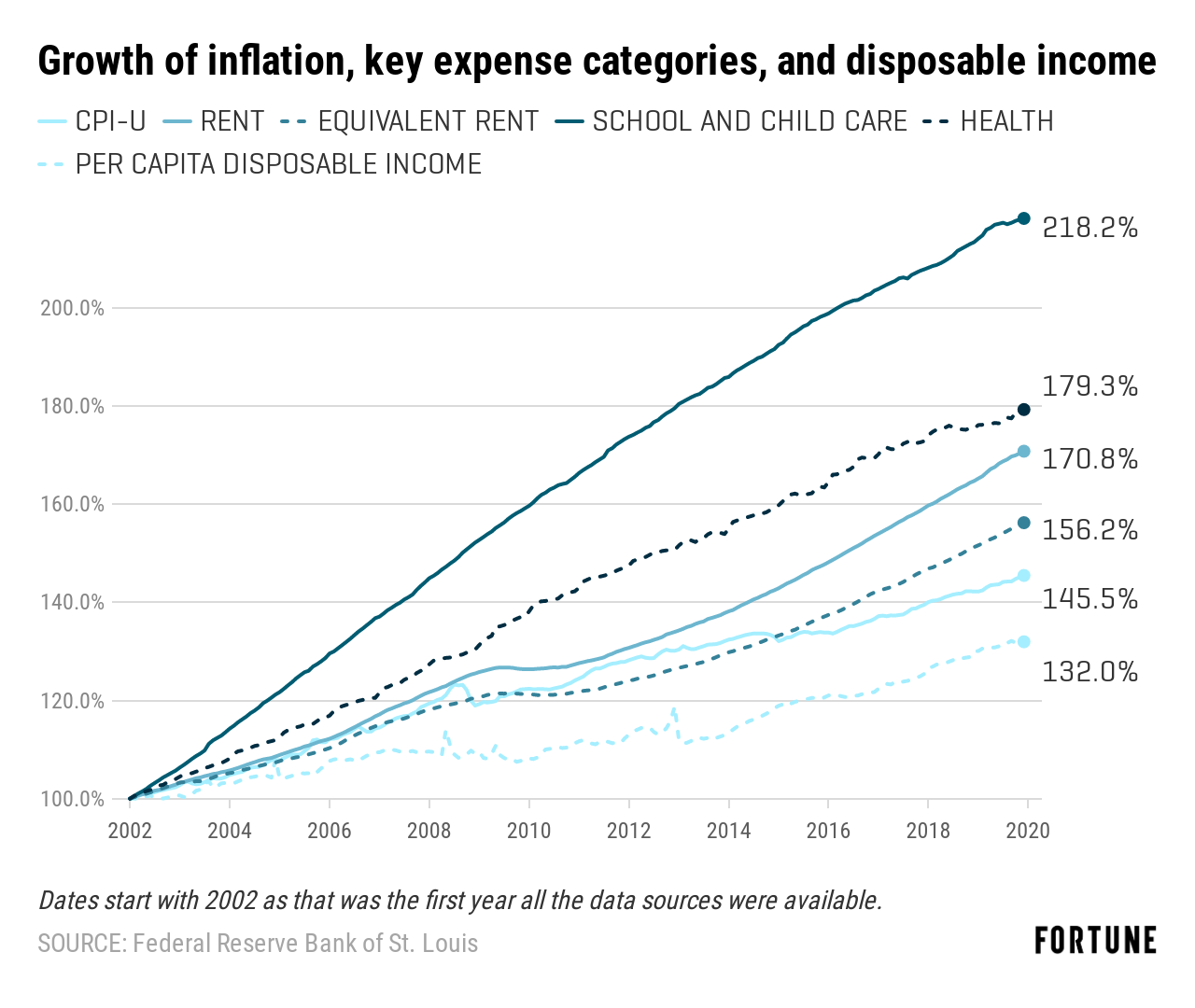
To dig deeper, you have to look at how inflation is calculated. And what the government measures, versus what the average person paying for housing, healthcare, school and childcare (categories that have grown anywhere from 18% to 65% faster than disposable income) experiences, are two very different things.

First, a bit of background. Inflation is the measure of how prices and wages grow over time. The faster they rise, the higher the level of inflation. To determine the general inflation rate—known as the CPI-U, or consumer price index for all urban consumers—the government tracks the cost of a market basket of goods and services, based on surveys of what consumers buy at any given time.

“The majority of that basket is going to be housing expenses” like mortgage or rent, food, and clothing, said Rebecca Neumann, an economics professor at the University of Wisconsin-Milwaukee. Other parts include such items as childcare, transportation costs, college, and health care.

The CPI-U is a complex composite. Some prices change more slowly and others, far quicker. The graph below compares the percentage growth rates of housing (both rent and a rent-equivalent for home owners), school and childcare, health, CPI-U, and per capita disposable income (average income after taxes across all people).
Economists, government officials, public policy advocates, investors, and businesses often discuss the CPI-U as a single measure of inflation—and for good reasons, as it is a way of discussing average changes in the overall economy. But there is a serious limitation. The calculated number doesn’t apply evenly across all categories of goods and services, in all places, or for all people.

“We’re not back in the 70s where you see pricing increases every day,” said Neumann. “But we have this steady [trend of] prices going up, and more in some categories than another.”

As the graph shows, the price increases in some of the most critical categories of expenses quickly outstrip inflation and, more so, the rate at which average disposable income grows. In addition, disposable income is not distributed evenly across the population; those who have lower take home pay will see an even bigger gap between income and expenses.

Individual inflation

While inflation is frequently treated as a hard and fast number, your ‘personal’ rate of inflation can vary greatly depending on which goods and services you’re spending your money on and where you live.

Part of an individual rate depends on location. Even one measure, like the CPI-U, doesn’t apply accurately across all geographic regions and demographics. The Bureau of Labor Statistics has a list of CPIs for different states as well as specific cities. Someone in a rural area may find different inflation rates because their likely market basket won’t completely match that of an urban dweller.

Where people are in their lives also has a big impact as types of incurred expenses can change. Someone dealing with college costs, daycare for young kids, or a health crisis will have a higher personal inflation rate because those fast-rising categories now have a heavier personal impact than the CPI-U would show.

There are also technical aspects of defining inflation that can make a general number virtually meaningless for many. The CPI-U is only one of three consumer price index versions. There is a CPI-W for urban wage earners and clerical workers. Both depend on survey data that is two to three years old.

The third is the C-CPI-U, or chained CPI for all urban consumers. It incorporates more recent information and also looks at relative prices and substitution of one good for another.

“You substitute other things you wouldn’t have bought when prices were different,” like maybe buying cheaper brands of clothing or swapping a chicken quarter for a steak, said Chester Spatt, a professor of finance at the Tepper School of Business at Carnegie Mellon University.

Substitution lets people decrease what they spend so the C-CPI-U inflation rate is lower than the CPI-U. The difference between the two measures of inflation has lead some politicians to support use of C-CPI-U when calculating automatic changes in government programs. The switch lowers government expenses.

For example, the 2017 tax overhaul changed how the IRS calculates automatic increases in tax brackets due to inflation. As goods and services get more expensive, a dollar doesn’t go as far as it once did. Brackets become higher to take that into account.

Adjustments used to be based on CPI-U. Now they use C-CPI-U, which is smaller so brackets grow more slowly. A greater portion of someone’s income can fall into higher brackets than would have been true using CPI-U, meaning more taxes are due.

There are also inconsistencies between economic theory and individual lives. Over time, CPI measurements have increased focus on the quality of goods and services.

“The quality of most goods, like technology goods, has improved,” said Steven Sheffrin, a professor of economics and affiliated professor of law at Tulane University. The differences in capabilities between a laptop computer or smartphone from the mid-2000s and 2020 are substantial. “If the good today is better and the price is the same, the good is actually cheaper,” he said.

But a word processor or browser might show no improvement that is obvious to the owner. This year’s model of smartphone likely has a better camera than one from two years ago, but you still pay today’s prices even if you can’t see, or don’t care, about the difference. From the consumer’s viewpoint, the product may not seem any cheaper.

The upshot of individual inflation and madly racing price growth in key areas is that personal finances become even more of a challenge.

How does a family plan for college costs when they can’t predict the gap between what they can save, the increase in prices, and the amount a school’s financial aid department expects as a contribution? How can an individual deal with an unexpected illness that far surpasses the support health insurance offers?

Those are equations that no government metric seems to be able to accurately solve.

More must-read stories from Fortune:

—All of your questions on filing taxes in 2020, answered
—The health of the economy in nine charts
—Global companies enter lockdown mode as coronavirus rocks China
—Bull market advice for investing in today’s market
—WATCH: Biggest investing opportunities and risks for 2020

Subscribe to Fortune’s Bull Sheet for no-nonsense finance news and analysis daily.

About the Author
By Erik Sherman
See full bioRight Arrow Button Icon

Latest in Finance

Finance
Lorem ipsum dolor sit amet, consectetur adipiscing elit, sed do eiusmod tempor incididunt ut labore et dolore magna aliqua. Ut enim ad minim veniam
By Fortune Editors
October 20, 2025
Finance
Lorem ipsum dolor sit amet, consectetur adipiscing elit, sed do eiusmod tempor incididunt ut labore et dolore magna aliqua. Ut enim ad minim veniam
By Fortune Editors
October 20, 2025
Finance
Lorem ipsum dolor sit amet, consectetur adipiscing elit, sed do eiusmod tempor incididunt ut labore et dolore magna aliqua. Ut enim ad minim veniam
By Fortune Editors
October 20, 2025
Finance
Lorem ipsum dolor sit amet, consectetur adipiscing elit, sed do eiusmod tempor incididunt ut labore et dolore magna aliqua. Ut enim ad minim veniam
By Fortune Editors
October 20, 2025
Finance
Lorem ipsum dolor sit amet, consectetur adipiscing elit, sed do eiusmod tempor incididunt ut labore et dolore magna aliqua. Ut enim ad minim veniam
By Fortune Editors
October 20, 2025
Finance
Lorem ipsum dolor sit amet, consectetur adipiscing elit, sed do eiusmod tempor incididunt ut labore et dolore magna aliqua. Ut enim ad minim veniam
By Fortune Editors
October 20, 2025

Most Popular

Finance
Lorem ipsum dolor sit amet, consectetur adipiscing elit, sed do eiusmod tempor incididunt ut labore et dolore magna aliqua. Ut enim ad minim veniam
By Fortune Editors
October 20, 2025
Finance
Lorem ipsum dolor sit amet, consectetur adipiscing elit, sed do eiusmod tempor incididunt ut labore et dolore magna aliqua. Ut enim ad minim veniam
By Fortune Editors
October 20, 2025
Finance
Lorem ipsum dolor sit amet, consectetur adipiscing elit, sed do eiusmod tempor incididunt ut labore et dolore magna aliqua. Ut enim ad minim veniam
By Fortune Editors
October 20, 2025
Finance
Lorem ipsum dolor sit amet, consectetur adipiscing elit, sed do eiusmod tempor incididunt ut labore et dolore magna aliqua. Ut enim ad minim veniam
By Fortune Editors
October 20, 2025
Finance
Lorem ipsum dolor sit amet, consectetur adipiscing elit, sed do eiusmod tempor incididunt ut labore et dolore magna aliqua. Ut enim ad minim veniam
By Fortune Editors
October 20, 2025
Finance
Lorem ipsum dolor sit amet, consectetur adipiscing elit, sed do eiusmod tempor incididunt ut labore et dolore magna aliqua. Ut enim ad minim veniam
By Fortune Editors
October 20, 2025
Fortune Secondary Logo
Rankings
  • 100 Best Companies
  • Fortune 500
  • Global 500
  • Fortune 500 Europe
  • Most Powerful Women
  • World's Most Admired Companies
  • See All Rankings
  • Lists Calendar
Sections
  • Finance
  • Fortune Crypto
  • Features
  • Leadership
  • Health
  • Commentary
  • Success
  • Retail
  • Mpw
  • Tech
  • Lifestyle
  • CEO Initiative
  • Asia
  • Politics
  • Conferences
  • Europe
  • Newsletters
  • Personal Finance
  • Environment
  • Magazine
  • Education
Customer Support
  • Frequently Asked Questions
  • Customer Service Portal
  • Privacy Policy
  • Terms Of Use
  • Single Issues For Purchase
  • International Print
Commercial Services
  • Advertising
  • Fortune Brand Studio
  • Fortune Analytics
  • Fortune Conferences
  • Business Development
  • Group Subscriptions
About Us
  • About Us
  • Press Center
  • Work At Fortune
  • Terms And Conditions
  • Site Map
  • About Us
  • Press Center
  • Work At Fortune
  • Terms And Conditions
  • Site Map
  • Facebook icon
  • Twitter icon
  • LinkedIn icon
  • Instagram icon
  • Pinterest icon

Latest in Finance

trump
PoliticsWhite House
America’s paying more at the pump. Trump’s new Air Force One jet donated by Qatar is nearly ready
By Jonathan J. Cooper and The Associated PressMay 2, 2026
4 hours ago
croatia
Travel & Leisuretourism
War in Iran has Croatia’s tourist hotspot wondering: will Dubrovnik host another 4 million visitors in 2026?
By Darko Bandic and The Associated PressMay 2, 2026
4 hours ago
shoplift
EconomyGen Z
Gen Z is rebelling against the economy with ‘disillusionomics,’ tackling near 6-figure debt by turning life into a giant list of income streams
By Jacqueline MunisMay 2, 2026
4 hours ago
Suze Orman once said earning more than $800,000 would make her ‘sick to my stomach’—but that turning down Oprah Winfrey cured her self-doubt
SuccessHow I made my first million
Suze Orman once said earning more than $800,000 would make her ‘sick to my stomach’—but that turning down Oprah Winfrey cured her self-doubt
By Orianna Rosa RoyleMay 2, 2026
4 hours ago
Pope Leo XIV encourages wealthy U.S. Catholics to keep donating after Papal Foundation approves most grants in its history
PoliticsPope
Pope Leo XIV encourages wealthy U.S. Catholics to keep donating after Papal Foundation approves most grants in its history
By Nicole Winfield and The Associated PressMay 2, 2026
5 hours ago
Berkshire’s cash pile hits $397.4 billion as profit more than doubles, but annual meeting attendance falls sharply without Warren Buffett as CEO
InvestingBerkshire Hathaway
Berkshire’s cash pile hits $397.4 billion as profit more than doubles, but annual meeting attendance falls sharply without Warren Buffett as CEO
By Josh Funk and The Associated PressMay 2, 2026
5 hours ago

Most Popular

Scott Bessent on financial literacy: 'it drives me crazy' to see young men in blue-collar construction jobs playing the lottery
Personal Finance
Scott Bessent on financial literacy: 'it drives me crazy' to see young men in blue-collar construction jobs playing the lottery
By Fatima Hussein and The Associated PressMay 1, 2026
1 day ago
A Chick-fil-A worker got fired and then showed up behind the register to allegedly refund himself over $80,000 in mac and cheese
Law
A Chick-fil-A worker got fired and then showed up behind the register to allegedly refund himself over $80,000 in mac and cheese
By Catherina GioinoMay 1, 2026
1 day ago
China dominates the world's lithium supply. The U.S. just found 328 years' worth in its own backyard
North America
China dominates the world's lithium supply. The U.S. just found 328 years' worth in its own backyard
By Jake AngeloApril 30, 2026
2 days ago
Current price of oil as of May 1, 2026
Personal Finance
Current price of oil as of May 1, 2026
By Joseph HostetlerMay 1, 2026
1 day ago
Apple cofounder Ronald Wayne—whose stake would be worth up to $400 billion had he not sold it in 1976—says that at 91, he has no regrets
Success
Apple cofounder Ronald Wayne—whose stake would be worth up to $400 billion had he not sold it in 1976—says that at 91, he has no regrets
By Preston ForeApril 27, 2026
5 days ago
Current price of gold as of May 1, 2026
Personal Finance
Current price of gold as of May 1, 2026
By Danny BakstMay 1, 2026
1 day ago

© 2026 Fortune Media IP Limited. All Rights Reserved. Use of this site constitutes acceptance of our Terms of Use and Privacy Policy | CA Notice at Collection and Privacy Notice | Do Not Sell/Share My Personal Information
FORTUNE is a trademark of Fortune Media IP Limited, registered in the U.S. and other countries. FORTUNE may receive compensation for some links to products and services on this website. Offers may be subject to change without notice.