
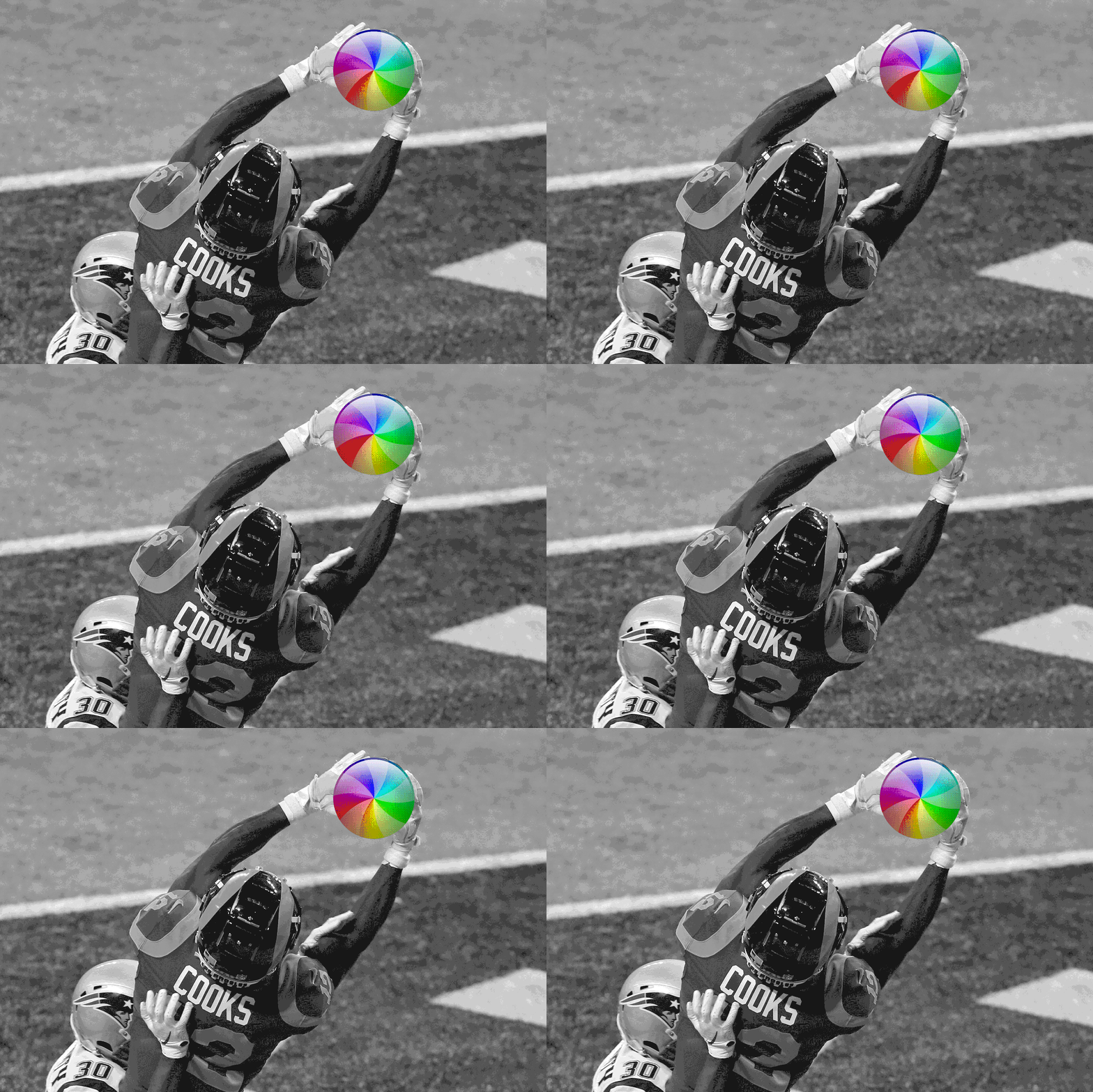
Jacob Feldman and his girlfriend awaited midnight this New Year’s Eve, 30 seconds from the ball drop. Or so they thought.
Suddenly, voices erupted down the hall in their Manhattan apartment building. Fireworks launched from nearby Central Park. But on Feldman’s television stream playing CNN’s broadcast of the festivities, the countdown hadn’t even reached its famous last 10 seconds.
“We realized the stream was off, which created this really anticlimactic moment where we got to zero and everybody else already knew,” Feldman says.
The lag Feldman experienced that evening is called latency, the delay between what a camera captures and what is transmitted to viewers. And as millions of Americans gear up to watch live, high-profile events such as Super Bowl LIV and the 92nd Academy Awards, latency will be on the minds of many hoping to avoid spoilers.
As TV audiences increasingly make the switch from traditional broadcast TV to Internet streaming services, latency is subtly shifting the ways viewers watch television. Now, push notifications from apps like ESPN must be turned off in advance of games. Group chats must be warned not to react too quickly to what unfolds on the screen. Social media must be avoided at all costs, at least until commercial breaks.
Latency is experienced on all cord-cutting services to a varying degree of roughly 15 to 60 seconds, and so companies have no problem acknowledging the issue. An Amazon Web Services web page dedicated to explaining video latency cites an example: “Perhaps you are watching a live talent competition, your anticipation building for the winner’s reveal, when your social media feed—typically generated by TV viewers—ruins the surprise 15 seconds before you see it.”
Geir Magnusson Jr., the chief technology officer of sports-focused Internet TV service FuboTV, says, “Latency is ironically important and somewhat unimportant to us.
“In general, there’s going to be latency no matter how it’s being delivered—classical, cable, satellite. They differ by provider,” he explains.
Traditional broadcasts for years have operated on short, five- to seven-second delays when showing live events in order to censor unacceptable behavior or language. Before streaming, though, everyone experienced the delay at the same time and length. But streaming companies today operate on different content delivery networks, or CDNs, meaning latency can differ significantly for a YouTube TV viewer or a Hulu watcher or those following standard TV broadcasts, and so on.
Similar to broadcast TV, the delay is intentional—though cord-cutting services also take into account the possibility of slowdowns between the network and the viewer’s device. Extra latency is added so that playback can continue while the stream catches up in the background, rather than pausing the stream as it buffers. Streaming apps prioritize high bandwidth, which maximizes video quality, over low latency. Due to current tech limitations, it’s difficult to achieve both.
“Technically, it’s possible to reduce the delay below a certain number,” says SlingTV chief technology officer Kannan Alagappan. “But we generally think it’s not worth risking high image quality with no buffering.”
Magnusson echoes practically identical sentiments, saying, “[Latency] is very important to us, but it will never be worth the cost of risking the playback experience. Consumers want to see it at the highest bandwidth possible.”
That may be true, but consumers still experience inconveniences as a result of delayed streams.
“I’ve had to jokingly scold my friends if they kept texting regarding things ahead of me,” says YouTube TV user Charlie Oliver. “I used to be on Twitter more during a baseball game, but I do less of that now in case of a potential spoiler.”
“I know when we’re watching the Super Bowl this week, you can’t be on Twitter,” Feldman says. “You go on Twitter during the commercials.”
“There’s a real question in sporting events whether users will be more frustrated by delay or buffering,” says Theo Schlossnagle, founder and chief technology officer of Circonus, a machine data intelligence platform.
“I think the right psychology is, if you watch [sports on] TV and it’s buffering, you’re gonna turn the TV off and go to the bar,” he adds. “But if it’s going to be a 10 to 15 seconds delay… I’d rather have a consistent and smooth visual and audio experience than have things play right away.”
Alagappan says that the widespread introduction of 5G technology will result in a lower latency in time. But experts say latency will likely always be present to some extent, and it’s just a facet of modern life to get used to.
“We certainly hear from our customers. When I’m sitting at a bar watching live TV, I’m always comparing how Sling is doing,” Alagappan says. “We’re a few seconds behind, and you see the discrepancy. I don’t know if it causes confusion. You just get it ahead of time.”
Being a few seconds behind for Internet-powered TV is a convenience many are willing to trade for. But in a hyperconnected world that lives for instantaneous information, those few seconds can make all the difference.
More must-read stories from Fortune:
—American Factory directors on capturing what “globalization looks like on a human scale”
—In the Dark podcast host Madeleine Baran on Curtis Flowers’ release, season three, and more
—The Grammys remain more of the same even amid calls for change
—Taika Waititi on Kiwi humor, directing as Hitler, and why kids should see Jojo Rabbit
—Zombi Child auteur Bertrand Bonello on colonialism, French trap music, and a “cinema of fear”
Follow Fortune on Flipboard to stay up-to-date on the latest news and analysis.