The Chinese coffee chain Luckin Coffee is staking its future on two bold ideas. First, that a tech-driven retail model can provide what customers are looking for, and second—that what Chinese consumers is looking for is coffee.
It’s a future investors, at least, seem to believe in. Last summer, the company listed on the Nasdaq stock exchange in the U.S., and raised over $500 million at a valuation of over $4 billion. With this funding, the company has adopted an aggressive growth strategy.
Luckin was only founded in 2017, and the company has already opened over 3,600 outlets in China—a pace that the company has said will put it on track to eventually surpass Starbucks’ 4,100 stores.
But recent concerns about the company’s growth strategy have given some investors and industry experts pause. In the wake of the recent collapse in the bike-sharing market—another buzzy new industry—investors in China may be increasingly weary of tech-driven unicorns adopting a grow-at-all-costs mentality, even as coffee start ups have not attracted anywhere near the sort of capital or number of companies.
That’s resulted in a bumpy year. In May, the company went public, but almost immediately, the company’s stock fell sharply amid concerns that its growth has been dependent on a fizzy blend of excessive spending on marketing campaigns, and discounted coffee.
But with every store that Luckin opens—as many as eight per day—the stakes for the company’s success will only grow.
“[This strategy] is very common in venture capital—but not terribly common in retail—which is to raise money, and grow very, very aggressively,” said Jeffrey Towson, investment professor at Peking University. “If it works out you’ve hit one over the fence, but if it doesn’t work out you crash and burn pretty fast.”
Robust profits, or pure foam?
On November 13th, Luckin posted a net loss for the third quarter of over $80 million—a $15 million improvement compared to the previous quarter— results that signaled either an inflection point in the company’s growth, or that the company’s marketing-heavy model still isn’t getting real results.

Those seeing it as a bright spot cite the company reaching a breakeven point on a store level for the first time. Compared to $17 million in losses in the same quarter a year ago, Luckin posted $26 million in operating profits on a store level. (Luckin Coffee could not be reached in time for publication.)
For Chen Lin, a marketing professor at China Europe International Business School in Shanghai, Luckin’s third quarter results were “pivotal.”
“It finally proves the company’s ability to be profitable. That’s something that Wall Street people were really, really eager to see,” Chen said, adding that it was also a “big surprise” in China because people thought Luckin relied on heavy, profit-eating discounts for its sales.
Yet for skeptics, these store level profits aren’t necessarily important in the context of Luckin’s massive investments and spending costs. In its third quarter totals, the company reported $215 million in net revenues against $298 million in expenses, almost $80 million of which were spent on marketing.
“It’s kind of the same story [as before],” said Towson, who pointed to the massive marketing budget that buoys the company’s sales. “What happens when you dial back the marketing spending? Because you can’t keep it at this level forever.”
The big marketing spend will likely bolster the company’s growth for at least the next six to 12 months, said Hu Yuwan, chief operating officer at Daxue Consulting.
For Hu, the real test will be to actually build the company’s brand beyond discounts and name recognition.
“The marketing costs cannot be decreased yet… and [profits] are still incentive-driven,” Hu said. “The one thing that’s missing for Luckin is building their brand.”
The model
The debate over Luckin’s ability to become profitable ultimately boils down to its model. And this too has been a point of contention.
Luckin argues that it is more a coffee network than coffeehouse chain, relying on technology as a backbone of its business. Some Luckin stores—called ‘elite’ or ‘relax’ stores—operate like an ordinary coffeehouse. There are counters and spaces to sit and drink cups of coffee.
In many other Luckin locations, you can’t come in off the street and buy a cup of coffee. In these mobile pick-up stores, which comprise up to half of all the company’s shops, there isn’t even a register—just employees handing over orders made via the company’s app. Some delivery-focused stores are even closed to the public entirely.
This tech-driven customer experience may have even inspired Starbucks to form its partnership with e-commerce giant Alibaba.
But to understand the company’s store structure, it is important to know that Luckin’s founders emerged from Car Inc, a major player in China’s car rental industry.
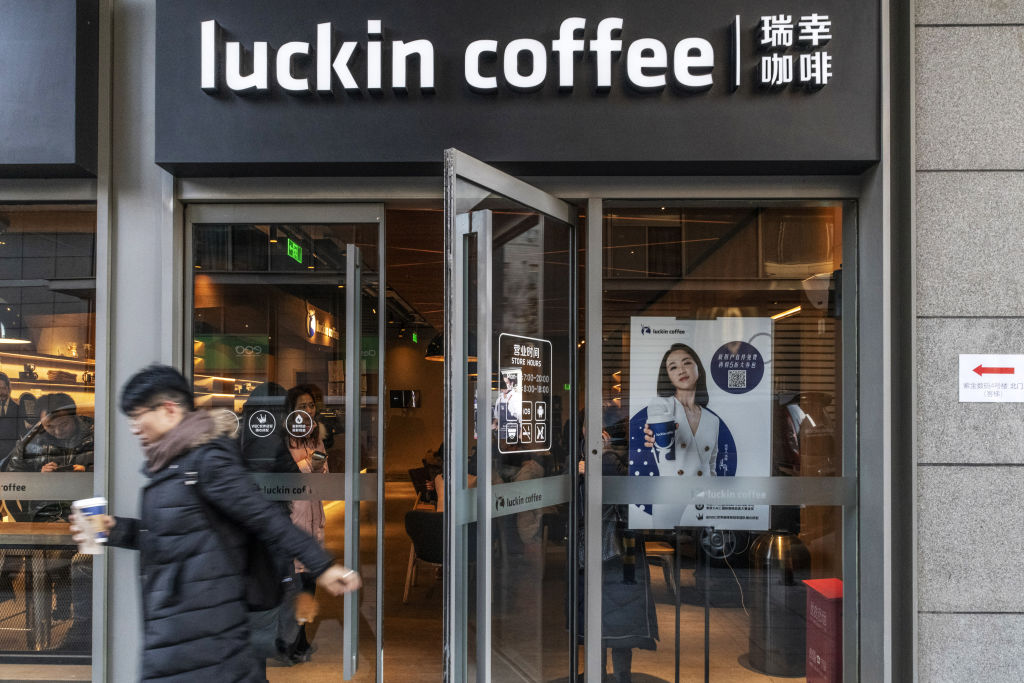
Many of Luckin’s stores operate more like car rental lots than coffeehouses. They are often small and in less prominent locations, and function mostly as small hubs for picking up cups of coffee or dispatching delivery orders.
This—plus its ordering technology—is why the company has been able to grow both quickly and efficiently, Chen said.
“To save on big rental costs, they want many stores and to be as concentrated as possible. And when an order comes in, everything needs to be digitized,” Chen said. Then, their technology automatically assigns orders to different machines and different stores in the vicinity, in order to make sure those orders are filled fast.
“This is why they need a lot of stores—a lot of small stores—not the fancy ones like Starbucks,” he said.
David Li of Centurion Capita, a leading Luckin investor, said that the company’s model was truly “groundbreaking” and that “Luckin is not Ofo,” referring to the once unicorn bike-share startup.
Yet however confident the company is in its “technology-driven new retail model,” it still has to face the reality that its final product is a cup of coffee.
This sort of tech-heavy language may have helped Luckin get a better valuation, but at the end of the day “they’re not a tech company,” said Towson. “They are very innovative, they are using apps and things to create a business model that was fairly clever… (but) if people don’t use it, you got nothing.”
The market
If Luckin is just a coffee chain, its success depends on China becoming a coffee-drinking country.
Coffee has been in China since the late 1800s when a French missionary began growing his own plants (they continue to live on today), but coffee drinking in the country has never taken off in a significant way.
Two decades after Starbucks opened its first store in mainland China, consumers there still only drink five cups of coffee per year, as opposed to the U.S.’ 400-per-person annual rate, according to the International Coffee Organization. Tea remains the drink of choice, with Chinese consumers drinking about 2 pounds of it a year, which equates to roughly 400 cups.
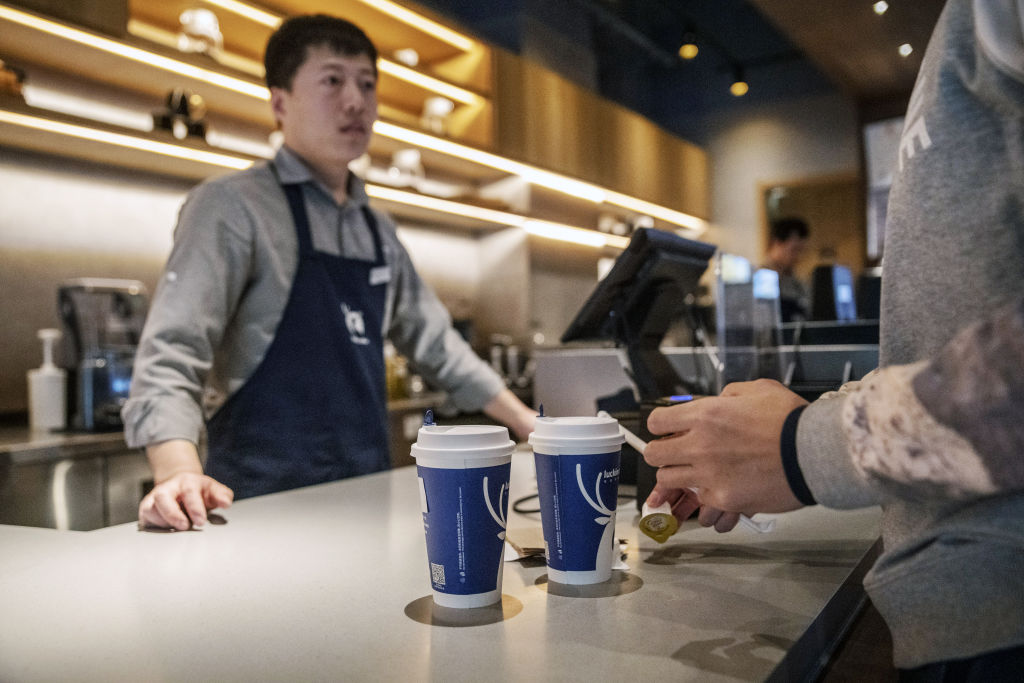
While Luckin’s emergence and rapid growth in China has often been framed as a “war” with Starbucks, in truth the two companies have their sights aimed on different markets. Whereas Starbucks offers higher-end, pricier coffee in carefully constructed and spacious stores, Luckin is going after the masses.
And Luckin is betting that the country’s middle class will indeed caffeinate at the pace of the company’s rapid expansion.
“The big question for Luckin has always been, do Chinese consumers really like coffee or not?” said Towson. “We’ll see.”
More must-read stories from Fortune:
—China’s big blockchain bet aims for an early advantage over the U.S.
—2020 Crystal Ball: Predictions for the economy, politics, technology, etc.
—China’s lessons from the bike sharing bust may hang over its A.I. boom
—Arsenal star’s Uighur comments risk another league’s China business
—Why it’s still so hard to sell medical marijuana in Asia
Catch up with Data Sheet, Fortune’s daily digest on the business of tech.
Sign up for the Fortune Features email list so you don’t miss our biggest features, exclusive interviews, and investigations.