• Home
  • Latest
  • Fortune 500
  • Finance
  • Tech
  • Leadership
  • Lifestyle
  • Rankings
  • Multimedia
TechData Sheet

What Senators Ignore When They Threaten Encryption

Robert Hackett
By
Robert Hackett
Robert Hackett
Down Arrow Button Icon
Robert Hackett
By
Robert Hackett
Robert Hackett
Down Arrow Button Icon
December 11, 2019, 10:47 AM ET

This is the web version of Data Sheet, Fortune’s daily newsletter on the top tech news. To get it delivered daily to your in-box, sign up here.

If anyone’s wondered where the Senate Judiciary Committee stands on the question of encryption, yesterday’s hearing on the subject left no room for ambiguity: The committee members have little tolerance for it, and they threatened to pass legislation mandating workarounds.

“It ain’t complicated for me. You’re going to find a way to do this or we’re going to do it for you,” Senator Lindsey Graham (R-S.C.), chair of the committee, told representatives from Facebook and Apple in attendance (apparently reversing a change of heart he had in 2016). “You’re either the solution or you’re the problem.”

The debate: whether tech companies should be allowed to deploy strong, end-to-end encryption across their products.

The case for it: The feature protects people’s data and communications from being intercepted or otherwise obtained. Any loophole in the system could be exploited by hackers, spies, and repressive political regimes.

The case against it: Encryption creates a potential sanctuary for criminals and terrorists to hide incriminating evidence about their nefarious activities. Law enforcement needs access to decrypted data for its investigations.

For this latest iteration of the so-called Crypto Wars, the Justice Department has been refining its arguments. A few years ago, the Federal Bureau of Investigation emphasized the threat of terrorism as the agency battled to force Apple to unlock the iPhone of a mass shooter in San Bernardino, Calif. Now the Feds appear to be zeroing in on the dangers of child exploitation and sex trafficking enabled by encryption.

In an October letter, Attorney General William Barr and his British and Australian counterparts asked Facebook CEO Mark Zuckerberg to halt the rollout of encryption across its apps. The heads of Facebook’s WhatsApp and Messenger divisions replied this week saying they would not delay encryption’s adoption. Adding so-called encryption backdoors, they said, would make people’s private messages “less secure and the real winners would be anyone seeking to take advantage of that weakened security. That is not something we are prepared to do.”

Tech companies might not have a choice. The message from Capitol Hill was clear: Figure out how to meet our demands, or prepare to face legislation.

My take: If Washington rams through anti-encryption policy, American businesses will find themselves at an economic disadvantage. Consumers will consider their products weaker and less trustworthy than ones with greater protections offered by competitors abroad. Although the prospect of passing anti-encryption laws appears remote despite senators’ rhetoric, the risk is real.

Thomas Rid, a Johns Hopkins professor and authority on cybersecurity matters, put it well on Twitter.
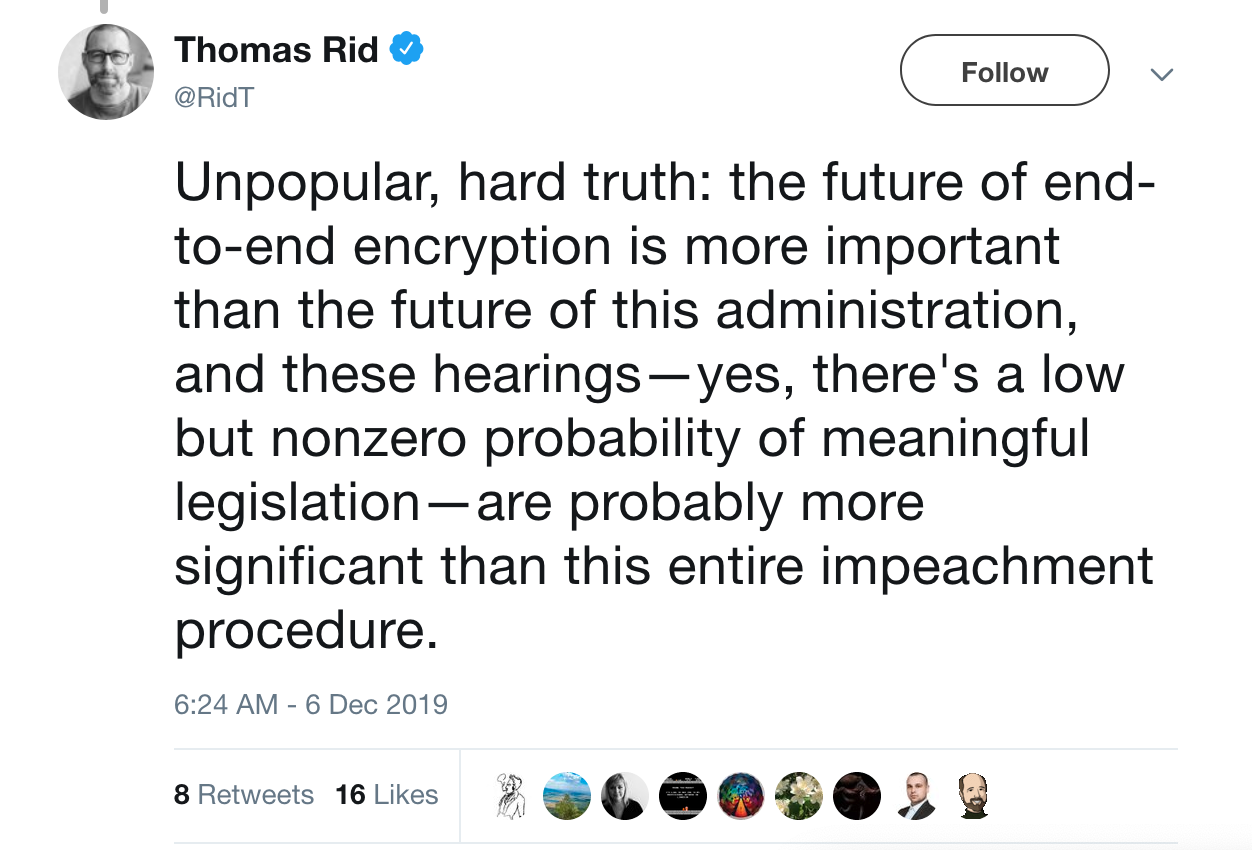
Any policy that gets passed will have enormous ramifications.

Robert Hackett

Twitter: @rhhackett

Email: robert.hackett@fortune.com

THREATS

On the other line. Government officials and cybersecurity experts are criticizing President Donald Trump's habit of using an insecure cellphone to conduct private phone calls. They warn that the line is likely being tapped by foreign adversaries, such as Chinese and Russian intelligence agencies. 

Tit for tat. A new government agency, the U.S. International Development Finance Corporation, is expected to put $60 billion toward helping developing countries purchase telecom equipment made by firms other than China's Huawei and ZTE. American officials have warned the Chinese companies' products pose a security risk. Meanwhile, Beijing has ordered that all foreign-made computers be removed from government offices within three years, delivering a blow to companies such as Dell, HP, and Microsoft.

Intel inside. Security researchers have discovered a vulnerability in Intel computer chips, dubbed "Plundervolt," that lets attackers steal secret information. The researchers have demonstrated they can obtain sensitive cryptographic and biometric data by fiddling with the devices' power supplies. Intel pushed out a firmware update on Tuesday to prevent attacks.

Avast ye, matey. Web browsers Mozilla and Opera removed extensions from the Czech cybersecurity firm Avast after Wladimir Palant, creator of the popular adblocker Adblock Plus, called them "spyware" and said they were harvesting people's data. Avast's recently appointed CEO, Ondrej Vlcek, tells Forbes there is no privacy scandal here. He says the company sells people's web browsing habits in an anonymized form to marketers.

Neighborhood watch. Gizmodo has cast doubt on the Amazon-owned camera company Ring's privacy safeguards by finding out the potential locations of tens of thousands of its installed cameras. The blog analyzed network traffic from the firm's crime-reporting app, Neighbors, which seems to have revealed hidden coordinates of the devices.

On your mark. A Facebook contractor took thousands of dollars in bribes to reactivate banned accounts from a shady affiliate marketer called Ads Inc., BuzzFeed reports. Facebook says the Austin, Texas-based worker, who identified in chats as "Ryan," no longer works at the company. "This behavior is absolutely prohibited under our policies," a spokesperson said.

License plate: THIEF.

ACCESS GRANTED

Starting in 2008, U.S. national security leaders helped the United Arab Emirates build a secret spy unit, a Reuters investigation uncovers. The Americans involved say they had good intentions: helping an ally combat terrorism. But the group has been implicated in human rights violations, targeting journalists, political dissidents...and even FIFA, the World Cup soccer organization.

In the years after 9/11, former U.S. counterterrorism czar Richard Clarke warned Congress that the country needed more expansive spying powers to prevent another catastrophe. Five years after leaving government, he shopped the same idea to an enthusiastic partner: an Arab monarchy with deep pockets.

In 2008, Clarke went to work as a consultant guiding the United Arab Emirates as it created a cyber surveillance capability that would utilize top American intelligence contractors to help monitor threats against the tiny nation. The secret unit Clarke helped create had an ominous acronym: DREAD.

FORTUNE RECON

Three Charged in $722 Million Cryptocurrency ‘Ponzi Scheme’ by Bob Van Voris

Upwork CEO Is Stepping Down Amid Depressed Stock Price by Alyssa Newcomb

Netflix Expects 40 Million Households to Watch ‘The Irishman’ Over the First Month by Lucas Shaw

This Year’s Hottest Job Involves Artificial Intelligence by Jonathan Vanian

Electric-Powered Commercial Airplane Makes History by Dan Catchpole

No, Humanities Degrees Don’t Mean Low Salaries by Gwen Moran

SoftBank Cuts the Leash on Troubled Dog-Walking Startup Wag by Polina Marinova

ONE MORE THING

What has William Gibson been up to? The 71-year-old sci-fi author and coiner of the term "cyberspace" is still writing novels. His next one, Agency, is due out next month. A New Yorker profile examines the futurist pioneer's life, process, and fixation with the present-day. You will also learn the meaning of "F.Q.," an acronym I will intentionally leave undefined here. (This is a family-friendly newsletter, after all.)


About the Author
Robert Hackett
By Robert Hackett
Instagram iconLinkedIn iconTwitter icon
See full bioRight Arrow Button Icon

Latest in Tech

Finance
Lorem ipsum dolor sit amet, consectetur adipiscing elit, sed do eiusmod tempor incididunt ut labore et dolore magna aliqua. Ut enim ad minim veniam
By Fortune Editors
October 20, 2025
Finance
Lorem ipsum dolor sit amet, consectetur adipiscing elit, sed do eiusmod tempor incididunt ut labore et dolore magna aliqua. Ut enim ad minim veniam
By Fortune Editors
October 20, 2025
Finance
Lorem ipsum dolor sit amet, consectetur adipiscing elit, sed do eiusmod tempor incididunt ut labore et dolore magna aliqua. Ut enim ad minim veniam
By Fortune Editors
October 20, 2025
Finance
Lorem ipsum dolor sit amet, consectetur adipiscing elit, sed do eiusmod tempor incididunt ut labore et dolore magna aliqua. Ut enim ad minim veniam
By Fortune Editors
October 20, 2025
Finance
Lorem ipsum dolor sit amet, consectetur adipiscing elit, sed do eiusmod tempor incididunt ut labore et dolore magna aliqua. Ut enim ad minim veniam
By Fortune Editors
October 20, 2025
Finance
Lorem ipsum dolor sit amet, consectetur adipiscing elit, sed do eiusmod tempor incididunt ut labore et dolore magna aliqua. Ut enim ad minim veniam
By Fortune Editors
October 20, 2025

Most Popular

Finance
Lorem ipsum dolor sit amet, consectetur adipiscing elit, sed do eiusmod tempor incididunt ut labore et dolore magna aliqua. Ut enim ad minim veniam
By Fortune Editors
October 20, 2025
Finance
Lorem ipsum dolor sit amet, consectetur adipiscing elit, sed do eiusmod tempor incididunt ut labore et dolore magna aliqua. Ut enim ad minim veniam
By Fortune Editors
October 20, 2025
Finance
Lorem ipsum dolor sit amet, consectetur adipiscing elit, sed do eiusmod tempor incididunt ut labore et dolore magna aliqua. Ut enim ad minim veniam
By Fortune Editors
October 20, 2025
Finance
Lorem ipsum dolor sit amet, consectetur adipiscing elit, sed do eiusmod tempor incididunt ut labore et dolore magna aliqua. Ut enim ad minim veniam
By Fortune Editors
October 20, 2025
Finance
Lorem ipsum dolor sit amet, consectetur adipiscing elit, sed do eiusmod tempor incididunt ut labore et dolore magna aliqua. Ut enim ad minim veniam
By Fortune Editors
October 20, 2025
Finance
Lorem ipsum dolor sit amet, consectetur adipiscing elit, sed do eiusmod tempor incididunt ut labore et dolore magna aliqua. Ut enim ad minim veniam
By Fortune Editors
October 20, 2025
Fortune Secondary Logo
Rankings
  • 100 Best Companies
  • Fortune 500
  • Global 500
  • Fortune 500 Europe
  • Most Powerful Women
  • Future 50
  • World’s Most Admired Companies
  • See All Rankings
Sections
  • Finance
  • Fortune Crypto
  • Features
  • Leadership
  • Health
  • Commentary
  • Success
  • Retail
  • Mpw
  • Tech
  • Lifestyle
  • CEO Initiative
  • Asia
  • Politics
  • Conferences
  • Europe
  • Newsletters
  • Personal Finance
  • Environment
  • Magazine
  • Education
Customer Support
  • Frequently Asked Questions
  • Customer Service Portal
  • Privacy Policy
  • Terms Of Use
  • Single Issues For Purchase
  • International Print
Commercial Services
  • Advertising
  • Fortune Brand Studio
  • Fortune Analytics
  • Fortune Conferences
  • Business Development
  • Group Subscriptions
About Us
  • About Us
  • Editorial Calendar
  • Press Center
  • Work At Fortune
  • Diversity And Inclusion
  • Terms And Conditions
  • Site Map
  • About Us
  • Editorial Calendar
  • Press Center
  • Work At Fortune
  • Diversity And Inclusion
  • Terms And Conditions
  • Site Map
  • Facebook icon
  • Twitter icon
  • LinkedIn icon
  • Instagram icon
  • Pinterest icon

Latest in Tech

Even Nvidia’s own research teams can’t get enough GPUs amid the race for AI computing power
NewslettersEye on AI
Even Nvidia’s own research teams can’t get enough GPUs amid the race for AI computing power
By Sharon GoldmanApril 9, 2026
15 hours ago
You’re looking at the AI revolution all wrong, top economist says: 40% unemployment and a 3-day work week are the same thing
AIdisruption
You’re looking at the AI revolution all wrong, top economist says: 40% unemployment and a 3-day work week are the same thing
By Nick LichtenbergApril 9, 2026
16 hours ago
Zoom CEO Eric Yuan
Successthe future of work
‘I hate working 5 days’: Zoom CEO says traditional work schedules are becoming obsolete—and predicts a 3-day workweek by 2031
By Preston ForeApril 9, 2026
17 hours ago
Nutella seen aboard the Orion spacecraft Integrity.
RetailFood and drink
Nutella jumps on the best product placement money can’t buy: A trip to the far side of the Moon
By Catherina GioinoApril 9, 2026
18 hours ago
kash
Cybersecuritycyber
Trump’s ‘cease-fire’ won’t stop Iranian hackers for long, cyber experts say
By David Klepper and The Associated PressApril 9, 2026
18 hours ago
lego
PoliticsIran
AI-savvy pro-Iran groups troll America with Lego Movie-style propaganda videos mocking American failure
By Sam McNeil and The Associated PressApril 9, 2026
19 hours ago

Most Popular

The U.S. government is spending $88 billion a month in interest on national debt—equal to spending on defense and education combined
Economy
The U.S. government is spending $88 billion a month in interest on national debt—equal to spending on defense and education combined
By Fortune EditorsApril 9, 2026
20 hours ago
A Meta employee created a dashboard so coworkers can compete to be the company's No. 1 AI token user—and Zuckerberg doesn't even rank in the top 250
AI
A Meta employee created a dashboard so coworkers can compete to be the company's No. 1 AI token user—and Zuckerberg doesn't even rank in the top 250
By Fortune EditorsApril 9, 2026
23 hours ago
Gen Z doesn't want your full-time job. They want several part-time roles, and it's reshaping the entire workforce
Success
Gen Z doesn't want your full-time job. They want several part-time roles, and it's reshaping the entire workforce
By Fortune EditorsApril 9, 2026
24 hours ago
White-collar workers are quietly rebelling against AI as 80% outright refuse adoption mandates
AI
White-collar workers are quietly rebelling against AI as 80% outright refuse adoption mandates
By Fortune EditorsApril 9, 2026
22 hours ago
Gen Z workers are so fearful AI will take their job they’re intentionally sabotaging their company’s AI rollout
AI
Gen Z workers are so fearful AI will take their job they’re intentionally sabotaging their company’s AI rollout
By Fortune EditorsApril 8, 2026
2 days ago
2 years ago, Saudi Arabia quietly canceled the ‘petrodollar’ deal with America that wired the world economy for 50 years. Then war broke out in Iran
Energy
2 years ago, Saudi Arabia quietly canceled the ‘petrodollar’ deal with America that wired the world economy for 50 years. Then war broke out in Iran
By Fortune EditorsApril 7, 2026
2 days ago

© 2026 Fortune Media IP Limited. All Rights Reserved. Use of this site constitutes acceptance of our Terms of Use and Privacy Policy | CA Notice at Collection and Privacy Notice | Do Not Sell/Share My Personal Information
FORTUNE is a trademark of Fortune Media IP Limited, registered in the U.S. and other countries. FORTUNE may receive compensation for some links to products and services on this website. Offers may be subject to change without notice.