Americans looking across the Atlantic to the United Kingdom may recognize a fundamental trend that’s happening there: the hollowing-out of the political center.
The trend has been underway in the ruling Conservative Party for some time now, particularly since Prime Minister Boris Johnson—a keen backer of a hard separation between the U.K. and the European Union—took over as leader.
In September, Johnson expelled 21 Tory MPs for disloyalty, after they voted in Parliament to block a no-deal Brexit. He subsequently let 10 of the rebels back into the party, but six of those 10 announced in recent days that they would not be standing for re-election—including former media minister Ed Vaizey, digital minister Margot James, and business and industry minister Richard Harrington.
As a result, the Conservative candidates at the Dec. 12 general election will be more hardline on a Brexit that the opposition Labour Party is painting as an attempt at widespread deregulation—and that could still end up as a form of “no-deal” Brexit, even if an initial Brexit agreement finally clears Parliament after the election.
But Labour is also heading further to the other side of the political spectrum.
On Wednesday, its deputy leader, Tom Watson, stunned Westminster by announcing that he would be stepping down as a lawmaker.
Watson has been widely seen as a relative centrist in the increasingly left-wing Labour Party of Jeremy Corbyn. His departure removes a key moderating force from the party’s decision-making structures, making it more likely that Labour will continue to tack further to the left. The party is already campaigning this election on promises of nationalizing water systems, energy networks and the nation’s railways.
Watson announced his departure on amicable terms, saying he wanted to focus his efforts on public health. (He recently lost a lot of weight and, as a diabetic, campaigns on sugar-related issues). His resignation letter even referred to his and Corbyn’s shared interest in horticulture.
But the animosity between the two is clear. Corbyn’s response included the line, “I hope the horseradish plants I gave you thrive,” which sounds friendly until you remember that horseradish spreads like a weed and is obnoxiously resistant to removal.
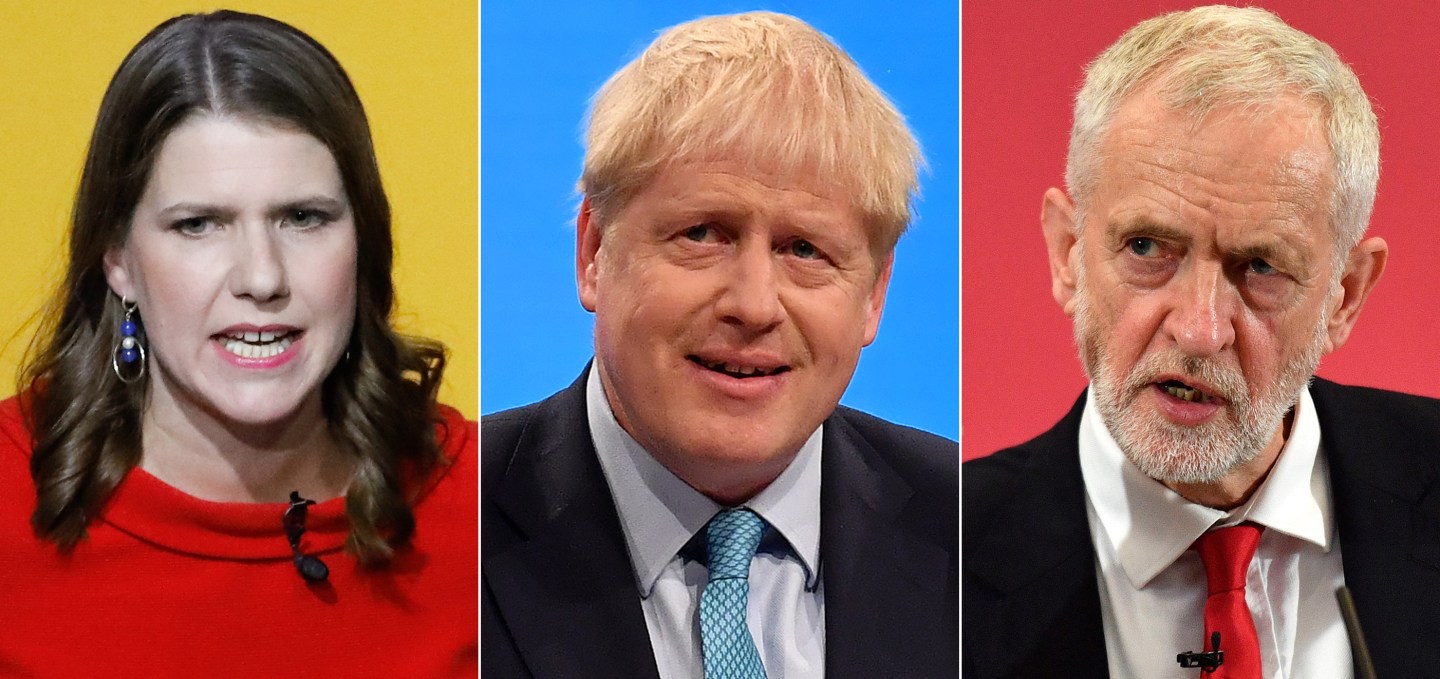
The polarization of the Tories and Labour should, in theory, leave the center ground for the U.K.’s third party, the Liberal Democrats, which is being led by Jo Swinson. But things aren’t quite so simple.
The Lib Dems, as they are widely known, have always been a centrist party overall—strong on civil liberties, and moderate enough on the economy that they went into coalition with David Cameron’s Conservatives in the first half of this decade, even though their supporters are largely center-left.
But the Lib Dems are campaigning this election pretty much on one issue: Brexit, which they want to simply cancel—a legal possibility, but political and social dynamite. In this regard, they are the polar opposites of those Tories who would happily enact a clean break with the EU, and who have now taken over their party.
Labour may be increasingly extreme in their economic plans, but on the Brexit axis they are (frustratingly to many supporters) somewhere in the middle. Labour’s policy is to renegotiate a “softer” Brexit deal—involving an ongoing customs union with the EU—than Johnson or his predecessor Theresa May did, then put it to the nation in a fresh referendum, with Remain as another option on the ballot paper.
So all three of the main parties have, in their own ways, adopted extreme policies on issues that will reshape the future of the U.K. The Tories are pursuing a hard Brexit and have conservative economic policies; Labour is economically heading ever leftwards while trying to occupy the middle ground on Brexit; and Swinson’s Liberal Democrats are effectively anti-Brexit extremists who happen to be pursuing moderate socio-economic goals.
(It is noteworthy that the Lib Dems now count among their numbers two of the lawmakers who were expelled from the Conservative Party, along with several of those who fled Labour in February over its Brexit policy and anti-Semitism within the party.)
But what will this all mean to the voters braving wintry weather as they head to the polls next month? As with anything Brexit-related, the outcome is impossible to predict with any certainty.
But one thing is for sure: the days of fighting over the political center ground, as all three parties did between the mid-1990s and the middle of this decade, are long gone.
More must-read stories from Fortune:
—Here’s what states have done with election security funding
—Wall Street’s scorn for Elizabeth Warren boils over
—Trump’s national parks changes could, ironically, help Jeff Bezos
—Sherrod Brown has some advice for 2020 candidates hoping to win in Ohio
—Prisoners are fighting wildfires on the front lines, but getting little in return
Get up to speed on your morning commute with Fortune’s CEO Daily newsletter.