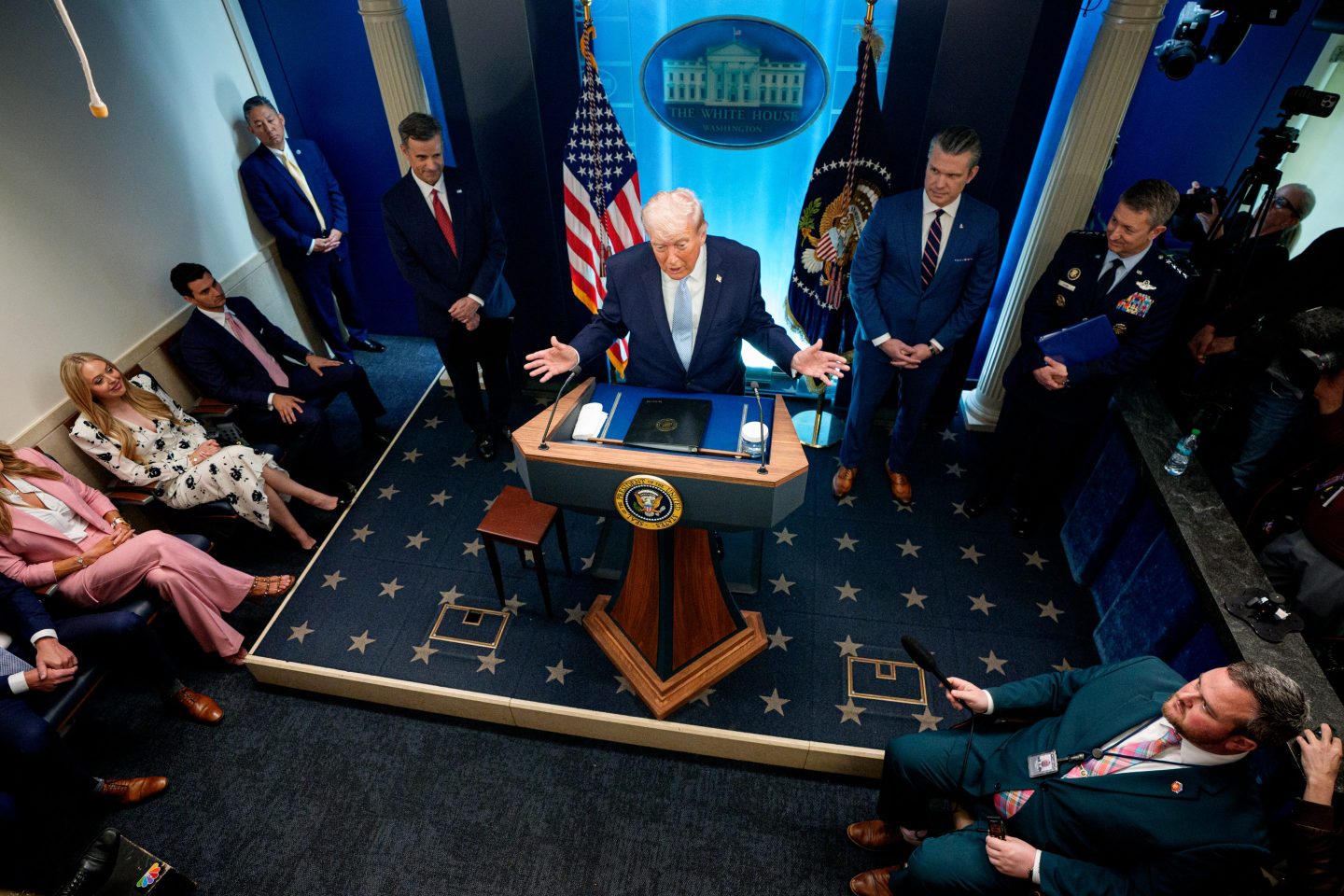
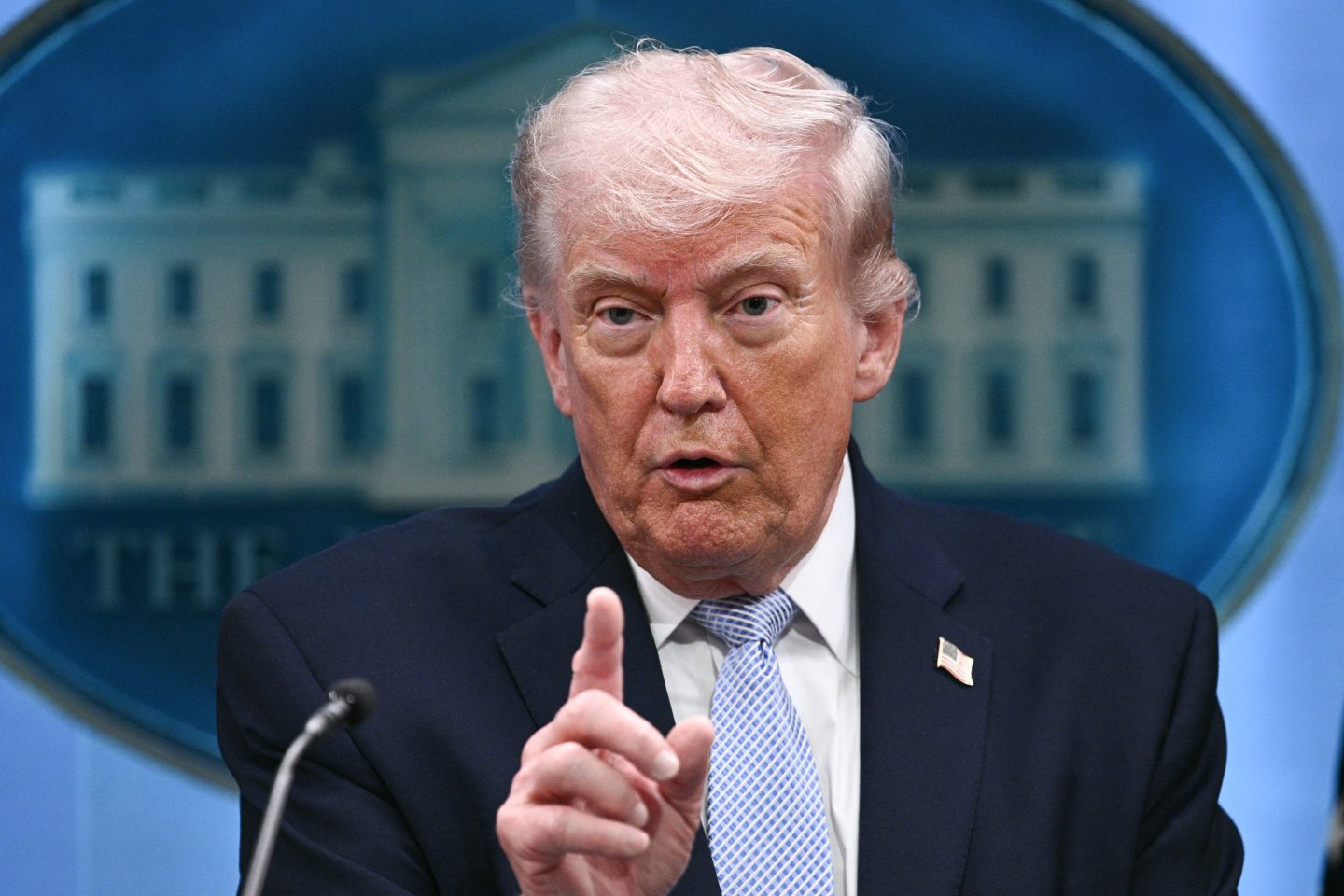
Global investors heaved a sigh of relief Friday at the sight of Donald Trump and Chinese vice premier Liu He shaking hands in the Oval Office. The two men, all smiles, announced a preliminary partial trade deal, which Trump said could be finalized as early as next month when he meets with Chinese president Xi Jinping in Santiago, Chile.
The bonhomie of the White House meeting belied the narrow scope—and vague terms—of the U.S.-China trade bargain.
Friday’s “deal,” as described by the White House, calls for the U.S. to suspend an increase to 30% (up from the current 25%) in the tariff rate on $250 billion of Chinese imports that were slated to take effect Tuesday. In exchange, China pledged to increase purchases of U.S. agricultural products by $40-50 billion and adopt new measures on intellectual property, currency and financial services.
Trump touted the pared-down pact as a “substantial phase one deal” designed to provide immediate relief for American farmers and businesses caught in the crossfire of the escalating U.S.-China trade war. He promised bigger and better deals to come.
That’s a stark reversal from Trump’s previous position that he would only accept a single, comprehensive trade agreement with China. And Friday’s accord fell far short of Trump’s campaign vow to force a sweeping transformation of the U.S.-China economic relationship.
In the U.S., many China experts noted the dearth of written information about Friday’s agreement. Some questioned whether anything had been agreed at all. “Wait until you see something in writing before you start making new plans,” attorney Dan Harris warned corporate clients on his firm’s widely read China Law Blog. The headline on Harris’s post dismissed Friday’s announcement as an “Alleged Micro-Deal That Does Not Mean a Thing for Most.”
Chinese analysts speculated Trump’s new willingness to accept a partial deal reflects a recognition that calls for his impeachment at home have diminished his negotiating leverage abroad.
Richard McGregor, senior fellow at Australia’s Lowy Institute, suggests in this Washington Post essay that, since Trump’s over-the-top May 5th Twitter tantrum, Xi has written off his U.S. counterpart as irrational and irrelevant—and is hunkered down, waiting to cut a deal with a more stable successor.
Meanwhile, an excellent new book by my friend and former Washington Post colleague Paul Blustein offers a timely reminder that, whatever one thinks of Trump’s China strategy, seeds of the current conflict were sown during the presidency of George W. Bush.
Paul argues that, only two years after China’s 2001 accession to the World Trade Organization, the Chinese government, led by president Hu Jintao and premier Wen Jiabao, lurched away from the market-oriented reforms championed by predecessors Jiang Zemin and Zhu Rongji and embraced instead a policy of “state capitalism” relying on tighter and more efficient control over giant state-owned enterprises. China began forcing foreign firms to surrender technological know-how as the price of entry to China’s vast market.
The shift to state capitalism has gained momentum under Xi. But Paul faults Bush’s China team, led by treasury secretary and former Goldman Sachs banker Henry Paulson, for failing to recognize the significance of this policy change early on. Paul suggests Paulson chose not to confront China for flouting rules of the global trading system partly because he thought it a temporary aberration, but also because he needed China’s help to cope with the global financial crisis.
Paul concludes that Trump might have remedied the negligence of China policies under both Bush and Obama administrations by revitalizing the WTO and seeking tighter alignment with America’s other trade partners. Instead, Trump has done exactly the opposite.
More China news below.
Clay Chandler
– Clay.Chandler@Fortune.com
– @ClayChandler
Innovation and Tech
Apple and Hong Kong. Apple Inc. CEO Tim Cook defended his company's removal of a Hong Kong protest-mapping app, HKmap.live, from the App Store, doubling down after attracting bipartisan criticism from U.S. lawmakers for the decision. Cook wrote in an email to Apple employees that Apple received "credible information" from Hong Kong's cybersecurity bureau that the app was being used to target police officers and "victimize individuals and property." The app's anonymous developers refuted the claims on Twitter. Fortune
TikTok troubles. Short-video app TikTok denies U.S. Sen. Marco Rubio's allegation that it is censoring content on its platform under pressure from the Chinese government. The hugely popular app is owned by Beijing ByteDance, a Chinese company, and Rubio wants the U.S. Treasury Department to investigate ByteDance's 2017 acquisition of the startup that later spawned TikTok in 2018. TikTok says it adheres to U.S. laws and its team functions independently from China, though the Guardian published a leaked document last month appearing to show evidence of TikTok censoring content deemed sensitive by the Chinese government. Abacus News
Gaming wars. The founder and CEO of Fortnite-creator Epic Games, jumped into the Activision Blizzard controversy, tweeting that his company supports free speech, in response to Blizzard's punishing of a player who voiced support for the Hong Kong protests, and predictably attracted the ire of patriotic Chinese commentators online. Epic's stance is surprising in an atmosphere where many American companies have bowed to pressure from China on political matters—especially given that Chinese gaming giant Tencent has a 40% stake in Epic (not to mention a 5% stake in Blizzard). But Epic's pronouncement also comes at a time when U.S. customers are starting to pay attention to how U.S. firms self-censor for their Chinese markets—Blizzard faced backlash in the U.S. for its punishment of the pro-Hong Kong player, and the ongoing NBA scandal is alarming American fans too. Abacus News
Economy and Trade
A glimmer of hope. The U.S. and China have agreed on a partial trade deal after two days of talks in Washington D.C. and 15 months of trade war volleys. As part of the "Phase One" agreement, the U.S. will suspend a tariff hike scheduled for Tuesday that would have targeted $250 billion in Chinese imports, and China will buy $40-50 billion in U.S. farm products. Previous rounds of talks failed in May and June. Fortune
Opening up. China is scrapping restrictions on foreign ownership of mainland-based securities, futures, and mutual fund management companies in 2020. The move will open up the Chinese securities markets to foreign investors: before the lift on limits, holdings were capped at 49%, but now foreign investors will wholly own their businesses in China. The relaxation is by analysts as a sign that Beijing is accelerating efforts to open up China's financial sector to offset the economic slowdown caused by the U.S.-China trade dispute. South China Morning Post
Walking on eggshells. Chinese president Xi Jinping heads to Nepal this weekend, marking the first visit in 23 years by a Chinese president to the mountainous Asian nation. Xi will meet Nepalese officials to discuss a $2.75 billion trans-Himalayan infrastructure deal, part of China's Belt and Road Initiative, that will expand routes between the two countries. Xi's Kathmandu trip follows his visit to India, where he meets with prime minister Narendra Modi amid heightened India-China tensions over shared borders, Kashmir, and Pakistan. India also has reservations about the Belt and Road Initiative, chiefly regarding the China Pakistan Economic Corridor project. CNN
In Case You Missed It
Wall Street Has Doubts After Partial Trade Deal CNBC
China Loses a Tech Generation as the Big Payoff Promise Fades Bloomberg
How Protesting a Facebook Suicide Turned a Coder Into a Chinese Folk Hero Fortune
With Xi in Its Corner, the Nike of China Wants to Go Global Bloomberg
Apple Has a Lot to Lose If It Crosses China's Party Bosses Associated Press
Politics and Policy
B-ball backlash. The L.A. Lakers and the Brooklyn Nets are set to play their second preseason game in China this week on Saturday in the southern metropolis of Shenzhen. If all goes well the game will be an uneventful cap on the NBA's week from hell, which started when Houston Rockets manager Daryl Morey tweeted a message in support of the protests in Hong Kong and set off a firestorm of patriotic fury in mainland China. The NBA, which has millions of Chinese fans, has already lost its official brand partners in China, and Rockets merchandise has been wiped from online stores there. With government officials in both the U.S. and China waiting on the NBA's next response, it's unlikely that the brouhaha will die down, even if the Shenzhen game goes smoothly. Bloomberg
Hong Kong protests. Hundreds of people in face masks, many of them office workers on lunch break, filled Hong Kong's central business district on Friday to protest the government's anti-mask law and express their anger over an alleged sexual assault by police officers on a university student. The city, still recovering from a long weekend of unrest and vandalism that left its usually flawless metro system semi-paralyzed for days, will likely see more protests this weekend, though a Friday night protest saw smaller crowds than the week before. South China Morning Post
This edition of CEO Daily was edited by Naomi Xu Elegant. Find previous editions here, and sign up for other Fortune newsletters here.