• Home
  • News
  • Fortune 500
  • Tech
  • Finance
  • Leadership
  • Lifestyle
  • Rankings
  • Multimedia
inverted yield curve

An Inverted Yield Curve, a Predictor of Recessions, Has the Stock Market Spooked

By
Kevin Kelleher
Kevin Kelleher
Down Arrow Button Icon
By
Kevin Kelleher
Kevin Kelleher
Down Arrow Button Icon
December 4, 2018, 7:45 PM ET

For the first time in a while, stock market investors are being spooked this week by what’s happening in the bond market. And the reason has something to do with an occurrence that is not exactly in the everyday investor’s lexicon: an inverted yield curve.

Put simply, an inverted yield curve happens when bond yields at the short end of the bond spectrum rise above those at the long end. Usually, the bond market focuses on the difference between the yields on U.S. Treasury two-year notes and those for 10-year notes. When the yield curve inverts, it means the two-year notes pay bondholders more in interest than 10-year notes do, something that’s both rare and counterintuitive.

For economists and investors, it’s a loud warning about the economy’s outlook. One portfolio manager called the inverted yield curve a “harbinger of doom.” It has a scarily accurate track record of predicting economic recessions, which in past decades have arrived six months to two years after an inversion.

“Every U.S. recession in the past 60 years was preceded by a negative term spread, that is, an inverted yield curve. Furthermore, a negative term spread was always followed by an economic slowdown and, except for one time, by a recession,” Michael Bauer and Thomas Mertens, two Federal Reserve research advisors in San Francisco, wrote in a March paper.

And while interest rates have been unusually low for most of the past decade, Bauer and Mertens believe the prophetic power of the inverted curve still applies. “While the current environment is somewhat special—with low interest rates and risk premiums—the power of the term spread to predict economic slowdowns appears intact,” their paper said.

Typically, the yield curve slopes upwards over time, especially in times of strong economic growth. That’s because the longer it takes a bond to mature, the higher the yields investors demand as a protection against inflation. But long-term bond yields have been lower this year, amid concerns about the U.S. economic outlook in coming years. Meanwhile, the Fed has pushed short-term interest rates up, bringing them closer to—and now, in some cases, above—longer-term yields.

The difference between the two-year and the 10-year Treasury yields hasn’t yet inverted, although it has flattened to 11 basis points—that is, 11 hundredths of a percent—from 25 basis points last Wednesday. But on Monday, the yields on five-year Treasury notes fell below those on three-year notes, an inversion that hasn’t happened since 2007.

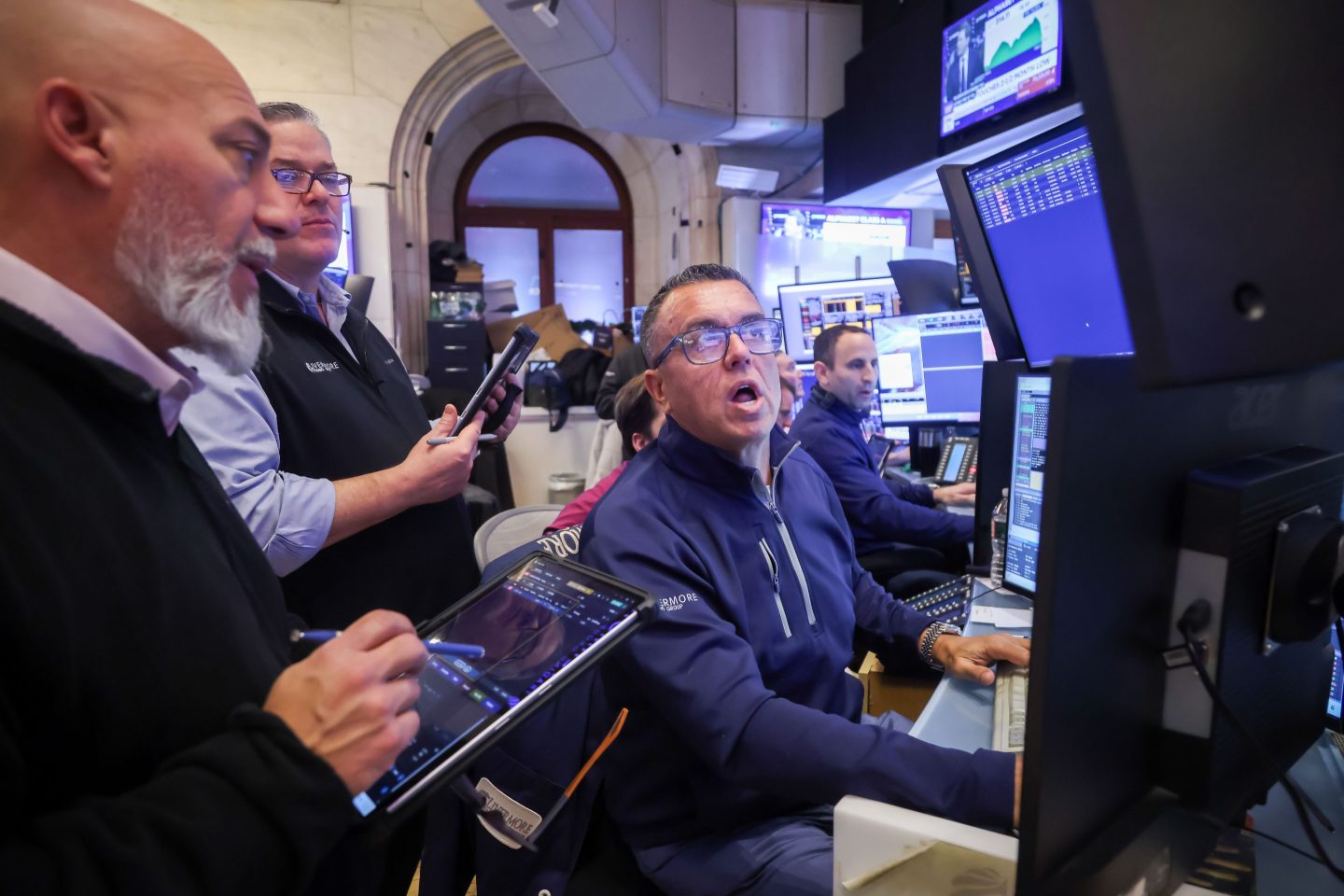
That hardly ensures that a recession is coming, let alone one as severe as the Great Recession a decade ago. But it has the bond and stock markets both worried that the classic two-year/10-year inversion is also coming. On Tuesday, the Dow Jones Industrial Average fell nearly 800 points, or 3.1%, largely in response to recession fears stoked by recent changes in the yield curve.

That the lower portion of the yield curve has inverted amid signs that the global economy is slowing is especially worrisome. Many market participants are now watching to see how the Fed reacts to that inversion, along with whether the two-year and 10-year yields will also invert.

“My bigger-term thought is the curve has to invert, and it’s going to happen sooner than people think. If twos and tens invert between now and Dec. 18, the Federal Reserve is going to have to take out some of the hikes next year—or they should do it,” Joseph Lavorgna, chief U.S. economist at Natixis, told Reuters. “I’m worried that they won’t.”

About the Author
By Kevin Kelleher
See full bioRight Arrow Button Icon

Latest in

Trump
PoliticsWhite House
‘We fixed inflation, and we fixed almost everything’: Trump travels to Pennsylvania to talk affordability while denying it’s a problem
By Josh Boak and The Associated PressDecember 4, 2025
56 seconds ago
Bear
RetailTariffs and trade
Build-A-Bear stock falls 15% as it reveals the real hit from tariffs, at last
By Michelle Chapman and The Associated PressDecember 4, 2025
10 minutes ago
Brown
Politicsdiscrimination
Trump administration shows a pattern of firing Black leaders across government, former Transportation officials claim
By Josh Funk and The Associated PressDecember 4, 2025
14 minutes ago
Erika Kirk
PoliticsMedia
Bari Weiss to moderate prime-time ‘town hall’ with Erika Kirk on CBS News
By The Associated PressDecember 4, 2025
17 minutes ago
Zoe Rosenberg
LawCrime
Gen Z activist gets jail time for liberating chickens from Perdue plant in Northern California
By The Associated PressDecember 4, 2025
20 minutes ago
Gen Z
EconomyGen Z
America, meet your alienated youth: ‘Gold standard’ Harvard survey reveals Gen Z’s anxiety and distrust, defined by economic insecurity
By Nick LichtenbergDecember 4, 2025
21 minutes ago

Most Popular

placeholder alt text
Economy
Two months into the new fiscal year and the U.S. government is already spending more than $10 billion a week servicing national debt
By Eleanor PringleDecember 4, 2025
9 hours ago
placeholder alt text
North America
Jeff Bezos and Lauren Sánchez Bezos commit $102.5 million to organizations combating homelessness across the U.S.: ‘This is just the beginning’
By Sydney LakeDecember 2, 2025
2 days ago
placeholder alt text
Economy
Ford workers told their CEO 'none of the young people want to work here.' So Jim Farley took a page out of the founder's playbook
By Sasha RogelbergNovember 28, 2025
6 days ago
placeholder alt text
Success
‘Godfather of AI’ says Bill Gates and Elon Musk are right about the future of work—but he predicts mass unemployment is on its way
By Preston ForeDecember 4, 2025
5 hours ago
placeholder alt text
North America
Anonymous $50 million donation helps cover the next 50 years of tuition for medical lab science students at University of Washington
By The Associated PressDecember 2, 2025
2 days ago
placeholder alt text
Economy
Scott Bessent calls the Giving Pledge well-intentioned but ‘very amorphous,’ growing from ‘a panic among the billionaire class’
By Nick LichtenbergDecember 3, 2025
1 day ago
Rankings
  • 100 Best Companies
  • Fortune 500
  • Global 500
  • Fortune 500 Europe
  • Most Powerful Women
  • Future 50
  • World’s Most Admired Companies
  • See All Rankings
Sections
  • Finance
  • Leadership
  • Success
  • Tech
  • Asia
  • Europe
  • Environment
  • Fortune Crypto
  • Health
  • Retail
  • Lifestyle
  • Politics
  • Newsletters
  • Magazine
  • Features
  • Commentary
  • Mpw
  • CEO Initiative
  • Conferences
  • Personal Finance
  • Education
Customer Support
  • Frequently Asked Questions
  • Customer Service Portal
  • Privacy Policy
  • Terms Of Use
  • Single Issues For Purchase
  • International Print
Commercial Services
  • Advertising
  • Fortune Brand Studio
  • Fortune Analytics
  • Fortune Conferences
  • Business Development
About Us
  • About Us
  • Editorial Calendar
  • Press Center
  • Work At Fortune
  • Diversity And Inclusion
  • Terms And Conditions
  • Site Map

© 2025 Fortune Media IP Limited. All Rights Reserved. Use of this site constitutes acceptance of our Terms of Use and Privacy Policy | CA Notice at Collection and Privacy Notice | Do Not Sell/Share My Personal Information
FORTUNE is a trademark of Fortune Media IP Limited, registered in the U.S. and other countries. FORTUNE may receive compensation for some links to products and services on this website. Offers may be subject to change without notice.