HTC sees a future in virtual realty that is broader than just involving video games and Hollywood. It is banking on companies wanting to use the emerging technology for tasks like training forklift drivers to transport cargo in warehouses or designing virtual homes that people can scope out in VR prior to construction.
That’s the focus of HTC’s new Vive Pro 2.0 Kit, which costs $1,399 and includes the new Vive Pro HMD VR headset, two revamped base stations for tracking movements, and two controllers. HTC released the Vive Pro VR headset, which costs $799, earlier in April. Companies will be able to buy the new Vive Pro 2.0 Kit, which costs $200 more than HTC’s previous VR bundle for businesses, as of Monday via HTC and other retailers.
HTC’s older VR headset, Vive, was geared to video gamers looking to race cars in digital worlds. The company is taking a different strategy with the Vive Pro, based on what it’s learned since the Vive premiered in 2016, HTC executives explained.
Adoption of virtual reality has been limited by the cost of pricey headsets as well as the beefy computers required to power them. But while the average consumer may not be able to spend big money on VR gear, HTC believes corporations have the cash to do so, if they believe VR can help their business and save money on things like workplace safety training and maintenance.
Some recent examples of companies using VR technology include Farmers Insurance, which is using Facebook’s Oculus Rift headsets to train its claims adjusters and PG&E, which also uses the Rift headset to help train workers in inspecting electrical equipment.
Over the past few years, HTC also has been courting businesses and has landed some big-name customers like Volkswagen, which uses the Vive headset to immerse car shoppers in virtual showrooms.
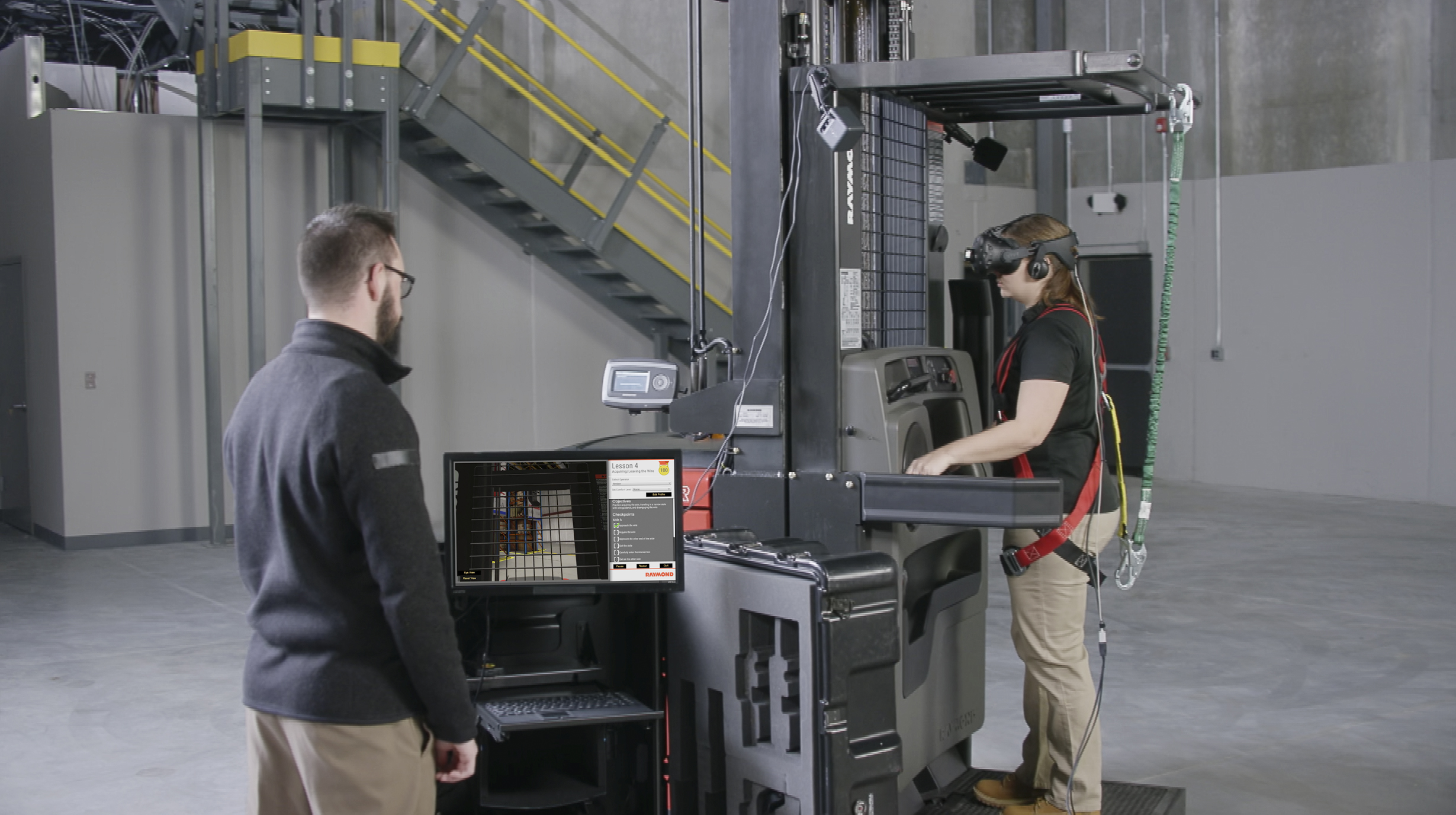
Forklift manufacturer Raymond Corporation currently uses the older HTC Vive to help companies train forklift drivers. Raymond, with the help of VR software company FreeRangeXR, created virtual reality forklift tutorials in which trainees sit inside a real forklift while wearing the VR headsets, said the company’s CEO Michael Field.
Instructors can see what the trainee sees on a separate computer screen, and help guide them while they do tasks like learn how to maneuver around people inside a virtual environment. The experience teaches forklift-driving skills without putting people in danger.
The VR forklift tutorials also let people experience what it’s like to be hoisted 30 feet up in the air, which can happen when operators must place cargo in high-up locations, Field said.
“It’s a little unnerving if they aren’t good at heights,” Field said of the task. With VR, however, trainees can get more easily acclimated to the feeling of being high above the ground because it “really gives you the full sensation,” he said.
“I cannot force myself to step off the truck,” Field said of VR’s immersive nature.
HTC Vive North America general manager Daniel O’Brien said that the company’s newest Vive Pro VR headset was specifically designed for corporate use, based on feedback from current customers.
Automakers, for example, wanted VR headsets with better resolution and visuals so that people could better see the icon on a dial of a virtual car, O’Brien said. Customers also wanted the bulky headsets to be more comfortable, which is important considering that some users could spend up to two hours using VR, he explained.
Although O’Brien concedes that consumers probably want VR headsets to display better graphics and be more comfortable, the new VR kit has a couple features specifically intended for businesses. One such feature includes software for IT managers to track and manage multiple Vive headsets behind corporate firewalls. Another feature is the ability to track a person’s movements within a 33-foot by 33-foot area when connecting multiple base stations.
O’Brien said that one automaker, Daimler, told him that it was difficult for people to look at a virtual car from all angles when limited to a 15 foot by 15 foot area like the Vive Pro’s predecessor. Customers should be able to “look at [the car] from a distance and walk to it,” he said, which makes for a more lifelike experience. It should be noted that companies will have to buy two more additional base stations if they want that maximum 33-foot by 33-foot area.
HTC is also selling newer versions of its enterprise service agreements, with the basic one starting at $199 that includes a two-year warranty. Another version that costs $299 includes the ability for companies to immediately receive replacement parts, like new controllers, without having to ship the broken ones back to HTC before they can be replaced, O’Brien said.
O’Brien declined to disclose details about HTC’s overall VR revenue or how much money its enterprise business brings in. He would only say that shipments of VR headsets to corporate customers have grown 200% quarter-by-quarter over the past year.
An HTC spokesperson said that the company wants to grow its enterprise business to represent 30% of its total VR revenue by 2020, which means video gamers would still account for the bulk of VR sales.
Get Data Sheet, Fortune’s technology newsletter.
When HTC first debuted its original Vive VR headset two years ago, it only had 15 employees working in North America, the spokesperson said. Now, HTC has about 100 people working in its North American Vive business.
It’s likely that video gamers wanting the next gadget will be most interested in the company’s latest VR headset. But HTC “really built it for the enterprise,” he said of the Vive Pro.
“That’s why we actually called it the Pro,” O’Brien said.