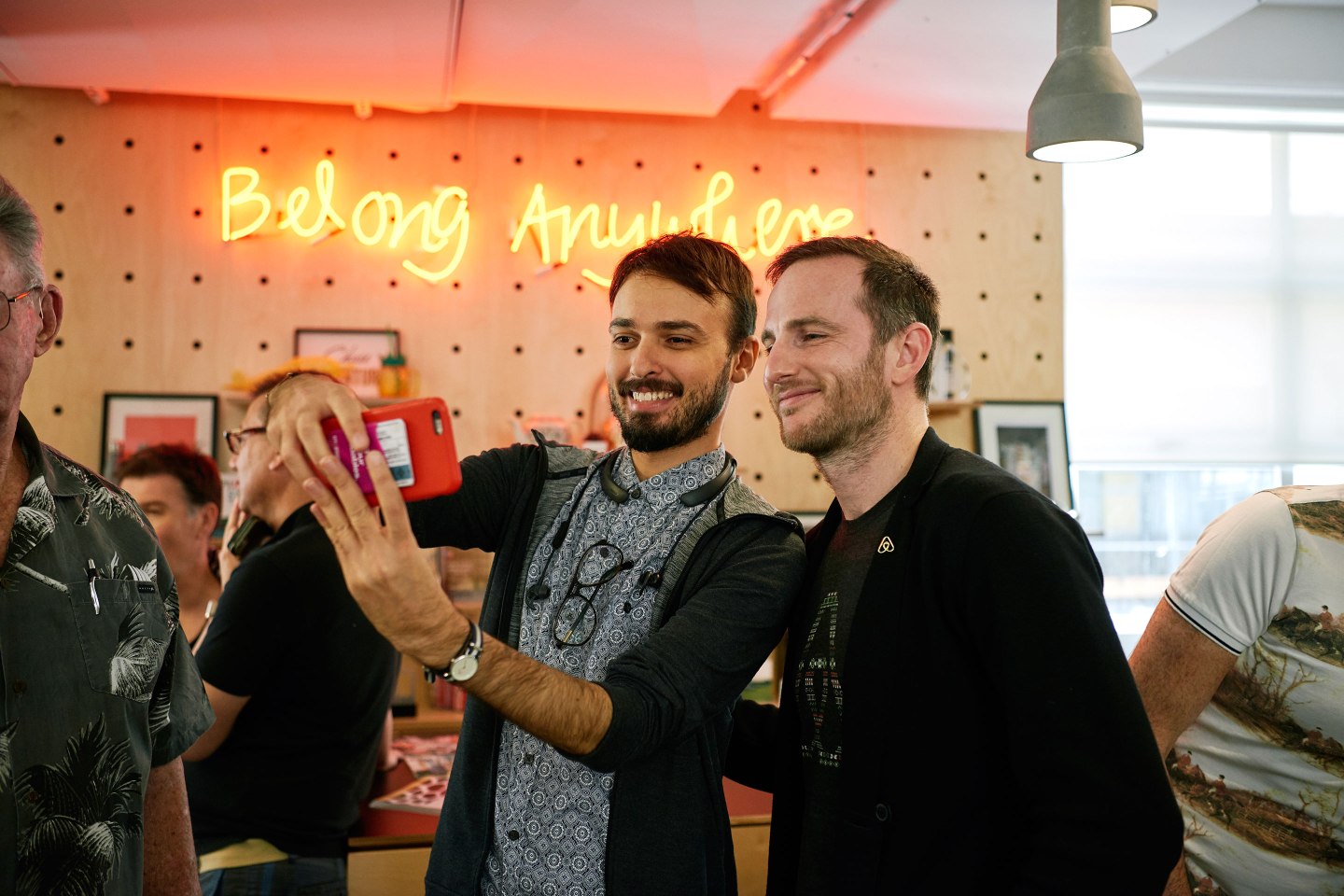
In a Q&A, Airbnb cofounder Joe Gebbia explains how the sharing-economy powerhouse ‘dog-foods’ to better understand its customers and why great design cultures never really fail.
Few companies have emphasized the importance of design thinking as much as Airbnb. Two of the San Francisco startup’s three cofounders, chief product officer Joe Gebbia and CEO Brian Chesky, are graduates of the Rhode Island School of Design (RISD)—a biographical detail that turned off some investors at first but turned out to be a big advantage for the sharing-economy giant, now valued at $31 billion by investors. We spoke with Gebbia, who also serves as head of Samara, the company’s in-house design and innovation studio, about his approach to design.
FORTUNE: What does “design thinking” mean to you?
Gebbia: To me, design thinking is another way of saying empathize with the customer. It’s consideration for the person you’re designing for. That’s all it is. What it means is you’re going to spend the time and the effort to understand the needs of the person you’re designing for such that you can create something that’s valuable to them. This is an old lesson from RISD when I was on a team working on a medical device. Through our research, we went out and talked to doctors and nurses and patients, but the big aha moment was when we actually had the existing solution applied to us, and we lay down on the hospital bed and got to experience what it was like to be the patient. It was this design principle, “Be the patient.” Go as far as you possibly can to see the world through the eyes of the person you’re designing for.
There’s also a Part 2, which is applying your own point of view to the world. Design thinking does not mean design by committee. It does not mean that you write down every feature request or every complaint that a customer has and just transmit that into a one-to-one match. So Part 2 is, you come back to your studio or your place of creation and combine what you learned with your own point of view and your own creativity and your own imagination as a designer. The term I use for this is “enlightened empathy.” And talking to somebody does not mean sending them a link to a survey. Digital communication is completely different from in-person, face-to-face conversations. One will give you surface insights and the other really gives you depth.
You also talk about “dog-fooding.” What’s that?
Dog-fooding is using your own products so that you understand from inside out what it is you’re providing the customers. It’s another way to gain insights and to gain intelligence. You use it yourself; you eat your own dog food. Every time we do that, we discover something that we can improve. It’s one reason why we highly encourage our team members to be hosts, and why we give out travel stipends to every employee inside the company. Everybody comes back with, “Oh yeah, I tried to search, and I found this bug.” Or “I really want to see this information as I’m driving to my Airbnb.”
What goes into building a creative environment?
One thing in particular to Samara is that the word “failure” is not allowed. And the reason is that failure is not actually a thing. It’s such a misconception. There is an action that takes place, and you get a result that you want or that you don’t want. And then you label that with whatever you want. And if you get a result that you didn’t want, some people label that as a failure. You can do that if you want to; or you can choose to label it as an incredible learning moment. The fact that you just figured out one less path to go down in order for us to achieve the goal that we’re after, well, thank you for that. Thank you for eliminating more paths. Cross it off the list, and we can now get to where we want to go quicker.
See the full Business by Design list here.
So many companies are now seeking to apply design thinking. What advice would you give to a big company seeking to do that if it doesn’t naturally have design DNA?
I think they need to hire more designers. I think they need to hire design executives. And I think that the leadership or the founders or the CEO or whoever’s running the company needs to go through some kind of crash course in the value of design. Because if the leader of the company doesn’t get it, then nothing else you can do really matters. There needs to be an executive sponsorship of design philosophy. If design is unfamiliar to them, I would recommend a weeklong workshop at either the d. school at Stanford on the West Coast or RISD on the East Coast. They both have executive programs to help leaders grasp the nature of design, the value of design, so that they can be more informed and more conscious about design.
Can you name a company you admire designwise?
I think Pixar’s done an amazing job integrating art and science. They really get this idea that art and engineering work side by side.
Has the thinking about design changed in the corporate world?
The good news is that there has been an incredible shift in investors’ mindset on the value of design. And so even the people that leaders are sometimes beholden to, they are now getting it in a way that 10 years ago, trust me, they didn’t. Because we met with them and they rejected us, because they didn’t understand the value of design. But I feel like we, along with many of our contemporaries, have proven that design is a differentiator, that design can help you expand your business, that design is a critical component.
One last question: How would you design, say, an IPO differently?
We’ll leave that one on the whiteboard. It’s up to somebody else to rethink that whole process.
A version of this article appears as part of our “Business by Design” package in the Jan. 1, 2018 issue of Fortune.