Snapchat’s name didn’t come up during Mark Zuckerberg’s address at Facebook’s annual developer conference on Tuesday, but the company’s presence was still felt regardless, since Facebook’s strategy consists largely of colonizing the ground already staked out by its smaller competitor.
This became immediately apparent even before the Facebook CEO started his keynote, when Snapchat’s parent, Snap Inc., announced that it had added 3D “lenses” or filters to its Snapchat app, which lets users add virtual elements like rainbows to real-world locations.
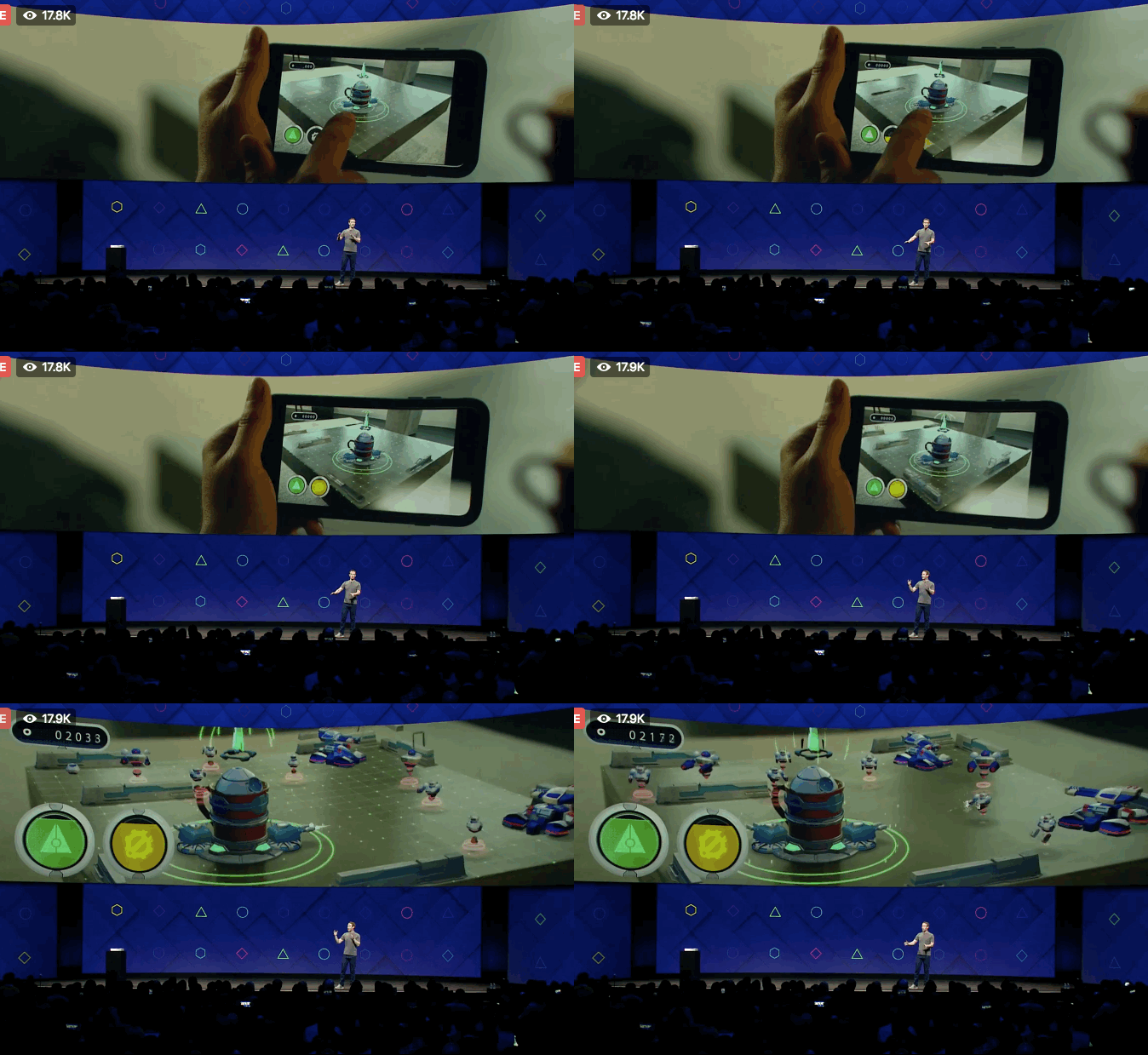
Just hours after that news broke, Zuckerberg announced that Facebook was rolling out similar 3D add-ons that combine the real world and the virtual, including ways of adding animated effects to real objects. Plants can be given virtual flowers, 3D games can be played on real tabletops, and virtual notes can be left in real locations.
The key insight behind all of this, the Facebook CEO said, is that augmented reality’s near future is one in which smartphone cameras are the key interface, not the bulky headsets or eyeglasses used for full-scale virtual reality.

This fixation on smartphone cameras sounds very much like the gospel that Snap Inc. has been preaching for some time, even before it went public in a hotly anticipated $25-billion initial public offering last month. Snap has been referring to itself as “a camera company” rather than a messaging app since it first filed its IPO documents, something that many observers seemed confused by.
What has become increasingly clear is that Snap doesn’t mean “camera company” in the sense of GoPro, the maker of wearable cameras that has lost much of its early luster, or Kodak. Instead, it means a company whose primary user interface is the camera, and everything that can be done with it.
Get Data Sheet, Fortune’s technology newsletter.
Snap’s goofy “lenses” and filters, which let users make themselves look like dogs or cats, or add simulated rainbows pouring out of their mouths, looked a lot like meaningless baubles to many, but they were just the beginning. Both Snap and Facebook clearly see them as the early building blocks of an interface for augmented reality.
Facebook has already duplicated virtually every one of Snap’s significant features, including the Stories function that lets users create collections of photos and videos (which it has added not just to Facebook but to Instagram and WhatsApp as well) and the filters and lenses features that add animated effects. Now, the giant social network has made no secret of the fact that it is going after the smaller company’s future roadmap as well.
Going head-to-head with a behemoth like Facebook isn’t easy, which could help explain why Snap’s share price has weakened substantially since its IPO (it is down by more than 25% from the peak it hit after the share issue). After all, Zuckerberg’s empire has a market value that is 15 times larger, and has an audience of more than 1.8 billion.
At the same time, however, Snapchat and Facebook are very different animals. Even Snapchat and Instagram, despite their many similarities, are different in some fundamental ways. For Facebook, everything is about public or semi-public sharing, whether it’s photos or videos or augmented reality games.
Snapchat, by contrast, doesn’t focus on public behavior at all. There isn’t even any way to share a Snap photo or video or story outside the service (or at least not easily), nor is there any way to track how many people have seen it or liked it or commented on it—things that Facebook and Instagram and many of their users are obsessed with.
That raises at least the possibility that Snap and Facebook could develop along very similar lines when it comes to augmented camera-based reality features, with one using them for public purposes and the other for private ones. How investors—not to mention users—wind up valuing those two very different approaches remains to be seen.