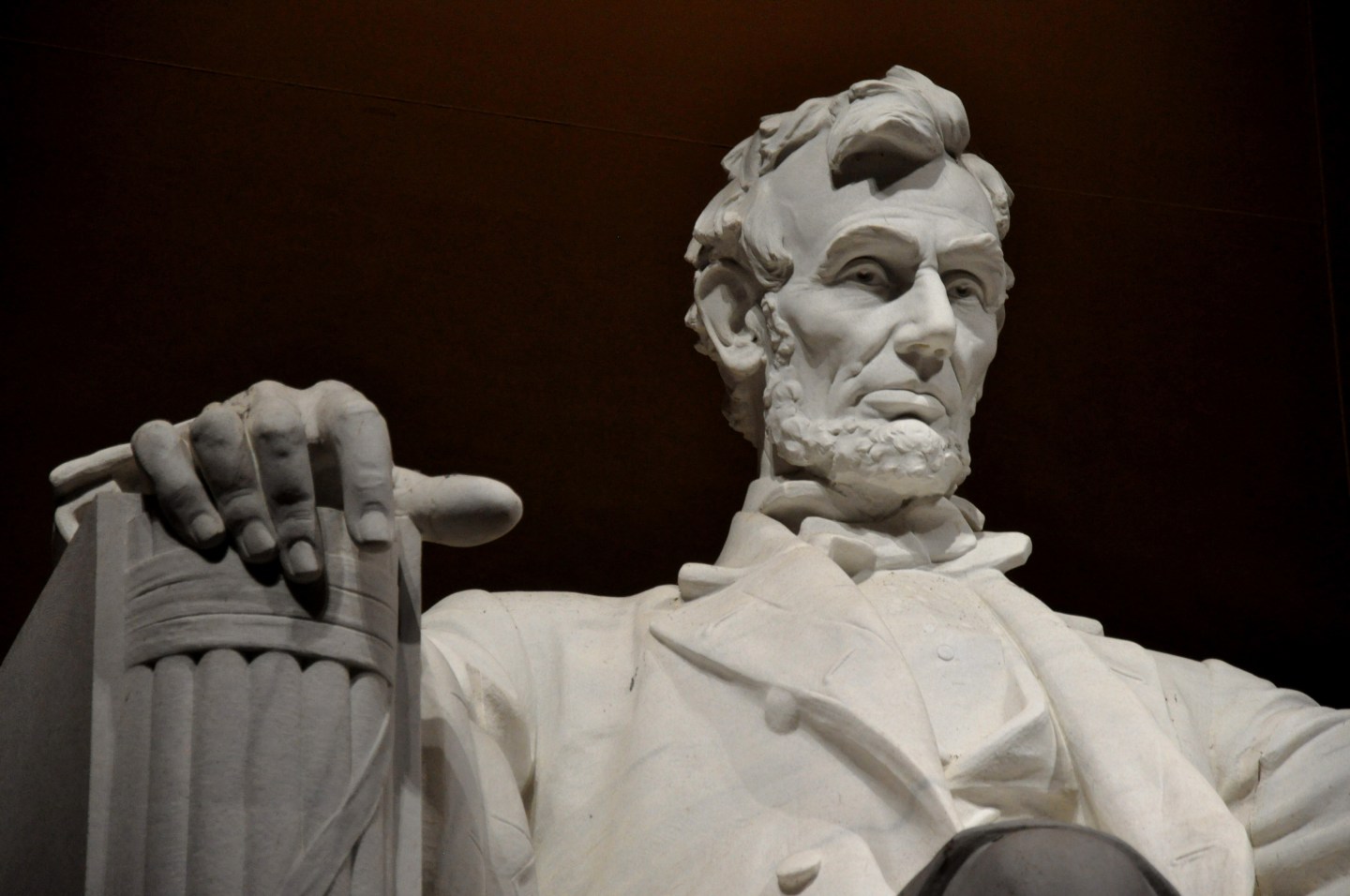
For his January 20 inaugural address, Donald Trump has indicated that he plans to combine elements of Ronald Reagan’s optimism with Jack Kennedy’s sense of mission. It would be a fine thing if he also based his time in office on a number of the finest accomplishments of Abraham Lincoln’s administration, with regards to infrastructure, immigration, education, innovation and politics.
Infrastructure
In 1862, the second year of Lincoln’s presidency, Lincoln signed into law the Pacific Railroad Act, which gave the Central Pacific and the Union Pacific Railroad companies Federal charters to build a transcontinental railroad to link the United States from coast to coast. Abraham Lincoln was a hands-on President. He told the head of the Union Pacific “The road must be built and you are the man to do it. By building [it], you will be the remembered man of your generation.” The transcontinental railroad transformed the United States.
Trump had pledged to invest $1 trillion to upgrade the nation’s roads, bridges, tunnels and airports, but he should look beyond potholes and have a vision of a grand accomplishment that will be celebrated in future history books. Perhaps it will take the form of high-speed rail linking cities, or intelligent highways and vehicles (that dramatically reduce the annual automobile death rate and shorten driving times), or state-of-the-art airports. Trump said during the debates, and few would argue with him: “Our airports are like from a third-world country.” In fact, America’s top airport ranks 28th worldwide in quality. And China is building 66 new airports over the next 5 years.
Immigration
Lincoln was strongly pro-immigration. He said “I regard our immigrants as one of the principal replenishing streams which are appointed by Providence to repair the ravages of internal war and its wastes of national strength and health.” Yes, the times and needs today are different than they were then, but Lincoln’s attitude is still relevant today. America’s current needs demand a response. America must continue to be the best place on earth in which individuals can excel and reach their full potential. In August, Trump in a speech in Phoenix backed “shifting legal immigration from extended-family reunification, mostly of low-skill immigrants, and setting aside many more places for high-skill immigrants “based on merit, skill and proficiency.” While compassion dictates that provision be made for families, attracting high-skilled contributors to come to this country is imperative if American is to be internationally competitive, and economic growth is to reach the targets that Trump has set. An immigration act should be high on the list of priorities for the first 100 days.
Education
On July 2, 1862, Lincoln signed into law the Morrill Act providing grants of federal land that supported the creation of 69 institutions of higher learning including Cornell University and MIT. While the U.S. university system is still among the best in the world, there are causes for concern. R&D spending is not keeping pace with national needs (see below), and this is a major source of funding for U.S. universities. The Federal government provides about 60% of support for university research, a level that is down dramatically from the 1960s when it was 73%.
The news with respect to the educational attainments of those entering college is not good either. Under a global worldwide exam called PISA (Program for International Student Assessment) that measures capabilities of 15-year-olds in 72 countries, students from the United States are not performing well. In 2015, the U.S. ranked 41st in math, 24th in reading and 25th in science. If the U.S. educational system is not competitive, an improved tax system, confronting currency manipulation, and all the other commitments made by Trump to making the U.S. a premiere place for making things is simply not going to achieve the results Trump seeks. Lincoln placed a high priority on education and signed into law a measure that dramatically changed the place of America in the world. Strong measures are needed now addressing today’s challenges.
Basic science
On March 3, 1863, Lincoln signed a law creating the National Academy of Sciences. He did so during a time when advancing science was essential to the war effort. This is still a time of challenges. There is again a need for action. Relative to the size of the American economy, the US has fallen to 10th place in investment in research and development. At current rates, China will surpass the US in total investment in basic science research by 2019. Today what is needed is not creation of a new Federally-chartered institution but stronger funding for the basic sciences and more emphasis on public-private partnerships for R&D.
Overcoming divisions
The most profound lesson to be derived from Lincoln was his dedication to pulling the country together. One of his most famous utterances was in a speech delivered when he ran for the Senate in 1858, that “a house divided cannot stand.” He was talking about slaves and free men. The divisions are certainly less stark today, but nevertheless of concern. On learning the result of the 2016 elections, Trump in his victory speech said “Now it’s time for America to bind the wounds of division; we have to get together. To all Republicans and Democrats and independents across this nation, I say it is time for us to come together as one united people.”
To fulfill our national purpose, to assure that the country remains secure and prospers, all Americans need to come together, putting partisanship aside, to rebuild the nation’s infrastructure, to make sure that all who can contribute to the nation’s well being are always welcome to these shores from abroad, to support improvements in education and training, and to make sure that the country is on the forefront of science and all learning. The first 100 days can be a start. There is always promise to a new Administration. Now it has to be realized.
Alan Wm. Wolff is a senior counsel at Dentons LLP and Chairman of the National Foreign Trade Council. He is also a National Associate of the National Academy of Sciences. The views expressed here are personal.











