• Home
  • Latest
  • Fortune 500
  • Finance
  • Tech
  • Leadership
  • Lifestyle
  • Rankings
  • Multimedia
Finance

Here’s Why Donald Trump Could Win Ohio and Michigan

By
Chris Matthews
Chris Matthews
Down Arrow Button Icon
By
Chris Matthews
Chris Matthews
Down Arrow Button Icon
August 9, 2016, 4:27 PM ET
Donald Trump
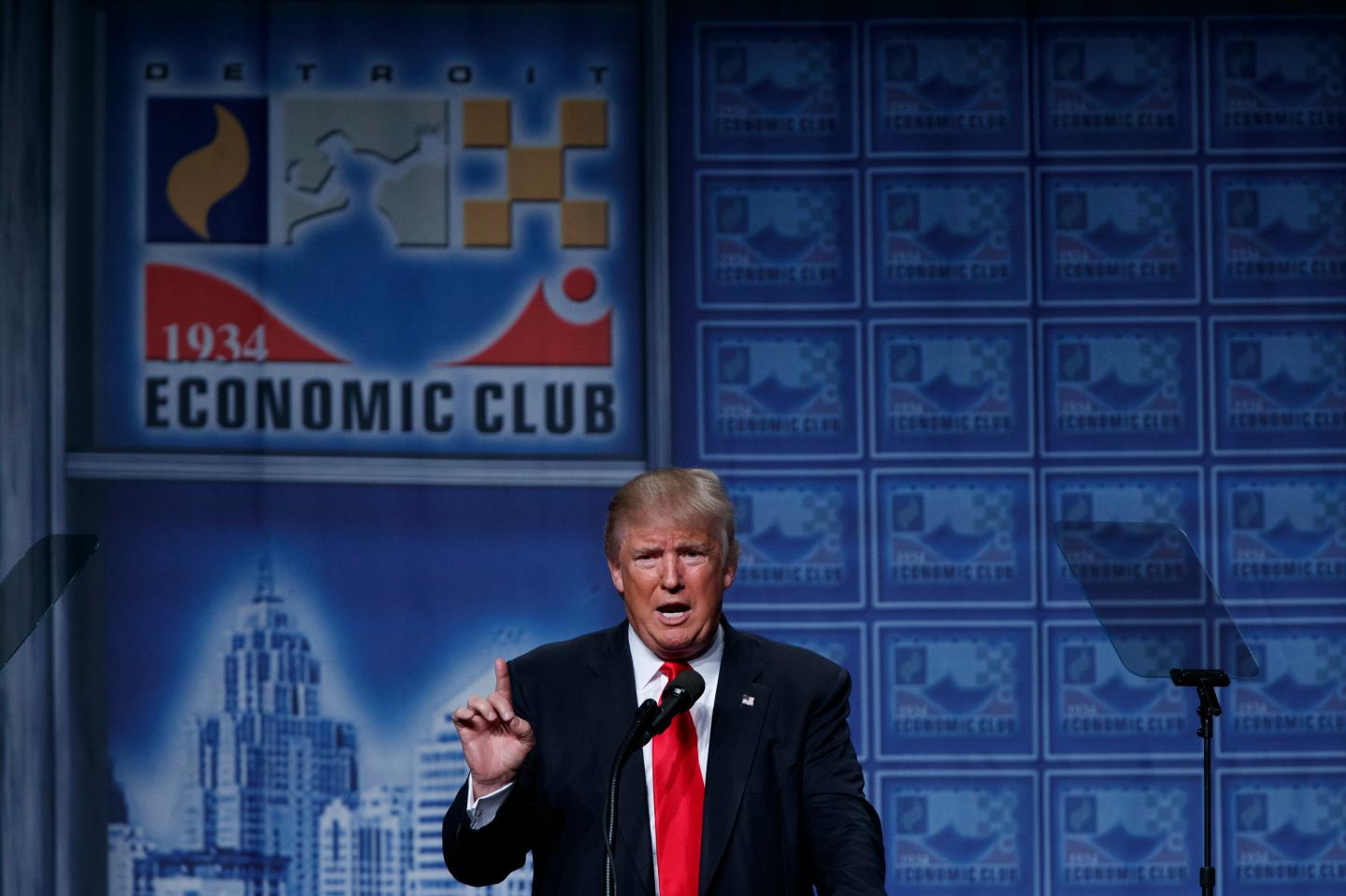
Republican presidential candidate Donald Trump delivers an economic policy speech to the Detroit Economic Club, Monday, Aug. 8, 2016, in Detroit. (AP Photo/Evan Vucci)Evan Vucci — AP

Whoever wins the presidential election, it appears a foregone conclusion that free trade, and potentially big business, will be the big loser.

Sure, Donald Trump has led the charge against agreements like NAFTA, but Hillary Clinton has also adopted an anti-free trade stance after contending with the popularity of that position in her primary battle with Bernie Sanders.

But the narrative that the electorate is pushing elected officials towards trade-skeptical policies doesn’t actually jive with poll numbers, which show that a majority of Americans think that increased trade is good for the economy.

So why have the candidates moved left on trade, even if the electorate has not? Economists Bradford Jensen, Dennis Quinn, and Stephen Weymouth of Georgetown’s McDonough School of Business may have an answer. In a new working paper shared with Fortune, the economists show that international trade “directly influences U.S. presidential elections.” The incumbent party tends to win counties with more highly skilled service sector jobs, not the type that are typically lost to trade, and lose counties in which there is a high concentration of trade sensitive low-skilled manufacturing.

“In national-level models, we show for the first time that increasing imports are associated with decreasing presidential incumbent vote shares,” the authors write. “These effects are large and politically consequential. We find an Electoral College incentive to protect the manufacturing sector and to oppose free trade agreements.”

That’s because the states that happen to be swing states, meaning they are crucial to an electoral-college victory, also happen to be places where there is a high concentration of manufacturing employment, like Ohio, Michigan, Iowa, and New Hampshire. The basic idea is that workers in these sectors have been hurt economically by deindustrialization and have been expressing their anger at this trend by voting against politicians in office. Politicians running for office, whether they are an incumbent or a challenger, try to leverage or blunt this effect by criticizing status-quo trade rules.

But there are also structural forces that work in the favor of greater free trade too. That’s because rising exports can increase jobs, as much as rising imports are killing them in traditional manufacturing sectors. The authors find that workers in high-skilled exportable services and high-skilled exportable manufacturing increasingly vote for the incumbent candidate. This reality, combined with the fact that just 10% of the labor force is now employed in manufacturing, means that there is plenty of electoral support for policies aimed at increasing trade. This support just happens to be more concentrated in non-swing states.

What’s more, as the authors point out, the sectors in the U.S. economy that benefit from more trade, rather than are hurt by it, are rising. For example, services now account for roughly 30% of all exports, and that this number is on the rise. These data explain why poll numbers show most Americans are in support of free trade at the same time that presidential candidates—who are fighting over the support of undecided voters in a few swing states—are increasingly not.

They also explain why, despite protectionism punching above its weight as an issue in presidential elections, there has been little movement on the issue in Congress over the years. Indeed, the last big vote on the free trade issue went free-traders way, when Congress voted to give President Obama fast track authority to negotiate the Trans Pacific Partnership Agreement.

What we are seeing in the 2016 presidential election, therefore, may be the last, dying gasp of protectionism. Sure, those who feel they have been hurt by free trade agreements are probably more motivated by their losses than the benefactors of free trade are motivated by their gains. Like many battles in modern politics, there are benefits to having a very angry minority in your corner as opposed to a majority that is happy, but not ecstatic, with the status quo. But this research out of Georgetown shows that the possible of voters who are angered by free trade is on the decline, and 2016 could be their last stand.

About the Author
By Chris Matthews
See full bioRight Arrow Button Icon

Latest in Finance

Finance
Lorem ipsum dolor sit amet, consectetur adipiscing elit, sed do eiusmod tempor incididunt ut labore et dolore magna aliqua. Ut enim ad minim veniam
By Fortune Editors
October 20, 2025
Finance
Lorem ipsum dolor sit amet, consectetur adipiscing elit, sed do eiusmod tempor incididunt ut labore et dolore magna aliqua. Ut enim ad minim veniam
By Fortune Editors
October 20, 2025
Finance
Lorem ipsum dolor sit amet, consectetur adipiscing elit, sed do eiusmod tempor incididunt ut labore et dolore magna aliqua. Ut enim ad minim veniam
By Fortune Editors
October 20, 2025
Finance
Lorem ipsum dolor sit amet, consectetur adipiscing elit, sed do eiusmod tempor incididunt ut labore et dolore magna aliqua. Ut enim ad minim veniam
By Fortune Editors
October 20, 2025
Finance
Lorem ipsum dolor sit amet, consectetur adipiscing elit, sed do eiusmod tempor incididunt ut labore et dolore magna aliqua. Ut enim ad minim veniam
By Fortune Editors
October 20, 2025
Finance
Lorem ipsum dolor sit amet, consectetur adipiscing elit, sed do eiusmod tempor incididunt ut labore et dolore magna aliqua. Ut enim ad minim veniam
By Fortune Editors
October 20, 2025

Most Popular

Finance
Lorem ipsum dolor sit amet, consectetur adipiscing elit, sed do eiusmod tempor incididunt ut labore et dolore magna aliqua. Ut enim ad minim veniam
By Fortune Editors
October 20, 2025
Finance
Lorem ipsum dolor sit amet, consectetur adipiscing elit, sed do eiusmod tempor incididunt ut labore et dolore magna aliqua. Ut enim ad minim veniam
By Fortune Editors
October 20, 2025
Finance
Lorem ipsum dolor sit amet, consectetur adipiscing elit, sed do eiusmod tempor incididunt ut labore et dolore magna aliqua. Ut enim ad minim veniam
By Fortune Editors
October 20, 2025
Finance
Lorem ipsum dolor sit amet, consectetur adipiscing elit, sed do eiusmod tempor incididunt ut labore et dolore magna aliqua. Ut enim ad minim veniam
By Fortune Editors
October 20, 2025
Finance
Lorem ipsum dolor sit amet, consectetur adipiscing elit, sed do eiusmod tempor incididunt ut labore et dolore magna aliqua. Ut enim ad minim veniam
By Fortune Editors
October 20, 2025
Finance
Lorem ipsum dolor sit amet, consectetur adipiscing elit, sed do eiusmod tempor incididunt ut labore et dolore magna aliqua. Ut enim ad minim veniam
By Fortune Editors
October 20, 2025
Rankings
  • 100 Best Companies
  • Fortune 500
  • Global 500
  • Fortune 500 Europe
  • Most Powerful Women
  • Future 50
  • World’s Most Admired Companies
  • See All Rankings
Sections
  • Finance
  • Leadership
  • Success
  • Tech
  • Asia
  • Europe
  • Environment
  • Fortune Crypto
  • Health
  • Retail
  • Lifestyle
  • Politics
  • Newsletters
  • Magazine
  • Features
  • Commentary
  • Mpw
  • CEO Initiative
  • Conferences
  • Personal Finance
  • Education
Customer Support
  • Frequently Asked Questions
  • Customer Service Portal
  • Privacy Policy
  • Terms Of Use
  • Single Issues For Purchase
  • International Print
Commercial Services
  • Advertising
  • Fortune Brand Studio
  • Fortune Analytics
  • Fortune Conferences
  • Business Development
About Us
  • About Us
  • Editorial Calendar
  • Press Center
  • Work At Fortune
  • Diversity And Inclusion
  • Terms And Conditions
  • Site Map
  • Facebook icon
  • Twitter icon
  • LinkedIn icon
  • Instagram icon
  • Pinterest icon

Latest in Finance

man with glasses stares into camera
CryptoCryptocurrency
Meld raises $7 million to integrate stablecoin networks, build the ‘Visa for crypto’
By Carlos GarciaJanuary 14, 2026
7 hours ago
newman
LawCrime
49-year-old former CEO of camp for sick kids charged with embezzling over $50 million from Paul Newman-founded nonprofit
By Rebecca Boone and The Associated PressJanuary 14, 2026
7 hours ago
Greenland
PoliticsGreenland
Trump demands NATO help with U.S. acquiring Greenland: ‘Anything less than that is unacceptable’
By Emma Burrows and The Associated PressJanuary 14, 2026
7 hours ago
newsom
PoliticsTaxes
‘You are really playing with fire with this one’: California billionaires tax ignites, pitting labor unions and voters against tech execs
By MIchael R. Blood, Michael Liedtke and The Associated PressJanuary 14, 2026
7 hours ago
Personal Financegold prices
Current price of gold as of January 14, 2026
By Danny BakstJanuary 14, 2026
7 hours ago
trump
PoliticsWhite House
‘Jamie Dimon probably wants higher rates. Maybe he makes more money that way’: Trump continues Fed attacks in Detroit visit
By The Associated Press and Nick LichtenbergJanuary 14, 2026
7 hours ago

Most Popular

placeholder alt text
Success
Despite his $2.6 billion net worth, MrBeast says he’s having to borrow cash and doesn’t even have enough money in his bank account to buy McDonald’s
By Emma BurleighJanuary 13, 2026
1 day ago
placeholder alt text
AI
'Godfather of AI' says the technology will create massive unemployment and send profits soaring — 'that is the capitalist system'
By Jason MaJanuary 12, 2026
2 days ago
placeholder alt text
Future of Work
'Microshifting,' an extreme form of hybrid working that breaks work into short, non-continuous blocks, is on the rise
By Nick LichtenbergJanuary 13, 2026
1 day ago
placeholder alt text
Economy
The longer the Supreme Court delays its tariff decision, the better it is for President Trump
By Jim EdwardsJanuary 13, 2026
1 day ago
placeholder alt text
Economy
Goldman Sachs top economist says Powell probe won’t change the Fed: 'Decisions are going to be made based on employment and inflation'
By Sasha RogelbergJanuary 12, 2026
2 days ago
placeholder alt text
Economy
Americans making more than $100,000 are quickly losing faith in the economy—and it's a red flag for the white-collar job market
By Tristan BoveJanuary 12, 2026
2 days ago

© 2025 Fortune Media IP Limited. All Rights Reserved. Use of this site constitutes acceptance of our Terms of Use and Privacy Policy | CA Notice at Collection and Privacy Notice | Do Not Sell/Share My Personal Information
FORTUNE is a trademark of Fortune Media IP Limited, registered in the U.S. and other countries. FORTUNE may receive compensation for some links to products and services on this website. Offers may be subject to change without notice.