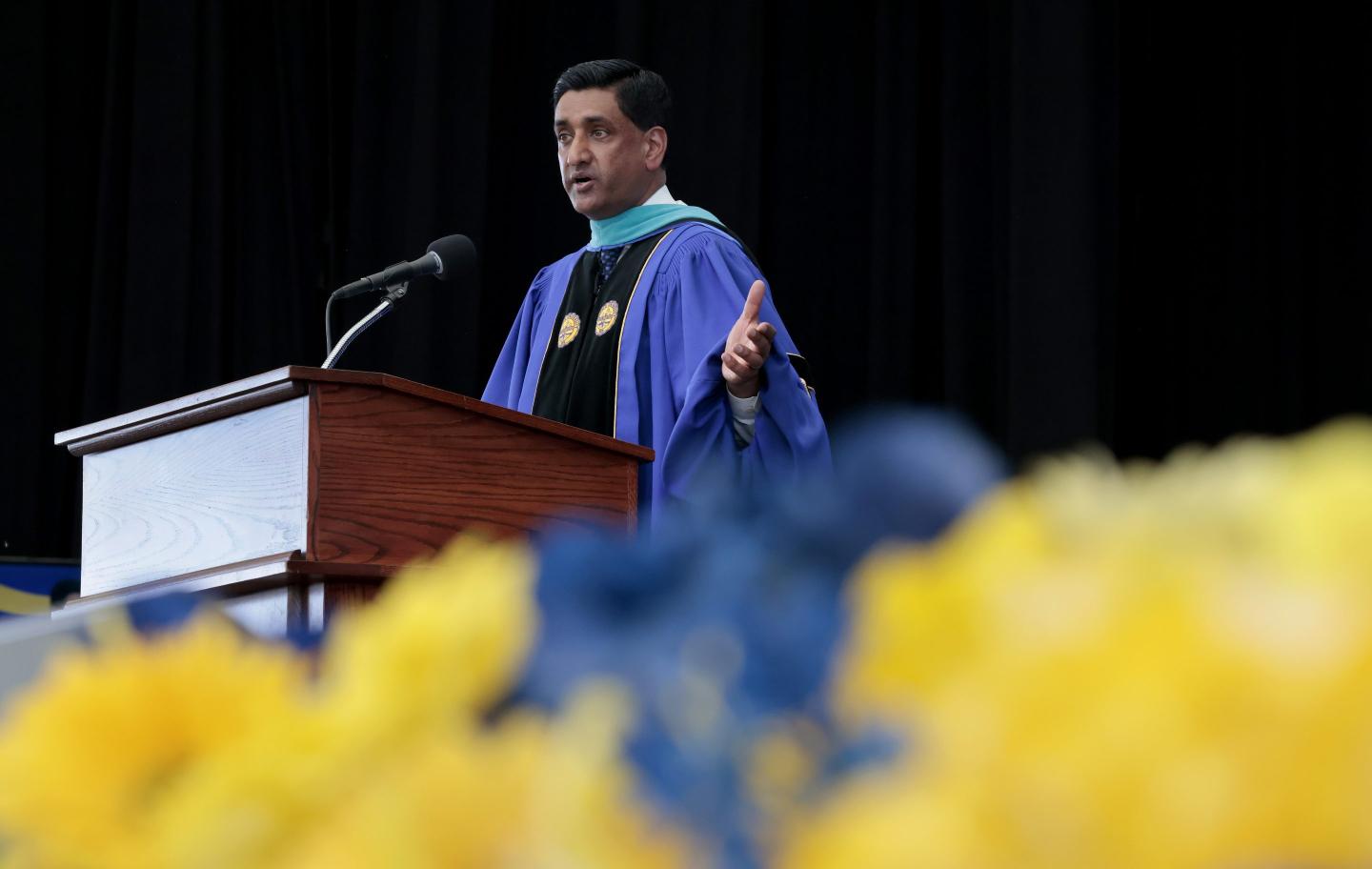
Rep. Ro Khanna (D-Calif.) had a simple message for graduates at Suffolk University in Boston last Sunday: AI’s windfall shouldn’t flow only to billionaires. “As AI transforms our economy, we must ensure it serves workers, not billionaires,” he said. The room erupted.
Khanna, whose district sits at the heart of Silicon Valley, didn’t shy away from the fears haunting graduates who’ve spent the past year being told their chosen careers may soon be automated away. His warm reception stood in sharp contrast to the boos greeting pro-AI speakers at commencement ceremonies across the country.
“I think a lot of the boomers who were the commencement speakers are clueless about how young people feel about the current broken economy,” he told Fortune.
The congressman, whose district lies more than 3,000 miles west at the heart of Silicon Valley, hammered a variety of points conducive to riling up a crowd of graduates who have, for over a year now, been told the careers they were encouraged to pursue may soon evaporate.
Gen Z’s resistance to AI is showing up everywhere, from commencement boos to young workers actively sabotaging their company’s AI rollouts out of fear of displacement. All the AI hype over the last year has excited investors but left young people cold. While Wall Street continues to boom thanks to the anticipated “revolution” or “renaissance”—and hyperscalers have committed $700 billion on infrastructure capex—excitement about AI among Gen Z dropped from 36% to 22% in a single year, according to a recent Gallup poll, while anger surged nine points.
Khanna talked to Fortune about his speech at Suffolk University, the backlash against data centers, trade schools, and workforce retraining—and that wealth tax that saw him trading tweets with disgruntled billionaires.
Khanna’s seven-point plan—and its blind spot
These are ways, the congressman said, to address the grievances Gen Z has with the technology.
He explained his thinking about the commencement speech typical of his profile: tech-forward, considering his Silicon Valley background and district, and yet also populist, striving to put a finger on the pulse of the angst within progressive culture.
“I understood that young people are anxious, that they’re economically frustrated, and they view AI with deep anxiety and suspicion, not as some kind of great thing,” Khanna said of his speech. “And then I offered an agenda of how we could have AI for them and the people and policies that were going to be for them as opposed to just seeing all the wealth pile up with tech billionaires.”
In February, Khanna—who hasn’t ruled out a 2028 presidential run—unveiled a “seven-point” AI agenda alongside Sen. Bernie Sanders. The proposal includes a plan to shift the burden of tax from labor to capital and investment in trade and technical schools.
One of the main concerns Khanna has about the ensuing AI revolution is the impact it will have on the labor market, an outcome likely to hamstring young graduates like the ones he spoke in front of at Suffolk University. Youth unemployment, while still elevated at 7.6% last month, has declined from a peak of 9.2% last year, according to Federal Reserve data, suggesting AI’s effects on the youth labor market are mixed and still playing out.
Still, Khanna proposed a “Work for America” plan to help young people get the professional skills they need as entry-level paths dry up. This program is meant to act as a safety net for those entering fields threatened by AI automation, offering federal jobs to displaced workers not unlike President Franklin Roosevelt’s New Deal Works Progress Administration.
“They could be building their skills towards their profession,” Khanna said of the proposal.
There’s an urgent need for employee reskilling. The private sector has started to fill that gap, with firms like BlackRock and Lowe’s launching training programs to address the shortage of electricians, plumbers, and other tradespeople needed to build out the country’s AI infrastructure.
But where Khanna diverges from some of his progressive colleagues is on data centers, the AI infrastructure sites swiftly popping up in rural and suburban regions across the country and which are being met with growing pushback. The congressman seems torn on the issue. He said earlier this year he’s against a data center moratorium, a proposal that Rep. Alexandria Ocasio-Cortez (D-NY) and Sen. Bernie Sanders (I-VT) introduced at the national level. And he told Fortune “We are going to need data centers.”
But acknowledging the necessity of data centers isn’t the same as embracing them. After saying the U.S. needs data centers, he advocated for stringent rules on their buildout, especially to prevent facilities from depleting local water resources—a single facility can consume roughly 300,000 gallons per day, the equivalent of what 1,000 households use—and to tamp down on personal data extraction.
“Right now it’s just a data extraction project,” he said, calling data centers, as currently configured, “extractive, predatory tools.”
Data centers don’t exactly extract personal data, although the AI companies that lease data center capacity have faced lawsuits for allegedly doing something like what Khanna describes. OpenAI, for example, is currently facing a class action lawsuit that accuses it of sharing data such as user chats, emails, and user IDs with tech giants like Meta and Google.
How to remedy Gen Z’s AI anxieties
But one crucial piece is missing. Many of the graduates sitting before him studied fields threatened by AI, leaving their career prospects in jeopardy, at least if the likes of Anthropic CEO Dario Amodei are right that AI will soon eliminate half of all white-collar work.
When asked about how to soften the blow for those who stand to have their dreams crushed by AI automation, the congressman turned to education policy. We should lower the cost of education so that graduates aren’t simultaneously drowning in debt and failing to find work, he said, explaining that economic safeguards should be critical components of a new social contract that aims to protect workers.
He also argued that Medicare for All could create a surge in healthcare roles. A 2020 report from the Economic Policy Institute found that while a single-payer system could eliminate 1.8 million jobs in health insurance and billing administration, it would simultaneously generate demand for 2.3 million healthcare workers, a net gain in an industry so far resistant to AI displacement. He’s similarly optimistic about law, predicting a boom in legal jobs as companies scramble to navigate AI governance, safety, ethics, and bias.
“There must be humans in the loop when it comes to medical or legal judgment,” he said. “So these careers may be more needed than ever.”
But beyond any single policy, Khanna’s pitch to those graduates ultimately came down to a broader argument about the widening wealth divide, a concern that seems to be at the heart of those boos.
“If we’re building all this wealth, you can’t have all this wealth and then people don’t have health care or people don’t have child care,” he said. “We need a new social contract in this country.”