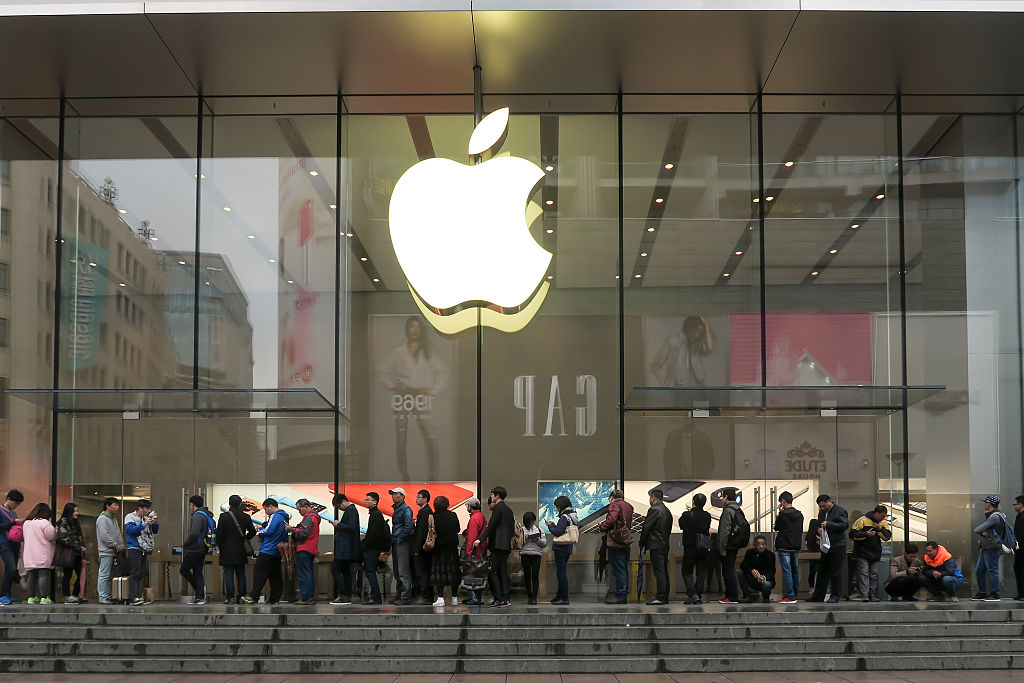
The masters of the universe running Apple (AAPL) have just discovered that the Celestial Kingdom is slipping out of their grasp.
China’s recent decision to ban Apple from offering its iTunes Movies and iBooks Store services must have come as a shock to executives at the world’s most valuable company. As Apple’s second-largest market for iPhones, China is critical to the Cupertino-based company’s future. Total revenue from the Greater China region (which includes mainland China, Hong Kong, and Taiwan) now accounts for about a quarter of Apple’s sales. And Apple has invested heavily in cultivating good relations with the Chinese government. CEO Tim Cook has visited China at least seven times since assuming his position in 2011.
Yet the ruling Chinese Communist Party (CCP) does not seem to value such demonstrations of goodwill. The CCP seldom allows sentimentality to get in the way when a foreign company – even an old “friend of China” such as Apple—does something that arouses the party’s paranoia.
In this particular case, the digital books and movies offered by Apple are considered a potential threat to the Chinese government’s ongoing campaign of keeping out Western liberal ideas. In addition, the notion that Apple could dominate China’s digital content market must also have offended Beijing’s protectionist instincts.
Apple’s unpleasant experience offers a warning to American tech giants eager to break into China. Facebook and Twitter, for instance, are currently blocked inside China, but both hope to get a piece of China’s vast Internet market in the future. What tech leaders such as Mark Zuckerberg and Cook need to learn is that no matter how hard they may try to convince Chinese leaders of their innocent intentions and the potential benefits of a partnership, they are unlikely to get anywhere. On a fundamental level, Beijing wants to keep foreign firms from dominating China’s information sector and from posing an existential threat to the CCP’s monopoly of power. China may have to pay a high price for such resistance. They may have to use inferior technology, products, and services. But such costs are considered affordable to the regime because they are borne almost exclusively by ordinary Chinese people.
American companies face a dilemma, as China’s market is simply too big to ignore. If they do not try to curry favor from Chinese authorities, their competitors will. And ceding China to a rival is simply unthinkable.
Driven by such considerations, Western companies, including American giants in all sectors, have adopted two principal strategies so far. The first is to demonstrate their commercial value to Beijing. The other is to establish rapport with Chinese leaders and build good guanxi (relations). Based on China’s recent turn toward protectionism and xenophobia, it looks like Western firms need to adopt a new approach to protect themselves.
Any strategy that relies on the good will of Chinese authorities is dicey because of the arbitrary nature of the Chinese regime. A Western company that’s an “old friend” today could be a reviled “foreign devil” tomorrow if Beijing does not like what it is doing in China.
Western companies ought to pursue a self-help strategy instead. The best source of such help is Washington. The Chinese government has signed many trade and commercial agreements with the U.S. and is a member of the World Trade Organization. U.S. firms should not hesitate to pressure Washington to hold Beijing to its commitments. China may have grown too powerful for most countries in the world to handle alone, but the U.S. retains sufficient clout to make China pay a heavy price if it treats American firms unfairly.
Western companies should also band together. China plays the classic game of “divide and conquer” in dealing with Western companies, wooing some while bullying others. Regrettably, Western companies have been unable to form a united front, making themselves vulnerable to Beijing’s capriciousness. Individually, no Western firm, however successful or big, is a match for China. But China cannot afford to alienate a group of Western companies whose technologies, products, and services it sorely needs.
So, the first step Apple should take is not to send Tim Cook to Beijing to plead its case. Kowtowing seldom works. Instead, Cook should take the lead in organizing other American companies with high stakes in the Chinese market to push back against Beijing’s opaque and arbitrary use of regulatory authority. Contrary to conventional wisdom counseling against public defiance toward Beijing, Apple and other American firms need to know that only collective action will get the attention of the Chinese government.
Minxin Pei is the Tom and Margot Pritzker Professor of Government at Claremont McKenna College and a non-resident senior fellow of the German Marshall Fund of the United States