This story originally appeared on time.com.
Politicians in several states are drawing national attention for supporting bills that are seen as “anti-LGBT.” Some are explicitly focused on controlling transgender people’s bathroom use, while others are positioned as measures that enhance religious freedom. Supporters generally say the measures protect moral rights or privacy, while critics deride them as cover for discrimination.
Advocacy organizations fighting these bills, like the Human Rights Campaign, say they have taken on more than 200 of them so far this year. And in defeating many, business leaders have proven to be their strongest allies. They have argued that bills that make a state so much as appear intolerant are bad for business—bad for recruiting, bad for retaining employees and, often, badly conflicting with their own, more progressive internal company policies.
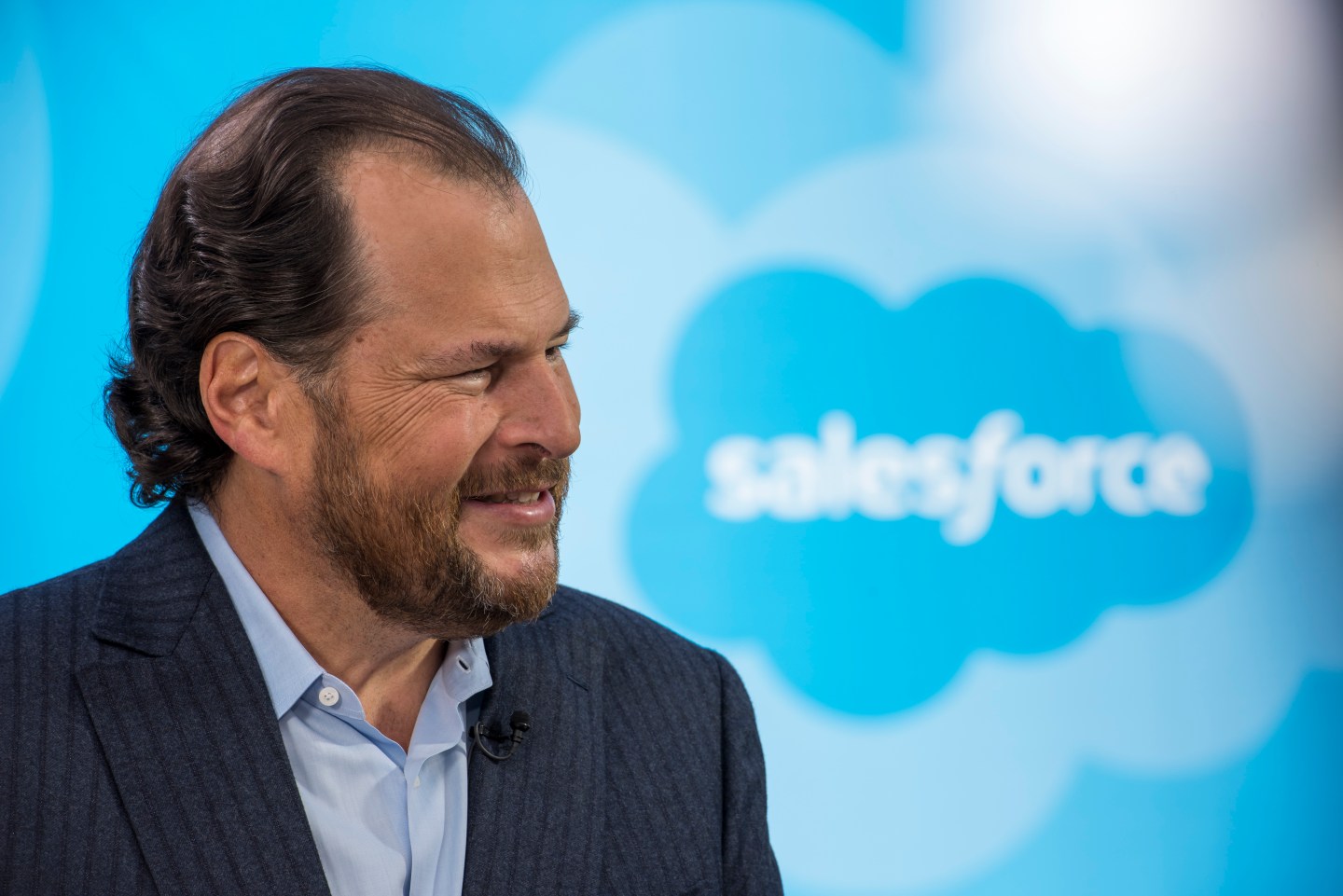
Marc Benioff, CEO of cloud computing giant Salesforce (CRM), is one of the most outspoken executives fighting against these bills. He has put together a network of high-powered executives to call on when one appears to be gaining steam. Benioff activated that network about a month ago to help pressure the governor of Georgia to veto a religious freedom bill, which he did on March 28. And Benioff’s attention is now focused on North Carolina, where Governor Pat McCrory recently signed a bill invalidating city-level non-discrimination protections for LGBT citizens.
TIME spoke to the tech icon about why he’s willing to throw the weight of his company behind social issues and why he doesn’t mind if he’s alienating some people in the process. Here follows a lightly edited transcript.
When you decide to weigh into these political frays over LGBT rights, what are the potential upsides and downsides for your business?
What we’re doing is advocating on behalf of our employees. We’re a company of 20,000 employees. We obviously have thousands of LGBTQ employees as well. And they expect us to take a position and advocate on their behalf.
. . . That traditionally has has not been part of business. But if I were to write a book today, I would call it CEO 2.0: How the Next Generation CEO Has to Be An Advocate for Stakeholders, Not Just Shareholders. That is, today CEOs need to stand up not just for their shareholders, but their employees, their customers, their partners, the community, the environment, schools, everybody. Anything that’s a key part of their ecosystem.
You saw many CEOs speak out aggressively in this fight in Georgia. This turned into a very significant and very important movement. Not just in LGBTQ. What this turned into is: ‘You better consider the economic consequences of your social and political advocacy if you are taking on a law that features discrimination.’
Why are businesses so much more willing than in the past to take stands on social issues like LGBT rights?
I think that there’s a lot more transparency in the world today with social media and mobility that makes it very easy to participate. Between the cloud, social networks, mobile phones, it’s not very hard for a CEO like myself or Richard Branson or Michael Dell to tweet something, and one little tweet can make a huge difference.
How do you draw the line between something you personally believe, politically, and a political stance you’re willing to speak out on and throw the whole weight of the company behind?
Well, these are not my decisions. These are the decisions of my employees. I am advocating on their behalf.
So unless something was bubbling up and you were seeing that demand from them, you would probably just keep it to yourself?
The way I look at being a CEO is I just represent their interests. Thinking that I’d have to make these decisions myself—that would be way too much stress. My job is to listen and to collaborate, to share, to align, and then to push it forward. My job is not just to go up a mountain and come up with all my own ideas.
All 20,000 employees aren’t all going to have the same political beliefs. Same thing with customers: 60% of people support same-sex marriage which means 40% of people still don’t. Do you weigh the potential to upset some customers or employees, or to lose business by alienating people who are less embracing of LGBT issues?
I default to this concept of stakeholder theory. CEOs have to decide: are they advocating for their shareholders or advocating for their stakeholders? If you’re only focused on shareholders, then you’ve got a very different situation on your hands. And in our case, we are very much focused on stakeholder theory.
But what do you think about those people who are among your stakeholders who don’t agree with a stance that is supportive of LGBT rights?
I, unfortunately, think that they are on the wrong side of history.
Like you said, a tweet can be powerful. You’ve also shown you’re willing to cancel conventions and ban travel to certain states over these bills. How far are you willing to go? Would you also move jobs out of a state?
Absolutely. We moved people out of Indiana last year. We had to. We had no choice. When you make a decision like some of these decisions these people are making, they don’t realize they are really impacting their community in a negative way.
Do you think lawmakers who push such bills don’t see LGBT people as being part of their workforces, their communities?
I just think they don’t think it through, honestly. I don’t think they understand that they’re voting against business, that they’re creating an anti-business environment.
To go back to North Carolina. Several advocates said that the bill was passed so fast, in one day, that there wasn’t an opportunity to rally businesses.
Right. We call that the ‘sneak attack approach.’ That happened in Indiana too.
Can you give me examples of what you’ll be doing to fight not a bill, but a law that is already on the books?
We take the same approach we took in Indiana. We will have to let people know this is not okay. You’ve already seen organizations ranging from the NBA to Salesforce to Bank of America to Dow Chemical all saying the North Carolina law does not align with their business practices. So it’s going to impact their ability to attract business.
[fortune-brightcove videoid=4194418802001]
Are you hoping for anything specific? A repeal of the law or something like in Indiana, where there were explicit changes that said the law could not be used to discriminate against LGBT people?
We are happy to negotiate a resolution with the governor, like we did in Indiana.
At this point what resources are you dedicating to political causes?
Mostly this is me and then my lawyers will have to go clean up whatever mess I’ve created . . . The organizations that had the biggest impact in Georgia were not Silicon Valley companies. We may have started some of this or I may have started some of this, but I certainly didn’t finish it. It was organizations like the NFL, who said to the governor of Georgia, ‘If you do this, we’re not going to consider you for the Super Bowl.’ That’s a big deal. It was people like Disney (DIS) who said ‘We’re not going to make any more movies in the state of Georgia.’
As part of the broader shift, beyond this fight, is Silicon Valley getting more political?
CEOs of other companies and employees of other companies see these CEOs doing this and they expect their CEO to do something too.
How much pressure is coming from consumers and employees, especially young people, who want to spend money on products and work for companies that align with their social values?
That sounds like what millennials are saying to us, who are coming out of school, that they want to work for a company that has a meaning associated with it, not just a product. And I think that’s very much the new reality. When we started Salesforce 17 years ago, we created our 1-1-1 model, which tightly integrated our company with our communities. And we’ve given away millions of dollars, we’ve done massive amounts of volunteerism and we run 25,000 non-profits and NGOs for free on our servers. And that was our approach to equality. Today, our approach to equality is not only are we doing our 1-1-1- model, which we’ve also gotten hundreds of other companies to agree to, but we are also willing to take a political position when it’s appropriate.
How much does it help you recruit workers to have a reputation of being a company that will fight for inclusion and diversity?
If you’re not doing this, you’re not going to attract modern workers. People show up from school and they expect us to hand them a phone and get to work. They don’t even want a computer. And they also want to know what the company stands for. They want to know why they’re going to be using their precious time on this planet to work for this company. And so you have to have an answer.
Is there enough influence among businesses to finally move the needle on something like the Equality Act [a federal bill that would protect people from discrimination based on sexual orientation and gender identity]?
You saw that Newsweek cover right, that came out when the vote happened for same-sex marriage in the Supreme Court? It said it all in a lot of ways. The headline was “The Love Vote,” and then under it said, “How Corporate America Propelled Same Sex Marriage.”
Does the influence that business has and is exerting these days work any differently on Republicans and Democrats?
This is much more than being a Democrat or a Republican. This is about being an American. And this is what America is about today.