• Home
  • Latest
  • Fortune 500
  • Finance
  • Tech
  • Leadership
  • Lifestyle
  • Rankings
  • Multimedia

Senators to Crack Down on “Soaring, Gouging” Airline Fees

By
Christopher Elliott
Christopher Elliott
Down Arrow Button Icon
By
Christopher Elliott
Christopher Elliott
Down Arrow Button Icon
March 10, 2016, 3:30 PM ET
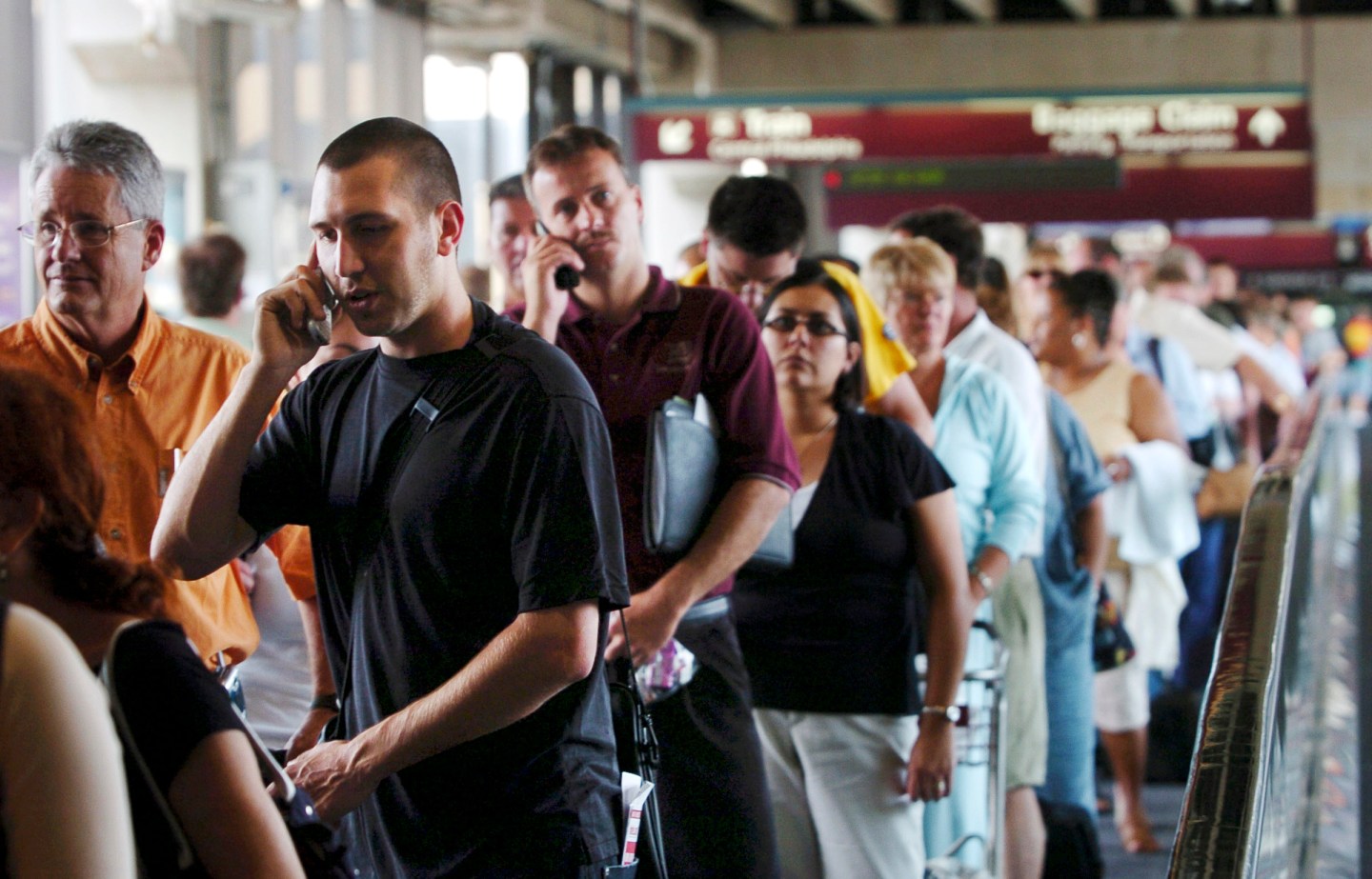
Long lines of passengers queue up at the Philadelphia International Airport.
UNITED STATES - AUGUST 10: Long lines of passengers queue up to go through increased security check points as news rules for carry on luggage cause long delays at the Philadelphia International Airport in Philadelphia, Pennsylvania, Thursday, August 11, 2006. Crude oil traded near its lowest level this month after a foiled terrorist attempt to attack airlines raised concern travelers will avoid flying, reducing jet-fuel demand. (Photo by Bradley C. Bower/Bloomberg via Getty Images)Photograph by Bradley C. Bower — Bloomberg via Getty Images

Just as airline fees seemed to have reached a cruising altitude, there is a movement afoot in the Senate to rein them in.

A bill, introduced yesterday, would reduce or even eliminate the fees passengers pay for baggage, ticket changes and the privilege of selecting where they will seat — options that once came with the price of the ticket. The Forbid Airlines from Imposing Ridiculous Fees Act of 2016 (FAIR Fees Act) specifically would prohibit air carriers from imposing fees that are “not reasonable and proportional” to the costs incurred by the air carriers.

In addition, the Senate version of the Federal Aviation Administration reauthorization bill, also introduced March 9 and surprisingly pro-consumer, has a provision that would commission a government study on how air carriers come up with their most profitable fees.

The measures, if enacted, would effectively undermine the airline industry’s current business model, to “unbundle” fees from their base fares. That keeps basic airfares low, while charging consumers for extras that used to be included in their ticket, like the ability to pick your own seat assignment, checking a bag, or get a pillow.

“This measure will ground the soaring, gouging fees that contribute to airlines’ record profits and passengers’ rising pain,” said Sen. Richard Blumenthal (D-Conn.), who co-sponsored the FAIR Fees Act. “With all the frills of flying already gone, airlines are increasingly resorting to nickel and diming consumers with outrageous fees.”

The introduction of these bills, however, came as a surprise as Congress has generally taken a hands-off approach to regulating airlines.


Grounding “soaring” fees

So-called “ancillary” fees have become a huge source of revenue for the airlines — and a chronic source of complaints among passengers.

Take checked baggage fees, for example. Between 2009 and 2014, three airlines increased checked baggage fees by 67%, according to a recent investigation by the minority staff of the U.S. Senate Commerce, Science and Transportation Committee. It’s a jarring increase, when you compare the revenue realized from the fee — $464 million in 2007 versus an eye-popping $3.5 billion in 2014. In the past, airline executives have said fees like this represent the difference between a profit and a loss.

Blumenthal also notes that four airlines increased domestic cancellation fees by 33% between 2009 and 2014, while one increased the fee by 50%, and a sixth by 66%, according to the Senate study. The revenue increases are dramatic here, too — rising from $915 million in 2007 to $2.9 billion in 2014. (It’s worth noting, though, airlines have waived ticket change fees for members of Congress.)

It’s difficult to argue that the airline’s cost to transport a checked bag or make a ticket change has increased by that much in just a few years, according to Blumenthal. He says these “runaway” fees can, in some cases, double a passenger’s airfare, and that people who are least able to afford them — non-elite level passengers who are traveling with young children — are the hardest hit.

“A parent who wants to sit with his young child, a customer who wants to check or carry on a bag, or have Wi-Fi, or a traveler who needs to change or cancel a reservation should not incur exorbitant, unnecessary fees on the whim of an airline,” he asserted.

An airline industry representative predicted that regulating fees would lead to higher fares.

“When the government last dictated airline pricing [before deregulation], many couldn’t fly because it was cost prohibitive,” warned Jean Medina, a spokeswoman for A4A, a trade association for airlines. “Today customers have choices. They can purchase non-refundable fares that are highly affordable. If they would like the flexibility to change their ticket at the last minute, they can do so as well.”

Undermining the airline business model

The FAIR Fees Act would require the Secretary of Transportation to create a regulation prohibiting an air carrier from imposing fees that are unreasonable or disproportional to the costs incurred by the air carrier and set standards for determining what is unreasonable.

The bill also would cover any fee for a change or cancellation of a reservation for a flight, any fee relating to checked baggage, and “any other fee” imposed by an air carrier. More importantly, it requires airlines justify the fees, demonstrating they would have lost money by the cancellation or were unable to resell the seat. Airlines would also have to show the actual cost of transporting luggage, including labor costs. It requires the Transportation Secretary to set standards for the fees, effectively regulating what airlines can — and can’t — charge.

Effectively, airlines will only be authorized to charge fees that cover the costs of the baggage handlers, ticket agents, the baggage processing, or anything that reasonably pertains to checking a bag. For example, American Airlines (AAL), Delta Air Lines (DAL), and United Airlines currently charge more money for the second checked bag than the first, yet there appears to be no appreciable cost increase for processing the second bag, according to Blumenthal.

For change and cancellation fees, airlines would only be authorized to charge fees that cover the cost of processing the new tickets and any potential loss of revenue due to the cancellation, since any loss of revenue would be minimal or even zero because the airline can resell the seat for a potentially higher fare.

The proposed law could get additional help from the recently introduced Senate version of the FAA reauthorization bill, which contains a provision that would require the Comptroller General of the United States to conduct a study of existing airline industry change and cancellation fees, and the current industry practice for handling changes to or cancellation of ticketed travel on covered air carriers. The bill asks the Comptroller General to consider whether and how each airline calculates its change and cancellation fees, and the relationship between the cost of the ticket and the date of change or cancellation as compared to the date of travel.

Airlines are likely to argue that limiting fees restricts a free market. But Kevin Mitchell, chairman of the Business Travel Coalition, says the current, consolidated airline industry is not competitive.

“In a perfectly competitive market, an airline industry consumer would be able to exercise his right to walk away from the $200 change fee and instead deal with other airlines eager to gain market share,” says Mitchell, whose group represents corporate travelers. “However, now that the U.S. marketplace has gone from 11 airlines controlling some 80 percent of seat capacity to 4 airlines, the opportunities to vote with one’s wallet have been considerably reduced.”

Whether these bills succeed or not, one thing seems clear: The days of airlines naming their own price, when it comes to fees and surcharges, may be numbered.

About the Author
By Christopher Elliott
See full bioRight Arrow Button Icon

Latest in

Finance
Lorem ipsum dolor sit amet, consectetur adipiscing elit, sed do eiusmod tempor incididunt ut labore et dolore magna aliqua. Ut enim ad minim veniam
By Fortune Editors
October 20, 2025
Finance
Lorem ipsum dolor sit amet, consectetur adipiscing elit, sed do eiusmod tempor incididunt ut labore et dolore magna aliqua. Ut enim ad minim veniam
By Fortune Editors
October 20, 2025
Finance
Lorem ipsum dolor sit amet, consectetur adipiscing elit, sed do eiusmod tempor incididunt ut labore et dolore magna aliqua. Ut enim ad minim veniam
By Fortune Editors
October 20, 2025
Finance
Lorem ipsum dolor sit amet, consectetur adipiscing elit, sed do eiusmod tempor incididunt ut labore et dolore magna aliqua. Ut enim ad minim veniam
By Fortune Editors
October 20, 2025
Finance
Lorem ipsum dolor sit amet, consectetur adipiscing elit, sed do eiusmod tempor incididunt ut labore et dolore magna aliqua. Ut enim ad minim veniam
By Fortune Editors
October 20, 2025
Finance
Lorem ipsum dolor sit amet, consectetur adipiscing elit, sed do eiusmod tempor incididunt ut labore et dolore magna aliqua. Ut enim ad minim veniam
By Fortune Editors
October 20, 2025

Most Popular

Finance
Lorem ipsum dolor sit amet, consectetur adipiscing elit, sed do eiusmod tempor incididunt ut labore et dolore magna aliqua. Ut enim ad minim veniam
By Fortune Editors
October 20, 2025
Finance
Lorem ipsum dolor sit amet, consectetur adipiscing elit, sed do eiusmod tempor incididunt ut labore et dolore magna aliqua. Ut enim ad minim veniam
By Fortune Editors
October 20, 2025
Finance
Lorem ipsum dolor sit amet, consectetur adipiscing elit, sed do eiusmod tempor incididunt ut labore et dolore magna aliqua. Ut enim ad minim veniam
By Fortune Editors
October 20, 2025
Finance
Lorem ipsum dolor sit amet, consectetur adipiscing elit, sed do eiusmod tempor incididunt ut labore et dolore magna aliqua. Ut enim ad minim veniam
By Fortune Editors
October 20, 2025
Finance
Lorem ipsum dolor sit amet, consectetur adipiscing elit, sed do eiusmod tempor incididunt ut labore et dolore magna aliqua. Ut enim ad minim veniam
By Fortune Editors
October 20, 2025
Finance
Lorem ipsum dolor sit amet, consectetur adipiscing elit, sed do eiusmod tempor incididunt ut labore et dolore magna aliqua. Ut enim ad minim veniam
By Fortune Editors
October 20, 2025
Rankings
  • 100 Best Companies
  • Fortune 500
  • Global 500
  • Fortune 500 Europe
  • Most Powerful Women
  • Future 50
  • World’s Most Admired Companies
  • See All Rankings
Sections
  • Finance
  • Leadership
  • Success
  • Tech
  • Asia
  • Europe
  • Environment
  • Fortune Crypto
  • Health
  • Retail
  • Lifestyle
  • Politics
  • Newsletters
  • Magazine
  • Features
  • Commentary
  • Mpw
  • CEO Initiative
  • Conferences
  • Personal Finance
  • Education
Customer Support
  • Frequently Asked Questions
  • Customer Service Portal
  • Privacy Policy
  • Terms Of Use
  • Single Issues For Purchase
  • International Print
Commercial Services
  • Advertising
  • Fortune Brand Studio
  • Fortune Analytics
  • Fortune Conferences
  • Business Development
About Us
  • About Us
  • Editorial Calendar
  • Press Center
  • Work At Fortune
  • Diversity And Inclusion
  • Terms And Conditions
  • Site Map

Latest in

An elderly man prepares ingredients, grating carrots on a plate in a home setting, emphasizing independence and routine.
North Americaaging
More Americans will die than be born in 2030, CBO predicts—leaving immigrants as the only source of population growth
By Eva RoytburgJanuary 7, 2026
8 hours ago
Delta plane flying
North AmericaAir Travel
These are the 10 most on-time airlines in the world, and only one American company made the cut
By Jacqueline MunisJanuary 7, 2026
10 hours ago
corner office
Future of WorkJobs
AI layoffs are looking more and more like corporate fiction that’s masking a darker reality, Oxford Economics suggests
By Nick LichtenbergJanuary 7, 2026
11 hours ago
Simple App as best intermittent fasting app
HealthDietary Supplements
The Best Nutrition Apps of 2026: Approved by Experts
By Christina SnyderJanuary 7, 2026
11 hours ago
Real EstateHousing
Trump threatens to ban Wall Street from buying the house next door, saying ‘American Dream is increasingly out of reach for far too many people’
By Nick LichtenbergJanuary 7, 2026
11 hours ago
trump
Economynational debt
The $38 trillion national debt is one thing 82% of Americans agree on: ‘Voters are understandably concerned,’ watchdog says
By Nick LichtenbergJanuary 7, 2026
11 hours ago

Most Popular

placeholder alt text
Law
Amazon is cutting checks to millions of customers as part of a $2.5 billion FTC settlement. Here's who qualifies and how to get paid
By Sydney LakeJanuary 6, 2026
2 days ago
placeholder alt text
Economy
Mark Cuban on the $38 trillion national debt and the absurdity of U.S. healthcare: we wouldn't pay for potato chips like this
By Nick LichtenbergJanuary 6, 2026
2 days ago
placeholder alt text
Future of Work
'Employers are increasingly turning to degree and GPA' in hiring: Recruiters retreat from ‘talent is everywhere,’ double down on top colleges
By Jake AngeloJanuary 6, 2026
2 days ago
placeholder alt text
Personal Finance
Janet Yellen warns the $38 trillion national debt is testing a red line economists have feared for decades
By Eva RoytburgJanuary 5, 2026
3 days ago
placeholder alt text
Success
The college-to-office path is dead: CEO of the world’s biggest recruiter says Gen Z grads need to consider trade and hospitality jobs that don't even require degrees
By Orianna Rosa RoyleJanuary 6, 2026
2 days ago
placeholder alt text
Personal Finance
Current price of silver as of Tuesday, January 6, 2026
By Joseph HostetlerJanuary 6, 2026
2 days ago

© 2025 Fortune Media IP Limited. All Rights Reserved. Use of this site constitutes acceptance of our Terms of Use and Privacy Policy | CA Notice at Collection and Privacy Notice | Do Not Sell/Share My Personal Information
FORTUNE is a trademark of Fortune Media IP Limited, registered in the U.S. and other countries. FORTUNE may receive compensation for some links to products and services on this website. Offers may be subject to change without notice.