• Home
  • Latest
  • Fortune 500
  • Finance
  • Tech
  • Leadership
  • Lifestyle
  • Rankings
  • Multimedia
LeadershipEuropean Union

Why Britain Should Leave the EU

By
Cyrus Sanati
Cyrus Sanati
Down Arrow Button Icon
By
Cyrus Sanati
Cyrus Sanati
Down Arrow Button Icon
February 22, 2016, 2:38 PM ET
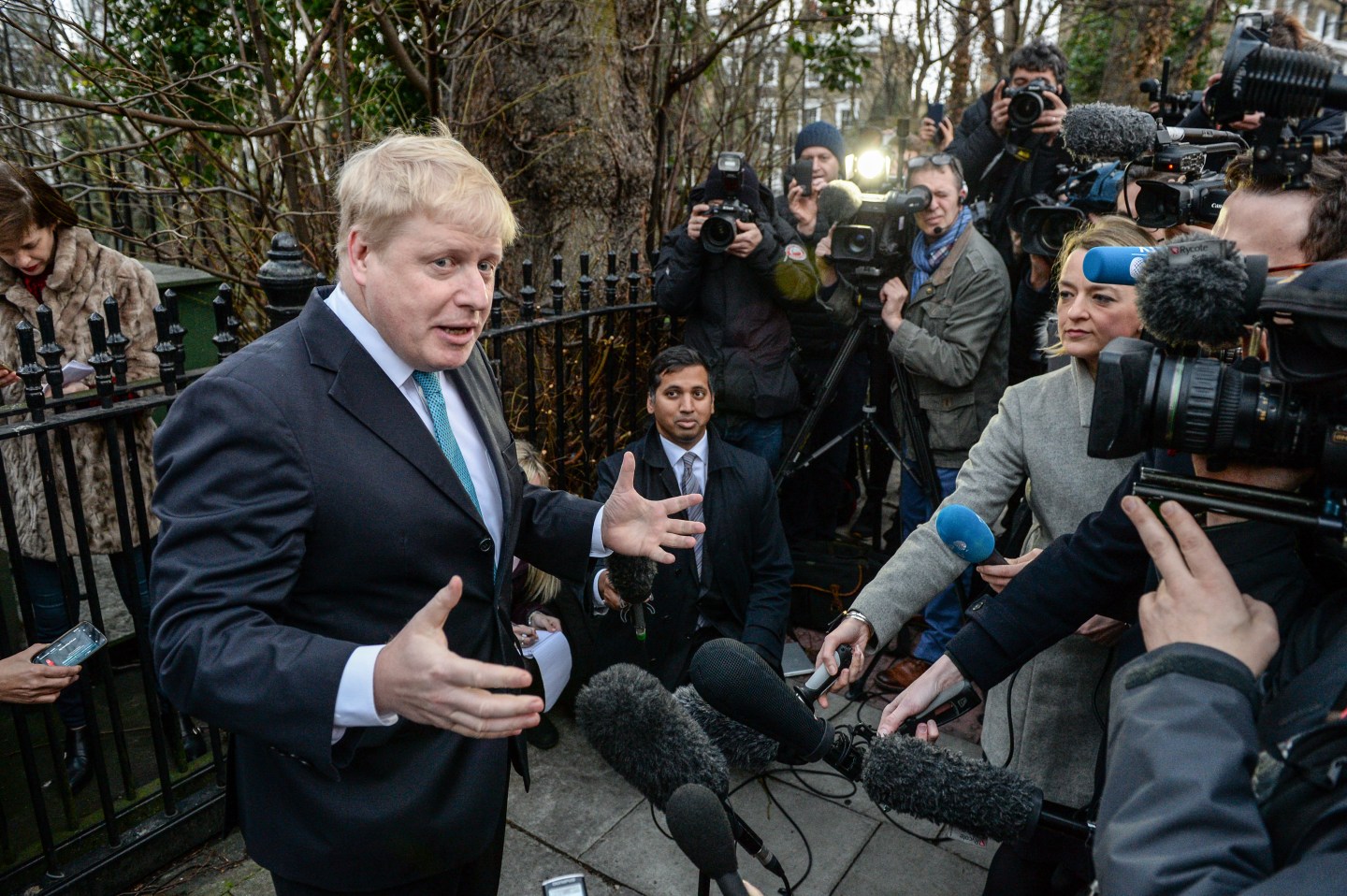
London Mayor Boris Johnson Announces Support For Brexit
LONDON, ENGLAND - FEBRUARY 21: Mayor of London Boris Johnson announces that he will be backing the 'Leave EU' campaign whilst speaking to the press outside his London home on February 21, 2016 in London, England. Mr Johnson announced his intentions for the EU referendum and to which campaign he will lend his support. (Photo by Chris Ratcliffe/Getty Images)Photograph by Chris Ratcliffe — Getty Images

The potential exit of the United Kingdom from the European Union will finally acknowledge what most scholars and bureaucrats have known for over a decade now: the E.U., in its current form, is fundamentally broken.

If the European Union is to become anything more than a glorified free trade zone or a terribly ineffective confederation, it needs to get closer and move forward with those members who are willing to diminish their own sovereign powers in the pursuit of a more perfect and secure union. That won’t happen with the U.K. on board.

So far, much of the discussion concerning a Brexit has focused on what leaving the E.U. would mean for Britain and its interests. Would it hurt the City of London’s status as the financial heart of Europe? Would it diminish Britain’s role on the world stage? But hardly anyone in the U.K., or elsewhere for that matter, is asking the bigger question: Would Brexit be good for the E.U.? The answer is a resounding “yes.”

It is difficult to build a strong team when one of the members believes it can pick and choose what it wants to do all the time. While the U.K. may be a full-fledged member of the E.U., it has chosen to “opt-out” of a multitude of provisions that it felt could compromise its sovereignty or threaten the profits of the big financial firms in the City of London.

This isn’t a recent phenomenon. Back in 1978, the U.K. was the only member of the European Economic Community (EEC), the direct predecessor to the European Union, not to join the European Monetary System (EMS). That pretty much doomed the experiment from the outset. And while the U.K. joined the European Exchange Rate Mechanism in 1990, it was kicked out two years later after the devaluation of its currency against its European rivals. Then in 2002, the U.K. failed to join 12 other member states in adopting the euro, choosing instead to keep the pound.

In 2011, U.K. Prime Minister David Cameron vetoed legislation that would have brought eurozone nations closer together in a fiscal compact because the City of London was against the introduction of a financial transaction tax or anything that might lead to a unified European banking system. Eurozone members in favor of the tax later banded together to adopt the measure without the U.K.’s say. They have also moved forward with creating a banking union and harmonizing a number of rules dealing with bank liquidity. In all of this, the U.K. is nowhere to be found.

Britain’s lack of commitment to the European Union goes beyond financial matters. The U.K. was one of only two nations in the E.U. to “opt-out” of the E.U. Charter of Fundamental Rights on the erroneous claim that it would somehow spell disaster for businesses in Britain. Then in 1995, Britain refused to sign the Schengen Agreement, which allowed member states to eliminate internal border controls, helping to increase trade and efficiency on the continent. Schengen advanced the notion of a common European polity, as people could go back and forth between countries as easily as Americans can travel between states. Britain’s failure to adopt Schengen was a reminder of the island nation’s lack of trust in its European allies and it put further distance between it and the rest of “the continent.”

To be sure, sovereign nations have a duty to put national interests above those of other nations, but when the U.K. signed the Treaty of Maastricht in the early 1990s and the Treaty of Lisbon in 2007, it understood that the EEC, the direct predecessor to the European Union, was morphing into a political body and would no longer be a purely economic organization. The structures put in place were clearly intended to lead to a closer political and fiscal union, which required member states to give up some of their sovereignty. If the U.K. was not comfortable taking that step, it should have not moved forward in the first place. Its continued obstructionism and “me first” attitude in all areas, especially in finance, have undermined the efforts of European countries fighting for a closer and more secure Europe.

When London’s mayor, Boris Johnson, told reporters on Sunday that he would support Brexit, the U.K. government issued a statement that pretty much sums up Britain’s lack of commitment to the E.U. and its opportunistic agenda: “Our message to everyone is we want Britain to have the best of both worlds: all the advantages of the jobs and investment that come with being in the EU, without the downsides of being in the euro and open borders.”

The U.K. is not the only one that wants to have its cake and eat it too. Denmark and Sweden have also wavered in their commitment to greater integration. So, the U.K. shouldn’t be the only one to leave the E.U. quickly; all other member states fundamentally opposed to building a stronger E.U. would be wise to head for the exits as well. The policy of “opting out” of E.U. provisions by any member state should be erased as it only creates divisions and confusion inside and outside of Europe. By attempting to accommodate all members, the E.U. has become weak and ineffective, unable to respond to even basic crises.

The opt-out disease is spreading, with member states taking it upon themselves to close borders and restrict trade and commerce due to the E.U.’s broken immigration policy. Imagine if the governor of Texas sealed the U.S. border with Mexico. Would the federal government just throw up its hands and say “whatever”? No, because the border police is controlled by Washington, not by the states. This is why the E.U. needs to go beyond just having a common immigration policy on paper; it needs enforcement mechanisms to ensure the policy is administered fairly and equally across member states.

Keeping Britain in the E.U. will only make it more difficult for other member states to implement the necessary reforms to fix the organization’s structural problems. But something big has to happen to give member states the courage to kill off the ineffective, please-everyone European Union. It didn’t happen when member states failed to unanimously support the E.U. constitution in 2004. It also didn’t happen after the near-collapse of the euro currency in 2011, or the overreach by the European Central Bank in 2014, or even the various Greek financial scares of 2011, 2012, 2013, 2014, and 2015.

But the Syrian migrant crisis, an increasingly aggressive Russia, the possible onset of an isolationist United States, mixed in with something as existentially damaging as Brexit might just be the proper toxic brew needed to euthanize the current structure and begin anew. To be sure, Brexit, along with the removal of the other obstructionist and noncommittal member states, won’t be enough to bring about positive change—but it is a necessary step just the same. After the U.K. and the other obstructionists are removed, it will be up to the original founding members, Germany and France, to get the E.U. back on track.


About the Author
By Cyrus Sanati
See full bioRight Arrow Button Icon

Latest in Leadership

Finance
Lorem ipsum dolor sit amet, consectetur adipiscing elit, sed do eiusmod tempor incididunt ut labore et dolore magna aliqua. Ut enim ad minim veniam
By Fortune Editors
October 20, 2025
Finance
Lorem ipsum dolor sit amet, consectetur adipiscing elit, sed do eiusmod tempor incididunt ut labore et dolore magna aliqua. Ut enim ad minim veniam
By Fortune Editors
October 20, 2025
Finance
Lorem ipsum dolor sit amet, consectetur adipiscing elit, sed do eiusmod tempor incididunt ut labore et dolore magna aliqua. Ut enim ad minim veniam
By Fortune Editors
October 20, 2025
Finance
Lorem ipsum dolor sit amet, consectetur adipiscing elit, sed do eiusmod tempor incididunt ut labore et dolore magna aliqua. Ut enim ad minim veniam
By Fortune Editors
October 20, 2025
Finance
Lorem ipsum dolor sit amet, consectetur adipiscing elit, sed do eiusmod tempor incididunt ut labore et dolore magna aliqua. Ut enim ad minim veniam
By Fortune Editors
October 20, 2025
Finance
Lorem ipsum dolor sit amet, consectetur adipiscing elit, sed do eiusmod tempor incididunt ut labore et dolore magna aliqua. Ut enim ad minim veniam
By Fortune Editors
October 20, 2025

Most Popular

Finance
Lorem ipsum dolor sit amet, consectetur adipiscing elit, sed do eiusmod tempor incididunt ut labore et dolore magna aliqua. Ut enim ad minim veniam
By Fortune Editors
October 20, 2025
Finance
Lorem ipsum dolor sit amet, consectetur adipiscing elit, sed do eiusmod tempor incididunt ut labore et dolore magna aliqua. Ut enim ad minim veniam
By Fortune Editors
October 20, 2025
Finance
Lorem ipsum dolor sit amet, consectetur adipiscing elit, sed do eiusmod tempor incididunt ut labore et dolore magna aliqua. Ut enim ad minim veniam
By Fortune Editors
October 20, 2025
Finance
Lorem ipsum dolor sit amet, consectetur adipiscing elit, sed do eiusmod tempor incididunt ut labore et dolore magna aliqua. Ut enim ad minim veniam
By Fortune Editors
October 20, 2025
Finance
Lorem ipsum dolor sit amet, consectetur adipiscing elit, sed do eiusmod tempor incididunt ut labore et dolore magna aliqua. Ut enim ad minim veniam
By Fortune Editors
October 20, 2025
Finance
Lorem ipsum dolor sit amet, consectetur adipiscing elit, sed do eiusmod tempor incididunt ut labore et dolore magna aliqua. Ut enim ad minim veniam
By Fortune Editors
October 20, 2025
Fortune Secondary Logo
Rankings
  • 100 Best Companies
  • Fortune 500
  • Global 500
  • Fortune 500 Europe
  • Most Powerful Women
  • Future 50
  • World’s Most Admired Companies
  • See All Rankings
Sections
  • Finance
  • Fortune Crypto
  • Features
  • Leadership
  • Health
  • Commentary
  • Success
  • Retail
  • Mpw
  • Tech
  • Lifestyle
  • CEO Initiative
  • Asia
  • Politics
  • Conferences
  • Europe
  • Newsletters
  • Personal Finance
  • Environment
  • Magazine
  • Education
Customer Support
  • Frequently Asked Questions
  • Customer Service Portal
  • Privacy Policy
  • Terms Of Use
  • Single Issues For Purchase
  • International Print
Commercial Services
  • Advertising
  • Fortune Brand Studio
  • Fortune Analytics
  • Fortune Conferences
  • Business Development
About Us
  • About Us
  • Editorial Calendar
  • Press Center
  • Work At Fortune
  • Diversity And Inclusion
  • Terms And Conditions
  • Site Map
Fortune Secondary Logo
  • About Us
  • Editorial Calendar
  • Press Center
  • Work At Fortune
  • Diversity And Inclusion
  • Terms And Conditions
  • Site Map
  • Facebook icon
  • Twitter icon
  • LinkedIn icon
  • Instagram icon
  • Pinterest icon

Latest in Leadership

Future of Workthe future of work
Have good taste? It may just get you a job during the AI jobs apocalypse, says Sam Altman
By Marco Quiroz-GutierrezFebruary 27, 2026
11 hours ago
C-SuiteFortune 500 Power Moves
Fortune 500 Power Moves: Which executives gained and lost power this week
By Fortune EditorsFebruary 27, 2026
12 hours ago
Successphilanthropy
Dolly Parton’s philanthropy inspiration is her father who couldn’t read or write: ‘I saw how crippling that could be’
By Sydney LakeFebruary 27, 2026
14 hours ago
Personal Financewealth management
The Great Wealth Transfer is already happening as millennials hitting their ‘Peak 35’ are richer than ever
By Catherina GioinoFebruary 27, 2026
15 hours ago
jack dorsey
AILayoffs
Block CEO Jack Dorsey lays off nearly half of his staff because of AI and predicts most companies will make similar cuts in the next year
By Jake AngeloFebruary 27, 2026
16 hours ago
Spencer Rascoff, chief executive officer of Match Group Inc
SuccessGen Z
CEO of the tech company behind Hinge and Tinder set up an employee hotline where staff can DM him anytime: ‘No hierarchy. No filters. Just real input.’
By Emma BurleighFebruary 27, 2026
17 hours ago

Most Popular

placeholder alt text
Innovation
An MIT roboticist who cofounded bankrupt robot vacuum maker iRobot says Elon Musk’s vision of humanoid robot assistants is ‘pure fantasy thinking’
By Marco Quiroz-GutierrezFebruary 25, 2026
3 days ago
placeholder alt text
Success
Japanese companies are paying older workers to sit by a window and do nothing—while Western CEOs demand super-AI productivity just to keep your job
By Orianna Rosa RoyleFebruary 27, 2026
18 hours ago
placeholder alt text
Commentary
'The Pitt': a masterclass display of DEI in action 
By Robert RabenFebruary 26, 2026
2 days ago
placeholder alt text
Economy
It’s more than George Clooney moving to France: America is becoming the ‘uncool’ country that people want to move away from
By Nick LichtenbergFebruary 27, 2026
1 day ago
placeholder alt text
Success
Walmart exec says U.S. workforces needs to take inspiration from China where ‘5 year-olds are learning DeepSeek’
By Preston ForeFebruary 27, 2026
1 day ago
placeholder alt text
Law
China's government intervenes to show Michigan scientists were carrying worms, not biological materials
By Ed White and The Associated PressFebruary 26, 2026
2 days ago

© 2026 Fortune Media IP Limited. All Rights Reserved. Use of this site constitutes acceptance of our Terms of Use and Privacy Policy | CA Notice at Collection and Privacy Notice | Do Not Sell/Share My Personal Information
FORTUNE is a trademark of Fortune Media IP Limited, registered in the U.S. and other countries. FORTUNE may receive compensation for some links to products and services on this website. Offers may be subject to change without notice.