• Home
  • News
  • Fortune 500
  • Tech
  • Finance
  • Leadership
  • Lifestyle
  • Rankings
  • Multimedia
Leadership

Why Voters Trust Some Candidates and Not Others

By
Down Arrow Button Icon
By
Down Arrow Button Icon
January 26, 2016, 12:34 PM ET
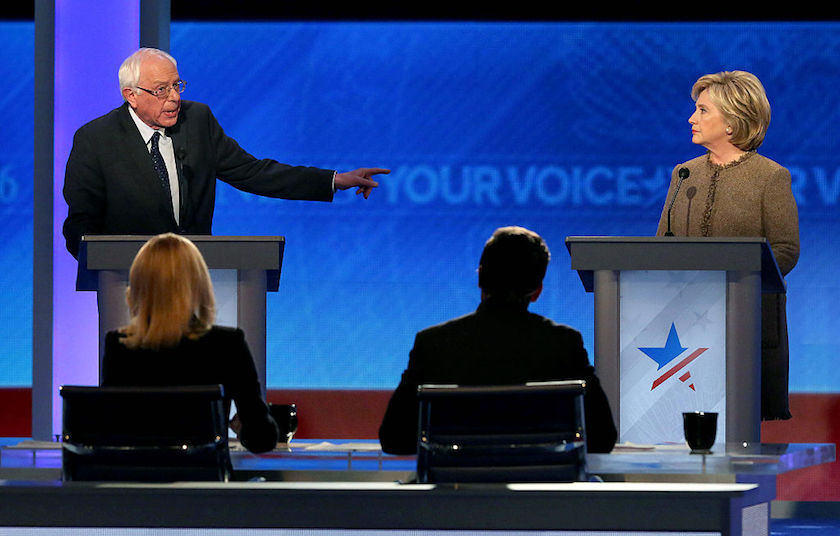
Democratic Presidential Candidates Debate In New Hampshire
MANCHESTER, NH - DECEMBER 19: Democratic president candidates (L to R) Bernie Sanders and Hillary Clinton debate at Saint Anselm College December 19, 2015 in Manchester, New Hampshire. This is the third Democratic debate featuring Democratic candidates Hillary Clinton, Bernie Sanders and Martin O'Malley. (Photo by Andrew Burton/Getty Images)Andrew Burton—Getty Images

Is there anything business leaders can learn from how politicians project their personalities on the campaign trail? Suzanne Bates thinks so.

“There’s always a vast group of voters whose visceral belief in a candidate, rather than knowledge of the issues, motivates them to go to the polls,” says Bates, CEO of Bates Communications. “Likewise, employees coming in to work every day are deciding whether to keep working for you, and how ‘engaged’ they’re going to be, based on how much, or how little, they trust you.”

Having coached executives at dozens of companies like Merck, Fidelity, American Express, Boeing, and Dow Chemical on polishing their public personae, Bates and her team have analyzed why some leaders draw more followers than others and have identified 15 specific attributes, explored in a new book, All the Leader You Can Be: The Science of Achieving Extraordinary Executive Presence.

“The usual definitions of executive presence, like ‘charisma’ and ‘command of the room’ are not really useful, because they’re so vague,” says Bates. “We wanted to pinpoint observable behaviors that affect how people perceive leaders.” Almost no one has all 15 of the strengths outlined in Bates’ book—among them humility, vision, appearance, and practical wisdom—but candidates who are poles apart politically share many of them.

Take, for instance, Donald Trump and Bernie Sanders. Nothing in common, you say? Think again. “Both candidates say exactly what they think, and mean what they say. They ‘tell it like it is,’” observes Bates. It’s a sign of what the Bates study calls authenticity, and a widespread yearning for it is behind the push for more transparency at companies.

Two other political opposites, Hillary Clinton and Jeb Bush, are struggling with a quality Bates has labeled restraint. There’s no question that composure under fire is an essential quality in a leader, but excessive calm can be too much of a good thing.

“Clinton’s long experience in the public eye has steeled her emotions to the point where she responds to crisis in ways that most people don’t believe are real,” says Bates. “She’s unruffled to a fault. So people tend not to trust her.” Bush, meanwhile, has shown so much restraint that “voters don’t see him as passionate,” says Bates. “That enabled Trump to label him ‘the low-energy candidate.’”

One lesson for business leaders, she says, is that “composure is a strength, but if you never show any negative emotion, especially in a crisis or in response to bad news, people won’t see you as authentic”—and nobody trusts a phony.

That matters, Bates adds, because “the definition of leadership is changing. People want to see more of leaders’ humanity and ability to connect to others.” Millennials in particular are “loyal to leaders who have a clear vision for the future and who also show authenticity, including being willing to talk candidly about their own experiences.”

A big difference between politicians and executives is that candidates get a constant flow of information on how they’re perceived, from polls and press coverage, and can tweak their message accordingly.

Business leaders, by contrast, “almost never get honest feedback, unless they seek it out,” Bates says. “Even if you think you’re coming across as authentic and trustworthy, the people under you may not see it.” In an era of intense competition for talent, she adds, that gap in perception makes employees more likely to vote with their feet.


Latest in Leadership

Workplace CultureBrainstorm Design
How two leaders used design thinking and a focus on outcomes to transform two Fortune 500 giants
By Christina PantinDecember 4, 2025
2 hours ago
Rich woman lounging on boat
SuccessWealth
The wealthy 1% are turning to new status symbols that can’t be bought—and it’s hurting Dior, Versace, and Burberry
By Emma BurleighDecember 3, 2025
12 hours ago
Mark Zuckerberg, chief executive officer of Meta Platforms Inc., during the Meta Connect event in Menlo Park, California, US, on Wednesday, Sept. 25, 2024.
AIMeta
Inside Silicon Valley’s ‘soup wars’: Why Mark Zuckerberg and OpenAI are hand-delivering soup to poach talent
By Eva RoytburgDecember 3, 2025
12 hours ago
Alex Karp smiles on stage
Big TechPalantir Technologies
Alex Karp credits his dyslexia for Palantir’s $415 billion success: ‘There is no playbook a dyslexic can master … therefore we learn to think freely’
By Lily Mae LazarusDecember 3, 2025
13 hours ago
Isaacman
PoliticsNASA
Billionaire spacewalker pleads his case to lead NASA, again, in Senate hearing
By Marcia Dunn and The Associated PressDecember 3, 2025
13 hours ago
UPS
LawUPS
Lawyer blasts UPS for favoring profits over safety after fiery, deadly crash in Kentucky
By Jeffrey Collins and The Associated PressDecember 3, 2025
14 hours ago

Most Popular

placeholder alt text
North America
Jeff Bezos and Lauren Sánchez Bezos commit $102.5 million to organizations combating homelessness across the U.S.: ‘This is just the beginning’
By Sydney LakeDecember 2, 2025
2 days ago
placeholder alt text
Economy
Ford workers told their CEO 'none of the young people want to work here.' So Jim Farley took a page out of the founder's playbook
By Sasha RogelbergNovember 28, 2025
6 days ago
placeholder alt text
North America
Anonymous $50 million donation helps cover the next 50 years of tuition for medical lab science students at University of Washington
By The Associated PressDecember 2, 2025
2 days ago
placeholder alt text
C-Suite
MacKenzie Scott's $19 billion donations have turned philanthropy on its head—why her style of giving actually works
By Sydney LakeDecember 2, 2025
2 days ago
placeholder alt text
Innovation
Google CEO Sundar Pichai says we’re just a decade away from a new normal of extraterrestrial data centers
By Sasha RogelbergDecember 1, 2025
3 days ago
placeholder alt text
Economy
Scott Bessent calls the Giving Pledge well-intentioned but ‘very amorphous,’ growing from ‘a panic among the billionaire class’
By Nick LichtenbergDecember 3, 2025
14 hours ago
Rankings
  • 100 Best Companies
  • Fortune 500
  • Global 500
  • Fortune 500 Europe
  • Most Powerful Women
  • Future 50
  • World’s Most Admired Companies
  • See All Rankings
Sections
  • Finance
  • Leadership
  • Success
  • Tech
  • Asia
  • Europe
  • Environment
  • Fortune Crypto
  • Health
  • Retail
  • Lifestyle
  • Politics
  • Newsletters
  • Magazine
  • Features
  • Commentary
  • Mpw
  • CEO Initiative
  • Conferences
  • Personal Finance
  • Education
Customer Support
  • Frequently Asked Questions
  • Customer Service Portal
  • Privacy Policy
  • Terms Of Use
  • Single Issues For Purchase
  • International Print
Commercial Services
  • Advertising
  • Fortune Brand Studio
  • Fortune Analytics
  • Fortune Conferences
  • Business Development
About Us
  • About Us
  • Editorial Calendar
  • Press Center
  • Work At Fortune
  • Diversity And Inclusion
  • Terms And Conditions
  • Site Map

© 2025 Fortune Media IP Limited. All Rights Reserved. Use of this site constitutes acceptance of our Terms of Use and Privacy Policy | CA Notice at Collection and Privacy Notice | Do Not Sell/Share My Personal Information
FORTUNE is a trademark of Fortune Media IP Limited, registered in the U.S. and other countries. FORTUNE may receive compensation for some links to products and services on this website. Offers may be subject to change without notice.