Late last month at a test facility outside of West Palm Bach, Fla., a self-piloting Black Hawk helicopter—made by Connecticut-based Sikorsky Aircraft—hovered into position over a simulated disaster zone. Unaided by its human handlers, the robotic aircraft selected a safe landing zone for the cargo suspended from its belly via tether—in this case, a robotic ground vehicle—and safely deposited it on the ground. The autonomous helicopter then turned for home, having passed what U.S. Army officials called a critical test of its autonomous flight capabilities.
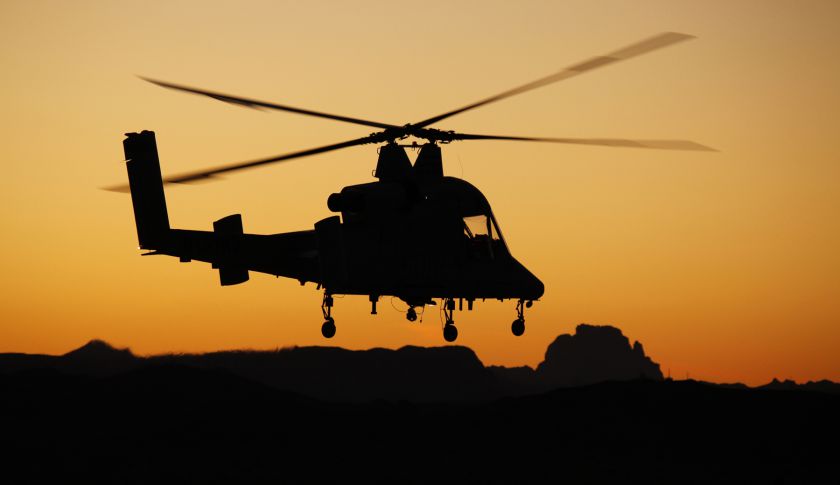
Sikorsky’s Black Hawk exists at the very bleeding edge of what’s currently possible in autonomous helicopter flight, but it doesn’t exist there alone. In 2011 Lockheed Martin’s unmanned, autonomous K-MAX helicopter deployed with the Marine Corps to Afghanistan where it piloted itself over treacherous terrain to supply forward-deployed Marines, hauling nearly 4.5 million pounds of cargo over three years.
Lockheed and Sikorsky lead the world in this kind of autonomous helicopter technology, so when Lockheed (LMT) completed its $9 billion acquisition of Sikorsky last week it didn’t just become the world’s largest maker of military helicopters. It also became the maker of the world’s most sophisticated autonomous helicopters, with no clear competition in sight.
In dollar terms that’s roughly the least significant part of the larger Lockheed-Sikorsky deal. But as the U.S. military seeks new ways to do with more with less and Lockheed prepares to deliver its first autonomous K-MAX to a civilian customer as soon as next year, that could soon change. Both Lockheed and Sikorsky are already transforming airborne logistics for the U.S. military, and they could soon transform airborne logistics for industry as well.
“Lockheed and Sikorsky are both leaders in these technologies,” says Jay McConville, Lockheed’s director of business development for unmanned integrated systems. “Now that we are one company we’re gong to build on that, and I think we’ll be able to bring solutions to our customers in a very diverse mission set.”
That’s another way of saying that merging Sikorsky’s engineers, patents, and expertise with Lockheed’s own extensive technological know-how will stretch the boundaries of autonomous helicopter flight and what it can achieve. The acquisition puts Lockheed at the front of the line for future Pentagon contracts for autonomous cargo-hauling as both the Army and Marines Corps seek better automated logistics. The company is also in talks with several potential customers including oil and gas companies, humanitarian relief organizations, and the U.S. Department of the Interior that could bring robotic helicopters to any number of civilian and commercial roles over the next few years.
The company sees self-piloting helicopters as an ideal solution for heavy industries that need to move equipment and resources over long distances or over austere and dangerous environments. For example, this technology could benefit energy companies in building infrastructure on the north shore of Alaska, or logging operations moving heavy equipment and timber around remote areas. For both the military and industry, automating routine airborne deliveries keeps human air crews out of harm’s way and well-rested for more complex missions that require a human at the stick.
Lockheed is also placing a particular emphasis on what K-MAX has to offer civil authorities battling wildfires from the air. Typically firefighters can only use their aircraft during daylight hours, and even then vision-obscuring haze will often ground them in low light conditions. K-MAX could operate day and night and in any visibility conditions, McConville says, all while keeping pilots out of harm’s way.
Last month Lockheed hosted a demo for the U.S. Department of the Interior outside of Boise, Idaho, in which an unmanned K-MAX repeatedly filled a bucket slung from its belly with water from a pond and dropped it at precise points around a simulated wildfire. Next week another demo in upstate New York will demonstrate K-MAX’s ability to autonomously work alongside a smaller spotting drone to seek out and suppress hot spots in another simulated wildfire environment.
Demonstrations like these and Sikorsky’s recent Black Hawk test continue to further the business case for autonomous flight, and prove that value helps push the state of the art in autonomous flight, says Army chief roboticist Dr. Robert Sadowski of the U.S. Army Tank Automotive Research Development and Engineering Center, or TARDEC. He added, “for me, if we can solve this and show that this has a demonstrated benefit, then the community at large can take a little more risk in other areas.”
That’s good news as other players in the traditional tech industry search for autonomous flight solutions to real-world problems. Self-piloting Black Hawks aren’t exactly the “delivery drones” envisioned by Amazon (AMZN) and Google (GOOG) that would zip around suburban landscapes dropping two-pound packages on customers’ doorsteps. But the overarching goal of enhanced automated aerial logistics and the underlying technologies are largely the same.
“Google, Amazon, these smaller services that want to do autonomous delivery—it’s not a huge stretch,” Sadowski says. “Some of these technologies will help us get there. Are we there yet? No. But we’re getting closer.”
For more on the drone industry, watch this Fortune video.
Subscribe to Data Sheet, Fortune’s daily newsletter on the business of technology.