• Home
  • Latest
  • Fortune 500
  • Finance
  • Tech
  • Leadership
  • Lifestyle
  • Rankings
  • Multimedia
Tech3d printing

How a Carnegie Mellon Professor Made a MakerBot a Cheap Bioprinter

By
Andrew Zaleski
Andrew Zaleski
Down Arrow Button Icon
By
Andrew Zaleski
Andrew Zaleski
Down Arrow Button Icon
November 4, 2015, 12:19 PM ET
Courtesy of Carnegie Mellon University

The question Carnegie Mellon University professor Adam Feinberg was trying to answer was how he could produce bioprints of cellular structures that wouldn’t collapse under their own weight while being printed. Being able to do that on the cheap would be nice, too, since industrial-size bioprinters cost more than $100,000.

One hacked MakerBot Replicator printer later, and he had his answer.

Since 2010, Feinberg has been working on a way to 3D print scaffolds, or cellular structures, that mimic what the heart does during embryonic development. The implications could be huge: Print such a scaffold from biomaterials mixed together with the right human stem cells, and one might be able to mature the printed product into heart muscle tissue. Heart muscle tissue, once damaged, is able to regenerate only in small amounts. Having a way to bioprint implantable heart tissue would be the first step in reducing the number of Americans waiting for a heart transplant—about 4,000, according to the United Network for Organ Sharing.

“Heart disease is the number one cause of death in adults,” says Feinberg. “So we’re trying to use the way the heart develops during embryonic development as a guide to rebuild heart muscle.”

But the challenge in bioprinting cellular scaffolds is in the softness of the materials. In this case, Feinberg has been using collagen, a protein found in skin, muscles, and tendons, and fibrin, a protein that helps in blood clotting. Layering these materials sometimes has the effect of producing a bioprinted object that collapses under the weight of air.

“They’re very, very soft. It’s the chemical properties of Jell-O,” Feinberg says. “If you start to create complex structures inside of that, it’s totally going to collapse.”

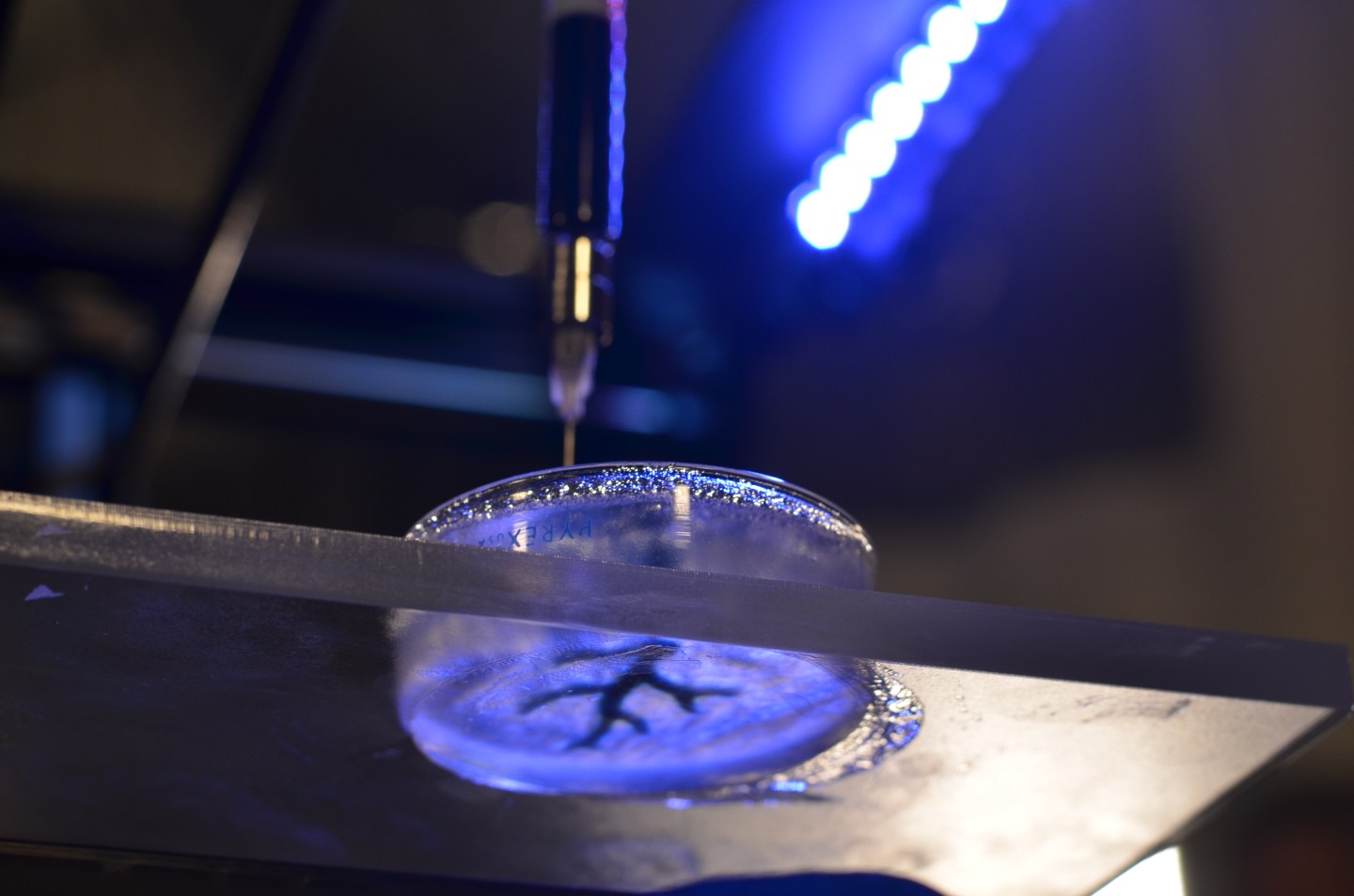
Feinberg’s innovation was to 3D print the cellular structures inside of a support gel of gelatin microparticles. He swapped out the standard MakerBot extruder—the piece that pushes out the material that would create a 3D-printed plastic object—and replaced it with a syringe. All the same software is used—his hacked MakerBot thinks it’s just printing a plastic object—but using a syringe allows Feinberg to 3D-print cellular structures inside of that support gel, which acts a little bit like mayonnaise: It’ll behave like a solid, and therefore cradle the cellular structure printed inside of it, but has just enough bend to it to allow a syringe extruding biomaterial to travel through it. The support gel melts away when heated to 98.6 degrees Fahrenheit, or normal human body temperature. What’s more, bioprinting with a syringe means Feinberg isn’t stacking a structure layer by layer, but printing continuously in a helix shape, kind of like how the 3Doodler pen works.

“The advance here is using a wider range of biomaterials and doing it at a higher resolution than you get with other systems,” he says. “Other systems that print in air are kind of limited in the complexity they can print in 3D. Our system allows us to get around that because we support it so well.”

So far Feinberg has bioprinted copies of coronary arteries and embryonic hearts using data collected from MRI images. The next step is incorporating real heart cells into these bioprinted structures as a way to regrow heart muscle tissue and testing the tissue’s survivability. But all told, it cost less than few thousand dollars for Feinberg to pull off his method of bioprinting, which is estimated to be a multi-billion-dollar market by the end of this decade. Large companies like Stratasys and 3D Systems are predicted to be big players in the bioprinting field. While Feinberg’s work is all research—he plans to release his 3D bioprints on the National Institute of Health’s open-source file database—the hack he performed spells good news for the growing number of startups beginning to tackle the bioprinting field.

“Having these technologies at a much, much lower cost will just accelerate the field,” Feinberg says.

For more on how technology is transforming healthcare, check out this Fortune video:

Subscribe to Data Sheet, Fortune’s daily newsletter on the business of technology.
About the Author
By Andrew Zaleski
See full bioRight Arrow Button Icon

Latest in Tech

Finance
Lorem ipsum dolor sit amet, consectetur adipiscing elit, sed do eiusmod tempor incididunt ut labore et dolore magna aliqua. Ut enim ad minim veniam
By Fortune Editors
October 20, 2025
Finance
Lorem ipsum dolor sit amet, consectetur adipiscing elit, sed do eiusmod tempor incididunt ut labore et dolore magna aliqua. Ut enim ad minim veniam
By Fortune Editors
October 20, 2025
Finance
Lorem ipsum dolor sit amet, consectetur adipiscing elit, sed do eiusmod tempor incididunt ut labore et dolore magna aliqua. Ut enim ad minim veniam
By Fortune Editors
October 20, 2025
Finance
Lorem ipsum dolor sit amet, consectetur adipiscing elit, sed do eiusmod tempor incididunt ut labore et dolore magna aliqua. Ut enim ad minim veniam
By Fortune Editors
October 20, 2025
Finance
Lorem ipsum dolor sit amet, consectetur adipiscing elit, sed do eiusmod tempor incididunt ut labore et dolore magna aliqua. Ut enim ad minim veniam
By Fortune Editors
October 20, 2025
Finance
Lorem ipsum dolor sit amet, consectetur adipiscing elit, sed do eiusmod tempor incididunt ut labore et dolore magna aliqua. Ut enim ad minim veniam
By Fortune Editors
October 20, 2025

Most Popular

Finance
Lorem ipsum dolor sit amet, consectetur adipiscing elit, sed do eiusmod tempor incididunt ut labore et dolore magna aliqua. Ut enim ad minim veniam
By Fortune Editors
October 20, 2025
Finance
Lorem ipsum dolor sit amet, consectetur adipiscing elit, sed do eiusmod tempor incididunt ut labore et dolore magna aliqua. Ut enim ad minim veniam
By Fortune Editors
October 20, 2025
Finance
Lorem ipsum dolor sit amet, consectetur adipiscing elit, sed do eiusmod tempor incididunt ut labore et dolore magna aliqua. Ut enim ad minim veniam
By Fortune Editors
October 20, 2025
Finance
Lorem ipsum dolor sit amet, consectetur adipiscing elit, sed do eiusmod tempor incididunt ut labore et dolore magna aliqua. Ut enim ad minim veniam
By Fortune Editors
October 20, 2025
Finance
Lorem ipsum dolor sit amet, consectetur adipiscing elit, sed do eiusmod tempor incididunt ut labore et dolore magna aliqua. Ut enim ad minim veniam
By Fortune Editors
October 20, 2025
Finance
Lorem ipsum dolor sit amet, consectetur adipiscing elit, sed do eiusmod tempor incididunt ut labore et dolore magna aliqua. Ut enim ad minim veniam
By Fortune Editors
October 20, 2025
Rankings
  • 100 Best Companies
  • Fortune 500
  • Global 500
  • Fortune 500 Europe
  • Most Powerful Women
  • Future 50
  • World’s Most Admired Companies
  • See All Rankings
Sections
  • Finance
  • Leadership
  • Success
  • Tech
  • Asia
  • Europe
  • Environment
  • Fortune Crypto
  • Health
  • Retail
  • Lifestyle
  • Politics
  • Newsletters
  • Magazine
  • Features
  • Commentary
  • Mpw
  • CEO Initiative
  • Conferences
  • Personal Finance
  • Education
Customer Support
  • Frequently Asked Questions
  • Customer Service Portal
  • Privacy Policy
  • Terms Of Use
  • Single Issues For Purchase
  • International Print
Commercial Services
  • Advertising
  • Fortune Brand Studio
  • Fortune Analytics
  • Fortune Conferences
  • Business Development
About Us
  • About Us
  • Editorial Calendar
  • Press Center
  • Work At Fortune
  • Diversity And Inclusion
  • Terms And Conditions
  • Site Map
  • Facebook icon
  • Twitter icon
  • LinkedIn icon
  • Instagram icon
  • Pinterest icon

Latest in Tech

EconomyFintech
Dorsey’s Block cutting up to 10% of staff in efficiency push
By Natasha Mascarenhas, Emily Mason and BloombergFebruary 7, 2026
9 hours ago
US Secretary of Defense Pete Hegseth, left, listens to Jacob DeWitte, CEO of Oklo, speak as US President Donald Trump signs executive orders in the Oval Office of the White House in Washington, DC, on May 23, 2025.
EnergyNuclear
Next-gen nuclear’s tipping point: Meta and hyperscalers start deals with Bill Gates’ TerraPower, Sam Altman-backed Oklo, and more
By Jordan BlumFebruary 7, 2026
10 hours ago
EconomyDebt
Elon Musk warns the U.S. is ‘1,000% going to go bankrupt’ unless AI and robotics save the economy from crushing debt
By Jason MaFebruary 7, 2026
13 hours ago
Future of Workthe future of work
Anthropic cofounder says studying the humanities will be ‘more important than ever’ and reveals what the AI company looks for when hiring
By Jason MaFebruary 7, 2026
15 hours ago
sarandos
CommentaryAntitrust
Netflix dominates streaming. No wonder it’s trying to redefine the market
By Hal SingerFebruary 7, 2026
16 hours ago
AIMark Cuban
AI can make anyone rich: Mark Cuban says it could turn ‘just one dude in a basement’ into a trillionaire
By Sydney LakeFebruary 7, 2026
17 hours ago

Most Popular

placeholder alt text
Success
Even with $850 billion to his name, Elon Musk admits ‘money can’t buy happiness.’ But billionaire Mark Cuban says it’s not so simple
By Preston ForeFebruary 6, 2026
2 days ago
placeholder alt text
Success
Gen Z Patriots quarterback Drake Maye still drives a 2015 pickup truck even after it broke down on the highway—despite his $37 million contract
By Sasha RogelbergFebruary 7, 2026
22 hours ago
placeholder alt text
Success
Nestlé’s CEO drinks 8 coffees a day, but says Gen Z staffers are his secret to staying sharp by ‘learning constantly’
By Emma BurleighFebruary 5, 2026
3 days ago
placeholder alt text
Success
Larry Ellison and Jeff Bezos have seen more than $66 billion swiped from their net worths since the start of this year as AI-driven slump sees tech billionaires’ wealth free-fall
By Emma BurleighFebruary 6, 2026
2 days ago
placeholder alt text
Personal Finance
Current price of gold as of February 6, 2026
By Danny BakstFebruary 6, 2026
2 days ago
placeholder alt text
Crypto
Bitcoin whales and ETFs are bailing out of the market; UBS warns: ‘Crypto is not an asset’
By Jim EdwardsFebruary 6, 2026
2 days ago

© 2026 Fortune Media IP Limited. All Rights Reserved. Use of this site constitutes acceptance of our Terms of Use and Privacy Policy | CA Notice at Collection and Privacy Notice | Do Not Sell/Share My Personal Information
FORTUNE is a trademark of Fortune Media IP Limited, registered in the U.S. and other countries. FORTUNE may receive compensation for some links to products and services on this website. Offers may be subject to change without notice.