There’s a silent killer wreaking havoc on our economy.
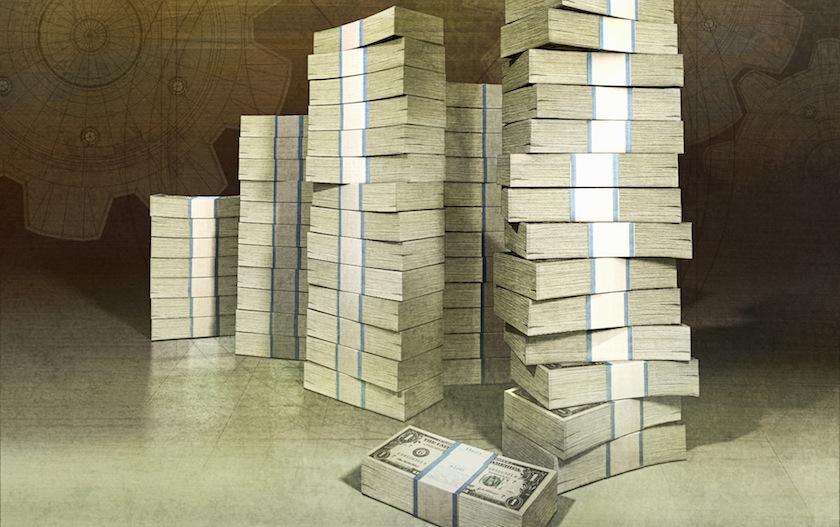
Last year, the CEOs of the S&P 500 cost their companies nearly $7 billion in wages and bonuses, according to the AFL-CIO. Or put another way, the average annual income paid by a company for a CEO in the S&P 500 last year was almost 45% higher than the average annual income for the top 0.1% (i.e. those in the 99.9 percentile earnings bracket), according to data from the Tax Policy Center quoted by the New York Times.
But $7 billion is just a drop in the bucket compared to the real price tag. The damage top executive compensation plans are inflicting on job creation, educational opportunity, investment, health, and economic prosperity far outweigh the billions in payouts that the CEOs and other executives have received.
Executive pay plans across U.S. companies are constructed pretty much alike. The one-size-fits-all approach provides “safety in numbers” for boards that approve the packages. But using the lemmings’ playbook means the outcomes of poorly designed plans are multiplied across companies, industries, and the economy as a whole with disastrous consequences.
The nearly universal decision by boards to pay executives in stock (and less frequently today, stock options) can create huge payoffs for CEOs. As specific examples, a recent Conference Board/Arthur J. Gallagher & Co report showed that CEO David Zaslav cost Discovery Communications (DISCA) $156 million in compensation last year, of which $145 million was in stock and stock options. CEO Satya Nadella cost Microsoft (MSFT) $84 million, of which $80 million was in stock awards. And CEO Larry Ellison cost Oracle (ORCL) $67 million, $65 million of which was in stock options.
The choice by boards to pay CEOs in stock and stock options may seem innocent enough, but the incentives those plans provide to boost stock prices unwittingly produce much more damage than the multimillion dollars in pay. Sam Pizzigati, author of The Rich Don’t Always Win, told me that with these “outrageously huge awards, [the CEOs will ] do whatever it takes to raise stock price” and “by offering such a disproportionate amount to one person or small group, the company undermines morale and attacks the productivity of the enterprise.”
This strong incentive to control stock prices can result in corporate decisions to hide bad news and to manipulate their financials. It also compels executives to engage in behavior directly tied to the mood of the market. When the market is exuberant, CEOs will take on excessive risk to boost a company’s stock price. When that works, like a monkey with a lever for a grape, the CEO will do it again—and again and again—until the market overheats and the bubble bursts. And that’s how paying in stock and stock options creates economic bubbles, researchers and university professors at Columbia and Pace, John Donaldson and Natalia Gershun, say. Once this happens and the market becomes fearful, CEOs will cut costs to boost their company’s stock price. When that works, CEOs will again keep cutting costs repetitively until that stops working. In so doing, they create deeper recessions and economic volatility, which when mimicked and multiplied across the economy devastate the finances and health of ordinary people.
According to research firm Factset’s data, in the last 10 years thru July 31, S&P 500 companies have spent $4.2 trillion on buying back their own stock. And in the last 12 months, the amount they spent on stock buybacks was more “than they generated in free cash flow.”
Why do companies choose to buy their own stock back and risk their workers’ health rather than, say, hire enough workers to cover all the shifts of a 24/7 business world? Or buy their own stock and risk reputational hits like McDonald’s (MCD) has rather than pay workers a living wage—pay which those workers would go out and spend in the economy? This summer even large investors questioned the size of McDonald’s and other companies’ buyback programs, noting that “95 percent of corporate earnings are being distributed to shareowners, prompting us to question whether companies are adequately reinvesting for sustainable returns over the long-term.” Or why do companies incur the costs of buying their own stock while complaining they can’t find the staff they need? Why don’t they just invest in training programs to skill up workers?
None of it makes sense unless you look at the way boards have structured incentive pay for CEOs. Factset research analyst Andrew Birstingl told me that the use of the earnings per share (EPS) metric that is prevalent in pay plans has helped to fuel the stock buyback boom. Buying back stock is a way to boost EPS by decreasing the shares outstanding, he says, without having to deliver earnings. Ed Yardeni, president and chief investment strategist of Yardeni Research, told me that paying executives in stock and stock options has been an important driver in corporate stock buybacks. Those forms of compensation became ubiquitous after tax law changes two decades ago gave an advantage to awards in stock.
Okay—so this is our current reality. But if we take on the skepticism of a Martian, a couple of questions immediately come to mind. Who in their right mind would provide multimillion dollar reasons for CEOs to wreck the economy? And who in their right mind would think that CEOs—or anyone else—should get paid millions for simply taking other people’s money (i.e. corporate cash) and using it to buy a readily marketed security (i.e. the company’s stock)? If boards think that is worth paying someone to do, I think we can all think of less expensive alternatives. Here’s an idea: Let’s train a monkey or a robot to do that. As for revamping compensation plans, if properly programmed, either one could do better than boards have.
We all know that it’s easier sometimes to drink the Kool-Aid that is being served rather than question the host. Consider Volkswagen where “Dozens’ of managers [have been] implicated in [the] Volkswagen scandal.” Or all the banks involved in Libor manipulation, in selling junk credit, or any number of other rotten activities.
No, your parents were right. Life is like high school—and CEO compensation today is like kindergarten. Just because everyone you know is doing it and defends it to the hilt means it’s probably wrong.
Eleanor Bloxham is CEO of The Value Alliance and Corporate Governance Alliance (http://www.thevaluealliance.com), an independent board education and advisory firm she founded in 1999. She has been a regular contributor to Fortune since April 2010 and is the author of two books on corporate governance and valuation, Economic Value Management: Applications and Techniques and Value-led Organizations.