Some time ago, I was chatting with my friend Rajiv Dutta about how a new hire was panning out, frustrated that this person didn’t seem to be getting up to speed swiftly enough.
Dutta, the former president of Skype and PayPal, counseled me to suspend my rush to judgment. “It often takes a year,” he said, “until you see what somebody is actually good at.”
I always considered Dutta, who passed away in 2011, to be unusually wise. Now I realize that he was also unusually patient.
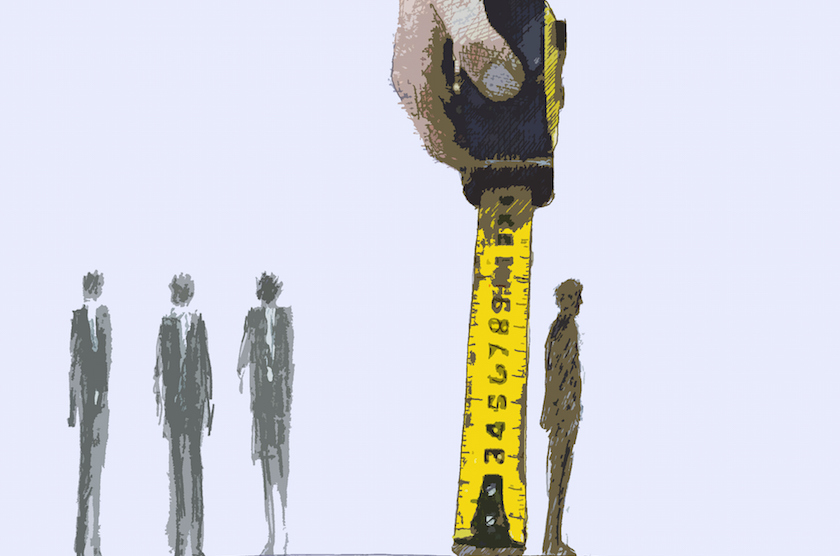
A survey of 319 executives at companies with revenue of $1 billion or more has found that 27% think that employers form an initial opinion as to whether an entry-level employee will be successful or not in less than two weeks. Seventy-eight percent think that employers make this determination in less than three months.
The survey, which was conducted by Harris Poll and will be released publicly next week, was fielded on behalf of Fullbridge, a company that teaches students and young professionals hard and soft business skills.
For Fullbridge, the takeaway from the survey results is clear: People must come into a job ready to make a mark from the get-go, even if they’re brand new to the world of work.
At more and more companies, from the moment you walk in the door, “they’re judging you every second,” says Candice Olson, Fullbridge’s co-founder and executive chair. “It’s not a very forgiving learning environment at many places” for a novice.
As I’ve written before, while many corporations invested a great deal in training young workers five or six decades ago, far fewer do so today—a casualty of the shredding of the traditional social contract between employer and employee. According to a 2012 study of 500 companies of varying sizes across the U.S., a third of them spend no money at all to onboard new hires, and the average amount spent per worker on such efforts is a mere $67.
“Oftentimes, the lack of a robust . . . assimilation process leaves the new employee confused and disoriented,” says Bill Conaty, who served as senior vice president of human resources at General Electric for nearly 15 years.
This gap is exactly what Fullbridge and a handful of others—including Koru, the Tuck Business Bridge Program, MiddCORE, and General Assembly—have stepped in to fill.
And yet, even if someone is fortunate enough to go through one of these boot camps—and, remember, only a tiny fraction of the millions of recent college grads about to enter the workforce are, in fact, so lucky—is it really smart or fair to size up a new employee in a couple of weeks, or even a few months?
Mike Bender believes it is. The senior director of agency sales at Fiksu, a mobile marketing company, says that he doesn’t expect anyone to be “awesome at their job” in two weeks. But he feels that he can tell in that time—with about 90% accuracy—whether a new hire is “professional, hardworking, and willing to learn.”
To some degree, evaluating people so quickly is inescapable. “Everyone has a gut feel,” says Keith Rollag, a management professor at Babson College and the author of What to Do When You’re New. “It’s impossible for you not to have one.”
What’s more, there’s always the likelihood that your organization has made a truly terrible hire and that you have a toxic employee or a total crank on your hands. In that case, you need to fire the person without delay.
At the same time, making a hasty assessment can backfire. Numerous researchers have proven the power of “first-impression bias” in which every new observation or piece of information you pull in automatically reinforces your initial take.
With this in mind, Rollag worries that it’s all too easy to confuse personality with performance. In certain work environments, for instance, employees who are more talkative may come across well at the outset, while those who are more introspective may be viewed as ineffective. The former may then get lots of help and encouragement, while the latter aren’t adequately supported, so that their ultimate failure becomes a self-fulfilling prophecy.
Even if a newbie is having trouble, it can be well worth taking the time to find an assignment that is a better match for their strengths.
“Have compassion for your worst performers,” Laszlo Bock, Google’s senior vice president for People Operations, advises in his book Work Rules!. “If you’re getting hiring right, most of those who struggle do so because you’ve put them in the wrong role, not because they are inept.”
The key for managers is to be conscious of their own biases, and to gather additional feedback—from supervisors, teammates, and administrative staff in the department—on how someone is faring. “Their collective wisdom is probably a far better predictor than the manager’s own,” Rollag says.
In the end, for some jobs, it will make sense to follow Dutta’s guidance and give a person a full year to grow into an organization. Conaty suggests that while a fortnight is too fast, three months is probably not unreasonable to get at least a basic handle on a new hire. “Within 90 days,” he says, “hopefully they’ve figured out the system or they might be the wrong cultural fit.”
Of course, none of this matters for those being measured in less than two weeks. Like it or not, plenty of employers seem to be demanding that their employees show they can gallop right out of the gate.
Rick Wartzman is the executive director of the Drucker Institute at Claremont Graduate University. The author or editor of five books, he is currently writing a narrative history of how the social contract between employer and employee in America has changed since the end of World War II.