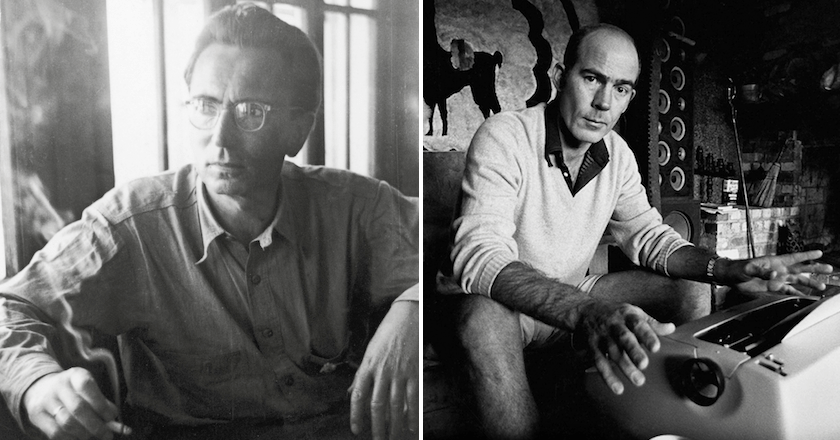
How do we learn to take the kinds of risks that infuse our souls with inspiration, propel our lives forward, and connect us with our own authenticity? Journalist Hunter Thompson and Holocaust survivor and psychiatrist Viktor Frankl—about as divergent in their life missions and experiences as it’s possible to be—shared a conviction that it is through the search for significance that people ultimately find their true life’s purpose. In the 1983 preface of his Auschwitz memoir, Man’s Search for Meaning, Frankl writes, “Don’t aim for success—the more you aim at it and make it a target, the more you are going to miss it. For success, like happiness, cannot be pursued; it must ensue, and it only does so as the unintended side-effect of one’s personal dedication to a cause greater than oneself …” Frankl is proposing that the more we let go of externally defined work objectives, and the more we are liberated to experiment, to explore the byways of different working paths, the more likely we are to find the one that suits us best.
In a recently unearthed 1958 letter to a friend, twenty-one-year-old Hunter Thompson—among the last people you might think to turn for safe career advice—challenged the friend to wake up, take charge, and find work that spoke to him. This applies to all of us, not just gonzo risk takers.
Each of us has a unique and deep-seated combination of beliefs, needs, desires, and sensibility—not necessarily wholly conscious, but nonetheless a vision—that guides our life. To do work out in the world, work that has consequence: entertaining people or changing their minds, helping them be healthier or more content, designing useful algorithms or clever new devices or beautiful clothing, getting rich or being the first earthling to walk on Mars. And if we’re conscious of those dreams, if we work at it and keep them at the top of our minds, and we’re lucky, they drive us to make certain choices—to go to art school, study engineering, become a lawyer … or intern at NASA or SpaceX.
Back in the eighteenth century, the Swiss mathematician Daniel Bernoulli approvingly suggested that people tend to make choices based less on quantifiable financial factors—this was a mathematician—and more on the projected emotional benefit of an outcome. The desire to be or to do good, to be engaged in work in which one feels real meaning and purpose, is key.
Deep down, people understand what matters most to them in a job. Nearly all of our thousands of survey respondents were very clear about what was most important to them in their work. And it wasn’t just a title or status or paycheck. They ranked the drivers of happiness in their work as follows:
1. Feeling appreciated.
2. Work that brings out the best in me.
3. Experiencing/learning new things.
4. Meaningful work.
But we know that the everyday details and vicissitudes of life get in the way. Inertia, fear, paying the bills, or other pressures and setbacks cause us to give up our dreams. In the research for my last book, I came across a concept from psychology called “emotion labor.” The labor part comes from the gap between how you feel at your most relaxed and natural and how you are obliged to act differently in different circumstances. When all cylinders are firing and we feel truly engaged and valued for the work we are doing, there is no gap between who we are and what we are doing. There is no emotion labor. When the gap between who we are and what we do for work is too great, trouble arises. For Thinkers and Defenders and Drifters—all of whom, according to the research for this book, are not so inclined to pay attention to their guts when making work decisions—reconnecting with what’s personally meaningful can become a defining anchor around which they can take risks exploring new kinds of work.
The goal of the hero’s journey is yourself, finding yourself. —Joseph Campbell
I think an upside to this moment of economic flux and volatility is that while old-fashioned set-and-forget career tracks are increasingly obsolete, if you can plausibly envision a particular kind of work that you want to be doing, chances are better than ever that you can figure out how to make it happen. So many of the forces that make our current world unsettling—digital transformation, outsourced project work, global competition, a premium on innovation and disruption—can work for you as well as against you.
The art of risk-taking is an odyssey of self-discovery. Finding and embracing your true north in your working life doesn’t mean that you have to dedicate yourself to capital-I “Important” work like curing diabetes or launching the next Facebook. Meaning can be derived from running a cozy farm-to-table bed-and-breakfast, or making certain that your team’s schedule always runs smoothly, or working in a job that guarantees you’re always home for dinner and never miss a child’s game or performance. The key is to develop confidence in what is most important to you and then to design your working life around that conviction.
It’s important to remember that getting a clear fix on your occupational lodestar doesn’t mean that your working life will thereafter be on a smooth, fixed track. Fixed career tracks are disappearing, autopiloting works for machines but not people, and everyone’s life circumstances are fluid—in response to which we each must constantly respond, adapt, change. In his memoir, The Night of the Gun, David Carr chose to go public in a big, risky way with a kind of personal truth telling that was brave for a New York Times reporter. “As Whitman suggested,” David told me, “we all ‘contain multitudes,’ and [my] history is a part of who I am.” Proceeding through life with his worst secrets “already manifest—there is something to be said for that.” Working from your core outward and being true to yourself simply means learning to align the values you consider important as best you can with what you’re good at and what you get paid to do. And realigning them again and again and again throughout your life.
The essence of bravery is being without self-deception. —Pema Chödrön
Excerpted from RISK/REWARD by Anne Kreamer Copyright © 2015 by Anne Kreamer. Excerpted by permission of Random House, a division of Penguin Random House LLC. All rights reserved. No part of this excerpt may be reproduced or reprinted without permission in writing from the publisher.