• Home
  • Latest
  • Fortune 500
  • Finance
  • Tech
  • Leadership
  • Lifestyle
  • Rankings
  • Multimedia
LeadershipWork 3.0

Wal-Mart, Starbucks, Aetna’s pay hikes: Why now?

By
Rick Wartzman
Rick Wartzman
Down Arrow Button Icon
March 4, 2015, 1:56 PM ET
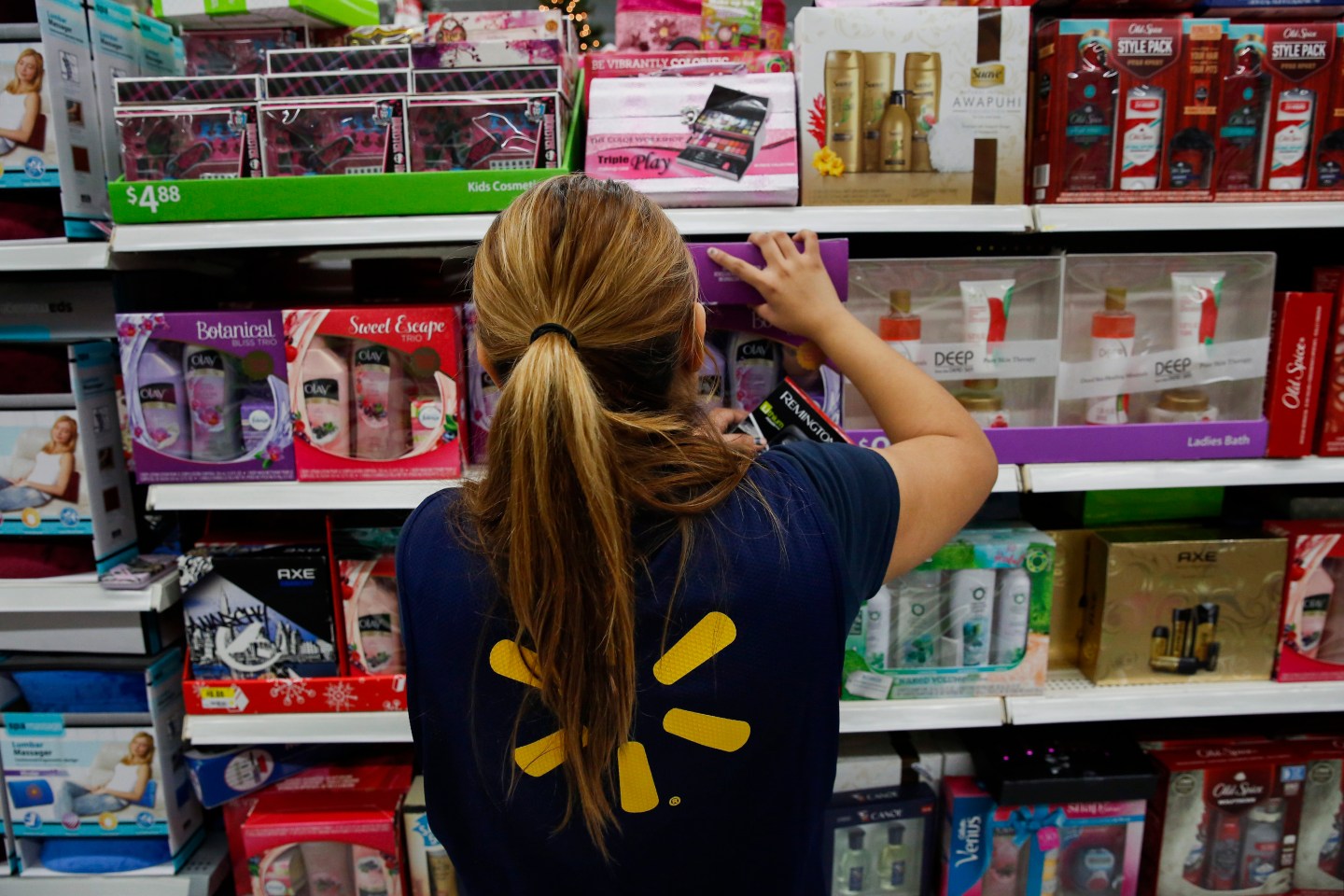
Operations Inside A Wal-Mart Stores Inc. Location Ahead Of Black Friday
An employee arranges beauty product gift boxes displayed for sale at a Wal-Mart Stores Inc. location ahead of Black Friday in Los Angeles, California, U.S., on Monday, November 24, 2014. Retailers are planning to open earlier on Thanksgiving day this year in a bid to draw shoppers. Wal-Mart Stores Inc. is making Black Friday, the shopping day after Thanksgiving, a weeklong event this year. Photographer: Patrick T. Fallon/Bloomberg via Getty ImagesPhotograph by Patrick T. Fallon — Bloomberg via Getty Images

Last week, it was TJX, the parent of T.J. Maxx and Marshalls. The previous week: Wal-Mart (WMT). Before that, it was Aetna, Starbucks, and Gap. One by one, corporate America suddenly seems inclined to lift its workers’ wages.

The question is, why?

Perhaps because Wal-Mart is the nation’s largest employer, with 1.3 million people on its U.S. payroll, its move has been the most heavily scrutinized, with observers trying to unearth the company’s true motive, the way Kremlinologists used to parse a decree from the Soviet Politburo.

Wal-Mart itself has stressed that the pay increase—which will raise its workers’ minimum wage from as little as $7.25 an hour to $9 in April and $10 next year—is just one part of an overall package that includes enhanced training and improved scheduling. The intention, says CEO Doug McMillon, is to “reignite the sense of ownership” that Wal-Mart’s employees have for the business so that, in turn, they’ll provide a better experience for customers.

Many economists, meanwhile, have suggested that Wal-Mart’s action is a simple and straightforward response to a tighter labor market. As the recovery from the Great Recession continues, offering workers more dough should help fill open vacancies and reduce employee turnover.

Others have maintained that the company, which is fiercely anti-union, succumbed to pressure applied by employees who have started to organize under the OUR Walmart banner.

But the most intriguing possible explanation for Wal-Mart’s decision to boost its workers’ pay comes from labor historian Nelson Lichtenstein, author of The Retail Revolution: How Wal-Mart Created a Brave New World of Business. As he sees it, Wal-Mart may be starting to realize that unless corporate America sticks more money in people’s pockets, overall consumer spending isn’t going to hold up over the long run—and that’s going to be bad for the entire economy.

“It’s kind of a classic Keynesian reason,” Lichtenstein told me, referring to economist John Maynard Keynes and his belief that low wages negatively affect aggregate consumer demand.

Whether Lichtenstein is right or not about Wal-Mart, there is evidence that more companies are worried about the fact that workers’ wages have been stagnant for decades. Last fall, just before the holidays, a study by the Center for American Progress found that 68% of the top 100 U.S. retailers had cited falling or flat incomes among consumers as risks to their business in their latest federal financial filings. That was double the number of companies that sounded such an alarm in 2006.

Lichtenstein notes that Wal-Mart in recent years has blamed rising payroll taxes that have cut into its customers’ purchasing power for its disappointing earnings. “They’re very sensitive to these things,” he says, adding that it’s not a huge stretch to see wage stagnation having the same fundamental effect.

Of course, it is farfetched to think that a wage boost by any one company can deliver significant economic ripples. “Even Wal-Mart is not going to change very much” in terms of the big picture, says Larry Summers, the Harvard professor and former Treasury secretary. Much more effective, he says, are broad-based policies such as government-mandated increases to the minimum wage and measures that strengthen industry-wide collective bargaining.

It’s worth remembering, though, that for a long time, some of the nation’s leading executives openly argued that businesses needed to pay their workers enough to keep the consumer economy humming.

The most oft-cited example is Henry Ford, who in 1914 famously doubled his workers’ wages to $5 a day. His employees thus became much more productive and far less inclined to quit. Summers, who has written about Ford’s gambit, says it makes sense that Wal-Mart would be looking to receive similar benefits today.

Yet Ford’s raise had wider ramifications. “Prosperous workers begat a prosperous marketplace, which in turn spawned more prosperous companies and in time the result was a new, conspicuously consumer-based economy,” Douglas Brinkley writes in Wheels for the World, his chronicle of Henry Ford and his company.

As the Roaring Twenties gave way to the Great Depression, some wished even more companies had followed Ford (F). Had profits been “distributed in wages, prosperity would have been maintained and increased,” the publishing baron William Randolph Hearst declared in 1931.

Edward Filene, the department-store entrepreneur, was equally adamant. “Low wages . . . are as bad for employers as they are for employees,” he asserted in 1936.

Eventually, with World War II underway, the economy began to soar. But the same logic about consumers held. “How am I going to sell my refrigerators if we don’t give ’em wages to buy with?” General Electric President Charlie Wilson asked in late 1944.

When Time magazine named General Motors President Harlow Curtice its Man of the Year in 1955, it highlighted the impressive wage gains made by GM workers. “People have got money,” the head of the largest department store in Flint, Mich., told Time. “They feel safe.” The Ad Council touted the era as one of “people’s capitalism.” Among the hallmarks of this concept were “high wages, high productivity, high purchasing power,” according to a two-page spread in Harper’s in 1956.

By the early 1970s, Americans had enjoyed a remarkable run of growing incomes and falling inequality. “The Keynesian problem was no longer a problem,” says the University of Michigan’s Mark Mizruchi, the author of The Fracturing of the American Corporate Elite. The chief concern now was raging inflation, which many attributed to a “wage-price spiral.”

Forty years later, “the Keynesian problem” appears to have returned. “Increased inequality contributes to . . . insufficient aggregate demand—too little spending by consumers and businesses to keep GDP at its capacity,” the Commission on Inclusive Prosperity, co-chaired by Summers, warned in January.

Indeed, all of this shows us that what goes around comes around—just like the money in people’s paychecks.

Rick Wartzman is the executive director of the Drucker Institute at Claremont Graduate University. The author or editor of five books, he is currently writing a narrative history of how the social contract between employer and employee in America has changed since the end of World War II.


About the Author
By Rick Wartzman
See full bioRight Arrow Button Icon

Latest in Leadership

Finance
Lorem ipsum dolor sit amet, consectetur adipiscing elit, sed do eiusmod tempor incididunt ut labore et dolore magna aliqua. Ut enim ad minim veniam
By Fortune Editors
October 20, 2025
Finance
Lorem ipsum dolor sit amet, consectetur adipiscing elit, sed do eiusmod tempor incididunt ut labore et dolore magna aliqua. Ut enim ad minim veniam
By Fortune Editors
October 20, 2025
Finance
Lorem ipsum dolor sit amet, consectetur adipiscing elit, sed do eiusmod tempor incididunt ut labore et dolore magna aliqua. Ut enim ad minim veniam
By Fortune Editors
October 20, 2025
Finance
Lorem ipsum dolor sit amet, consectetur adipiscing elit, sed do eiusmod tempor incididunt ut labore et dolore magna aliqua. Ut enim ad minim veniam
By Fortune Editors
October 20, 2025
Finance
Lorem ipsum dolor sit amet, consectetur adipiscing elit, sed do eiusmod tempor incididunt ut labore et dolore magna aliqua. Ut enim ad minim veniam
By Fortune Editors
October 20, 2025
Finance
Lorem ipsum dolor sit amet, consectetur adipiscing elit, sed do eiusmod tempor incididunt ut labore et dolore magna aliqua. Ut enim ad minim veniam
By Fortune Editors
October 20, 2025

Most Popular

Finance
Lorem ipsum dolor sit amet, consectetur adipiscing elit, sed do eiusmod tempor incididunt ut labore et dolore magna aliqua. Ut enim ad minim veniam
By Fortune Editors
October 20, 2025
Finance
Lorem ipsum dolor sit amet, consectetur adipiscing elit, sed do eiusmod tempor incididunt ut labore et dolore magna aliqua. Ut enim ad minim veniam
By Fortune Editors
October 20, 2025
Finance
Lorem ipsum dolor sit amet, consectetur adipiscing elit, sed do eiusmod tempor incididunt ut labore et dolore magna aliqua. Ut enim ad minim veniam
By Fortune Editors
October 20, 2025
Finance
Lorem ipsum dolor sit amet, consectetur adipiscing elit, sed do eiusmod tempor incididunt ut labore et dolore magna aliqua. Ut enim ad minim veniam
By Fortune Editors
October 20, 2025
Finance
Lorem ipsum dolor sit amet, consectetur adipiscing elit, sed do eiusmod tempor incididunt ut labore et dolore magna aliqua. Ut enim ad minim veniam
By Fortune Editors
October 20, 2025
Finance
Lorem ipsum dolor sit amet, consectetur adipiscing elit, sed do eiusmod tempor incididunt ut labore et dolore magna aliqua. Ut enim ad minim veniam
By Fortune Editors
October 20, 2025
Rankings
  • 100 Best Companies
  • Fortune 500
  • Global 500
  • Fortune 500 Europe
  • Most Powerful Women
  • Future 50
  • World’s Most Admired Companies
  • See All Rankings
Sections
  • Finance
  • Leadership
  • Success
  • Tech
  • Asia
  • Europe
  • Environment
  • Fortune Crypto
  • Health
  • Retail
  • Lifestyle
  • Politics
  • Newsletters
  • Magazine
  • Features
  • Commentary
  • Mpw
  • CEO Initiative
  • Conferences
  • Personal Finance
  • Education
Customer Support
  • Frequently Asked Questions
  • Customer Service Portal
  • Privacy Policy
  • Terms Of Use
  • Single Issues For Purchase
  • International Print
Commercial Services
  • Advertising
  • Fortune Brand Studio
  • Fortune Analytics
  • Fortune Conferences
  • Business Development
About Us
  • About Us
  • Editorial Calendar
  • Press Center
  • Work At Fortune
  • Diversity And Inclusion
  • Terms And Conditions
  • Site Map

© 2025 Fortune Media IP Limited. All Rights Reserved. Use of this site constitutes acceptance of our Terms of Use and Privacy Policy | CA Notice at Collection and Privacy Notice | Do Not Sell/Share My Personal Information
FORTUNE is a trademark of Fortune Media IP Limited, registered in the U.S. and other countries. FORTUNE may receive compensation for some links to products and services on this website. Offers may be subject to change without notice.


Latest in Leadership

Brian Niccol sits in a white chair wearing a suit. "Fast Company" is written on the screen in the background.
RetailStarbucks
Starbucks CEO Brian Niccol says a Reddit thread about people interviewing at the company convinced him his ‘Back to Starbucks’ plan is working
By Sasha RogelbergDecember 31, 2025
2 hours ago
C-SuiteWarren Buffett
Warren Buffett’s career advice for young professionals: ‘Hang out with people better than you’
By Sydney LakeDecember 31, 2025
4 hours ago
Zohran, Trump
Commentarywork culture
Strange political bedfellows not that strange in the season of the new nihilism
By Ian ChaffeeDecember 31, 2025
4 hours ago
Moreland
CommentaryRetirement
Retirement is changing. Here’s why companies need to change, too
By Mary MorelandDecember 31, 2025
5 hours ago
Melinda French Gates
SuccessMelinda French Gates
Melinda French Gates got her start at Microsoft because an IBM hiring manager told her to turn down its job offer—’It dumbfounded me’
By Emma BurleighDecember 31, 2025
5 hours ago
Clooney
EuropeMoving
George Clooney moves to France and sends a strong message about the American Dream
By Nick LichtenbergDecember 30, 2025
1 day ago

Most Popular

placeholder alt text
Europe
George Clooney moves to France and sends a strong message about the American Dream
By Nick LichtenbergDecember 30, 2025
1 day ago
placeholder alt text
Success
Gen Z could wave goodbye to résumés because most companies have turned to skills-based recruitment—and find it more effective, research shows
By Orianna Rosa RoyleDecember 29, 2025
2 days ago
placeholder alt text
Environment
'I opened her door and the wind caught me, and I went flying': The U.S. Arctic air surge is sweeping northerners off their feet
By Holly Ramer and The Associated PressDecember 30, 2025
21 hours ago
placeholder alt text
C-Suite
Exiting CEO left each employee at his family-owned company a $443,000 gift—but they have to stay 5 more years to get all of it
By Nick LichtenbergDecember 30, 2025
1 day ago
placeholder alt text
Arts & Entertainment
Gen Zers and millennials flock to so-called analog islands 'because so little of their life feels tangible'
By Michael Liedtke and The Associated PressDecember 28, 2025
3 days ago
placeholder alt text
Law
YouTuber’s viral ‘Somali day care’ video spurs sweeping federal fraud probe in Minnesota as Walz defends oversight of $18 billion
By Nick LichtenbergDecember 30, 2025
1 day ago