• Home
  • News
  • Fortune 500
  • Tech
  • Finance
  • Leadership
  • Lifestyle
  • Rankings
  • Multimedia
Oil Prices

What’s behind the drop in oil prices? Here’s what analysts have to say

By
Laura Lorenzetti
Laura Lorenzetti
Down Arrow Button Icon
By
Laura Lorenzetti
Laura Lorenzetti
Down Arrow Button Icon
October 15, 2014, 3:34 PM ET
High Oil Prices Continue To Drive Gas Prices Steadily Upwards
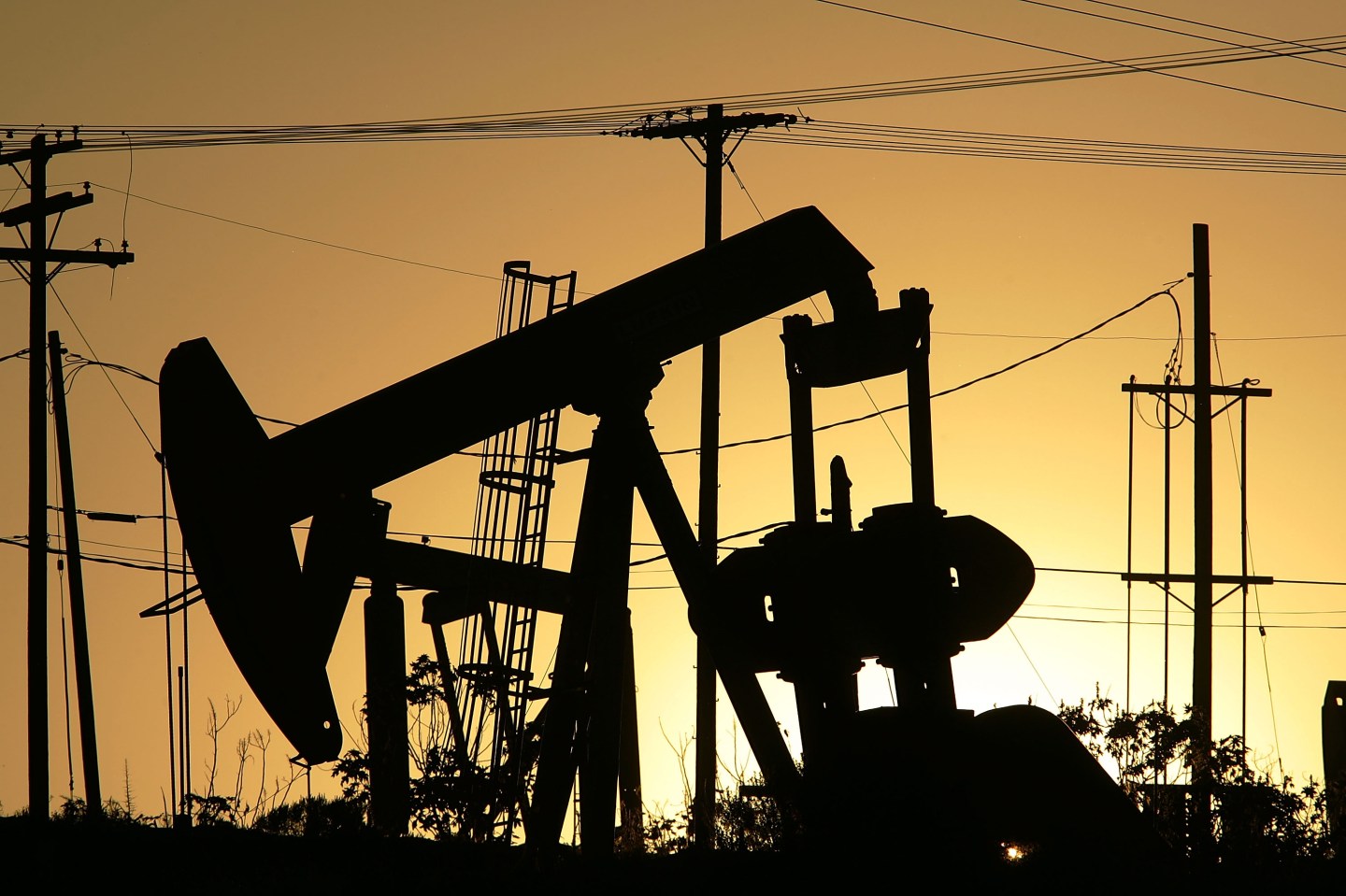
CULVER CITY, CA - APRIL 25: Oil rigs extract petroleum as the price of crude oil rises to nearly $120 per barrel, prompting oil companies to reopen numerous wells across the nation that were considered tapped out and unprofitable decades ago when oil sold for one-fifth the price or less, on April 25, 2008 in the Los Angeles area community of Culver City, California. Many of the old unprofitable wells, known as "stripper wells", are located in urban areas where home owners are often outraged by the noise, smell, and possible environmental hazards associated with living so close to renewed oil drilling. Since homeowners usually do not own the mineral rights under their land, oil firms can drill at an angle to go under homes regardless of the desires of residents. Using expensive new technology and drilling techniques, California producers have reversed a long decline of about 5 percent annually with an increased crude flow of about 2 1/2 million barrels in 2007 for the first time in years. (Photo by David McNew/Getty Images)Photograph by David McNew—Getty Images

Oil prices have been in a free-fall for nearly four months, and Tuesday’s $4 plunge was the biggest drop in more than two years.

Since hitting a peak of over $107 in June, the price of West Texas Intermediate crude oil has since fallen over 24%. It dropped as far as $80 a barrel on Wednesday, the lowest since June 2012. Brent crude oil has also struggled, falling as low as $84.85 a barrel Wednesday. That’s the lowest since November 2010.

The oil price collapse, paired with gloomy global economic reports, has weighed on stocks, and commodity-correlated currencies, such as the Russian ruble, have suffered. Here’s a roundup of what analysts are saying about the energy price drop.

There’s too much supply.

The current free-fall in oil prices is drawing comparisons with the “bubble bursting” crash of 2008, although there are some key differences this time around, said Tarun Dang, managing partner with Trend-Wise Capital Management.

“While decline in demand was the key driver for the 2008 crash, the sharp drop in prices this time around is being caused by a supply glut. Continued growth in U.S. shale production and increase in non-OPEC countries oil exports have led to excess capacity,” he wrote in a note to clients.

Rising global tensions aren’t even boosting oil prices: “The impact of this increased U.S. oil production is quite immense, that unlike in the past, geopolitical tensions have been unable to push oil prices higher,” Dang wrote.

And too little demand.

What’s making the supply glut even worse? Slowing demand. The International Energy Administration lowered its crude oil demand projections for 2014 to about 200,000 barrels per day from the current 700,000 barrels per day. The IEA forecast is the lowest since 2009.

“Chinese demand seems to be softening and there are severe questions about the Eurozone’s recovery, leading the International Energy Agency to cut its outlook,” Scotiabank Economics wrote.

Total world oil demand is expect to grow at 1.05 million barrels per day this year. That’s well below the expected increase in production from non-OPEC countries alone, which is anticipated to grow by 1.68 million barrels per day in 2014, according to KAMCO research.

“Dynamics in the crude oil market are not supporting prices — to say the least,” said Scotiabank.

Economic growth concerns fuel fears.

Dragging oil demand may continue longer than many economists would like as global economies struggle to post strong recoveries, and some nations, such as Japan, substitute oil for natural gas and alternative fuel sources.

“One of the reasons for an extension in the decline was the disappointing German output that reinforced worries that global oil demand will falter,” wrote Dukascopy Bank in a note to clients.

Those fears are compounded by the International Monetary Fund’s global growth downgrade, which “reinforces the narrative of the last few weeks, meaning that demand is set to remain soft,” the bank said.

And then there’s the stronger U.S. dollar.

A stronger U.S. dollar isn’t helping prices. The dollar hit a 4-year high on Oct. 3 as measured by the Bloomberg Dollar Spot Index, which tracks the greenback against 10 global trading partners.

“Oil prices continued the downward movements during Sept-14 for the third consecutive month … as sluggish demand, ample supply and a strong U.S. dollar continued to be the key points pressuring the oil market,” KAMCO wrote to clients. “This is in addition to the pressures from the weak economic data from the world’s biggest energy consumers.”

If the U.S. dollar were to fall, oil prices would have been supported more than what the market has seen recently, Dukascopy Bank said.

OPEC won’t be coming to the rescue.

OPEC’s next meeting is scheduled for Nov. 27, and many experts are hoping the cartel will push up that date. That is looking unlikely, as is any help from OPEC to boost prices as Saudi Arabia sits quietly on the sidelines.

For most of the 21st century, Saudi Arabia has been willing to be the swing producer for the globe, helping to support oil prices. However, much of the rhetoric coming out of Riyadh indicates that the nation is not inclined to cut production or call for an early meeting, said Tom Kloza, chief oil analyst for GasBuddy.com.

“The Saudis are the Michael Jordan’s of OPEC and they don’t appear ready to take one for the team right now and cut unilaterally,” he said.

All of these factors will add up to a “very sloppy oil market,” said Kloza. “Speculation drives prices higher and is now probably driving prices lower.”


About the Author
By Laura Lorenzetti
See full bioRight Arrow Button Icon

Latest in

PoliticsDonald Trump
National Park Service drops free admission on Martin Luther King Jr. Day and Juneteenth while adding Trump’s birthday
By David Klepper and The Associated PressDecember 6, 2025
7 hours ago
EconomyEurope
JPMorgan CEO Jamie Dimon says Europe has a ‘real problem’
By Katherine Chiglinsky and BloombergDecember 6, 2025
8 hours ago
PoliticsMilitary
Hegseth likens strikes on alleged drug boats to post-9/11 war on terror, saying Trump can order use of force ‘as he sees fit’
By David Klepper and The Associated PressDecember 6, 2025
8 hours ago
Elon Musk
Big TechSpaceX
SpaceX to offer insider shares at record-setting $800 billion valuation
By Edward Ludlow, Loren Grush, Lizette Chapman, Eric Johnson and BloombergDecember 6, 2025
8 hours ago
EconomyDebt
The most likely solution to the U.S. debt crisis is severe austerity triggered by a fiscal calamity, former White House economic adviser says
By Jason MaDecember 6, 2025
8 hours ago
Big TechApple
Apple rocked by executive departures, with chip chief at risk of leaving next
By Mark Gurman and BloombergDecember 6, 2025
10 hours ago

Most Popular

placeholder alt text
AI
Nvidia CEO says data centers take about 3 years to construct in the U.S., while in China 'they can build a hospital in a weekend'
By Nino PaoliDecember 6, 2025
13 hours ago
placeholder alt text
Big Tech
Mark Zuckerberg rebranded Facebook for the metaverse. Four years and $70 billion in losses later, he’s moving on
By Eva RoytburgDecember 5, 2025
2 days ago
placeholder alt text
Success
Nvidia CEO Jensen Huang admits he works 7 days a week, including holidays, in a constant 'state of anxiety' out of fear of going bankrupt
By Jessica CoacciDecember 4, 2025
3 days ago
placeholder alt text
Real Estate
The 'Great Housing Reset' is coming: Income growth will outpace home-price growth in 2026, Redfin forecasts
By Nino PaoliDecember 6, 2025
18 hours ago
placeholder alt text
Economy
Two months into the new fiscal year and the U.S. government is already spending more than $10 billion a week servicing national debt
By Eleanor PringleDecember 4, 2025
3 days ago
placeholder alt text
Economy
The most likely solution to the U.S. debt crisis is severe austerity triggered by a fiscal calamity, former White House economic adviser says
By Jason MaDecember 6, 2025
8 hours ago
Rankings
  • 100 Best Companies
  • Fortune 500
  • Global 500
  • Fortune 500 Europe
  • Most Powerful Women
  • Future 50
  • World’s Most Admired Companies
  • See All Rankings
Sections
  • Finance
  • Leadership
  • Success
  • Tech
  • Asia
  • Europe
  • Environment
  • Fortune Crypto
  • Health
  • Retail
  • Lifestyle
  • Politics
  • Newsletters
  • Magazine
  • Features
  • Commentary
  • Mpw
  • CEO Initiative
  • Conferences
  • Personal Finance
  • Education
Customer Support
  • Frequently Asked Questions
  • Customer Service Portal
  • Privacy Policy
  • Terms Of Use
  • Single Issues For Purchase
  • International Print
Commercial Services
  • Advertising
  • Fortune Brand Studio
  • Fortune Analytics
  • Fortune Conferences
  • Business Development
About Us
  • About Us
  • Editorial Calendar
  • Press Center
  • Work At Fortune
  • Diversity And Inclusion
  • Terms And Conditions
  • Site Map

© 2025 Fortune Media IP Limited. All Rights Reserved. Use of this site constitutes acceptance of our Terms of Use and Privacy Policy | CA Notice at Collection and Privacy Notice | Do Not Sell/Share My Personal Information
FORTUNE is a trademark of Fortune Media IP Limited, registered in the U.S. and other countries. FORTUNE may receive compensation for some links to products and services on this website. Offers may be subject to change without notice.