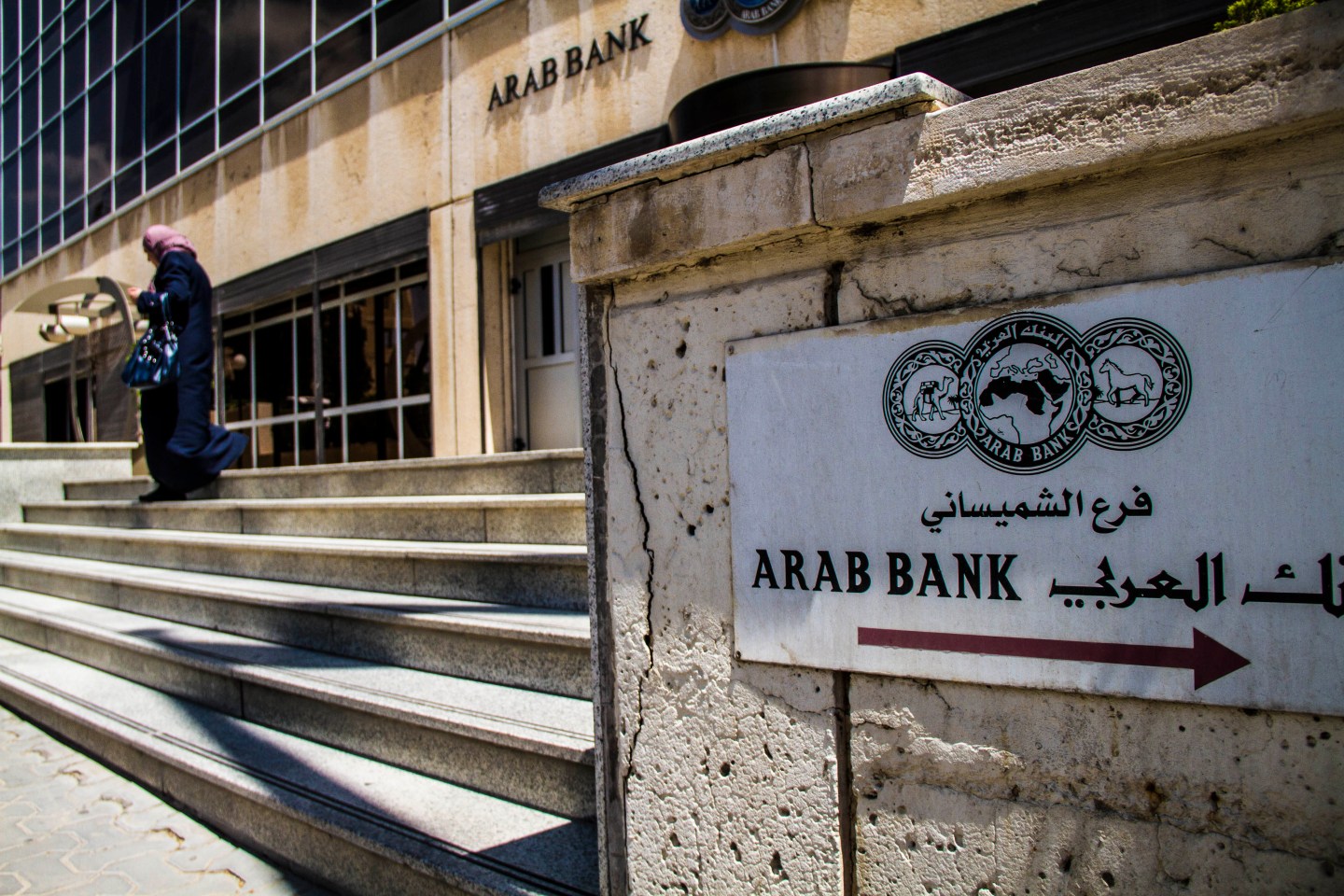
Yesterday the U.S. Supreme Court refused to hear an appeal by Arab Bank, Jordan’s largest financial institution, forcing it to defend itself next month before a Brooklyn federal jury in a private, treble-damages civil suit for alleged terror financing.
The suit, on behalf of the families of more than 100 American citizens killed or injured in 24 attacks in Israel, Gaza, and the West Bank, will be the first civil terror finance trial against a financial institution, according to the lead lawyer bringing it, attorney Gary M. Osen of Manhattan and Hackensack, N.J. (There were criminal terror finance prosecutions against officers of an Islamic charity, the Holy Land Foundation, in Dallas in 2007 and 2008, and a private civil trial against the same charity in Chicago in 2004.)
Other civil terror finance cases are now pending against Crédit Lyonnais and the Bank of China in federal courts in Brooklyn and Manhattan, respectively.
The Arab Bank’s prospects of successfully defending itself have been hobbled, if not foreclosed, by U.S. District Judge Nina Gershon’s July 2010 order imposing stiff sanctions on the bank for its failure to turn over records, an act that would have—according to both the bank and the Kingdom of Jordan, which filed papers on the bank’s behalf—violated the country’s bank secrecy laws.
It was the propriety of Gershon’s sanctions order that the bank asked the Supreme Court to review a year ago. The High Court then asked U.S. Solicitor General’s office to weigh on the matter last October. In May Solicitor General Donald Verrilli, Jr., did so, in a rather schizophrenic filing.
On the one hand, Verrilli agreed with the bank that Judge Gershon and the U.S. Court of Appeals for the Second Circuit, which declined to overturn her order, had each “erred in several significant respects.” In fact, Verrilli wrote, her flawed order “could undermine the United States’ vital interest in maintaining close cooperative relationships with Jordan and other key regional partners in the fight against terrorism.”
Nevertheless, he counseled the Court not to hear the case, but to consider it only if and when it might became necessary to do so later on, in the event a jury ultimately does hand down an adverse verdict.
The Arab Bank, on the other hand, together with the Kingdom of Jordan, which submitted its own amicus case, had warned the Supreme Court that a verdict finding that the bank had aided terrorism could instantly torpedo its business relationships and send depositors fleeing, sinking the bank into bankruptcy and rendering any appeal “academic.”
In a statement issued yesterday, however, after the Court refused to intervene, the bank expressed optimism that it could persuade the trial judge—U.S. District Judge Brian Cogan—to take to heart the Solicitor General’s criticisms of Gershon’s order, and to “reconsider or modify” her order. Jury selection in the case is scheduled to start August 11.
The case, known as Linde v. Arab Bank, was filed in July 2004 under the Antiterrorism Act of 1990. It alleges that the private bank “knowingly and purposefully” performed financial services for Hamas, Hezbollah, and other groups designated “terrorist organizations,” resulting in attacks between 1995 and 2004 that killed about 40 and injured roughly 100 more. Counting surviving family members, close to 500 U.S. citizens are plaintiffs in the case, seeking treble damages. (The U.S. has jurisdiction because certain financial transactions were allegedly processed through the bank’s New York branch.)
The complaint also alleges that the bank helped administer a “death and dismemberment benefit plan,” whereby the Saudi Committee for the Support of the Intifada al-Quds, an ostensible charitable group, incentivized such attacks by pledging to pay rewards to families of suicide bombers. The committee allegedly deposited sums of 20,000 Saudi riyals—about $5,330 today—into the accounts of the families of “martyrs” after their attacks.
In a statement issued after the Supreme Court declined review, the bank said that “the full evidentiary record in this case – which may be withheld from the jury because of the sanctions order – demonstrates it did not cause or provide material support for the tragic acts described by plaintiffs. The facts show that Arab Bank provided routine banking services in accordance with applicable laws and regulations in all of the jurisdictions where it operates.”
The bank also stressed that a different Brooklyn federal judge, Jack Weinstein, dismissed a closely related case, Gill v. Arab Bank, in November 2012, writing that “the evidence does not prove that the bank acted with an improper state of mind or proximately caused plaintiffs’ injury.”
On the other hand, the timing of the Gill and Linde cases are different in important ways. Gill involved a 2008 shooting, while Linde concerns acts that occurred before 2004. Judge Weinstein acknowledged in his Gill ruling that, “viewed most favorably to [the] plaintiff, a reasonable jury might conclude that the bank violated one of the material support of terrorism statutes in 2005 or before.” (In August 2005, the bank paid a $24 million fine to settle an investigation by the Financial Crimes Enforcement Network of the U.S. Treasury Department, which was looking into possible violations of money laundering and terror-finance regulations. The bank admitted no wrongdoing.)
Judge Gershon’s controversial sanctions order relates to document requests the plaintiff made in 2005, seeking bank records of certain named individuals and organizations. Most of the records were located in Jordan, Lebanon, or Palestinian territories, where they were protected by bank secrecy laws, meaning that the bank would have risked criminal prosecution in those countries for complying with Judge Gershon’s order.
The general U.S. rule is that, even under such circumstances, U.S. judges do have the power to order records to be turned over, but they must first perform a balancing test, examining all the equities of the situation and taking into account considerations of international “comity”—i.e., respect for foreign countries’ laws. Given the interests that both the U.S. and Jordan had expressed in fighting terrorism, Judge Gershon ordered the records turned over and, when they weren’t, imposed a crushing and, potentially, case-dispositive sanction order.
Under that order the jury would be instructed that it may (though it need not) infer solely from the bank’s failure to turn over those records that the bank did, indeed, “knowingly and purposefully” aid the financing of terrorists. Equally devastating, the order forbids the bank from introducing any evidence of its allegedly innocent state of mind if that evidence might have been contradicted by the records that were never turned over.
The order was not technically “appealable,” meaning that the bank’s only hope was to try to have appellate courts intervene through a rarely granted, hail-Mary-type procedure known as a “mandamus” proceeding, arguing that Judge Gershon had abused her discretion and that her ruling was “obviously incorrect.”Applying that tough standard of review, the federal appeals court upheld Gershon’s order, and the bank then sought Supreme Court review.
In its brief to that Court, the bank argued that Gershon’s order would “threaten the ruin of the single most important financial institution in the Palestinian territories and Jordan if not the entire Middle East.” The bank is a key purchaser of Jordan’s debt; its market capitalization has, in recent years, represented 20% to 33% of the total market capitalization of Jordan’s stock exchange; and about 15% of the bank’s stock is held by the pension fund for most of Jordan’s labor force.
In its own brief, the Kingdom of Jordan argued that the order risked “destabilizing the economies of Jordan and surrounding countries.” Jordan’s embassy also issued a statement warning that “Jordan will face a very real and grave threat to its economic stability and prosperity.” The Supreme Court then invited Solicitor General Verrilli to give his views on the matter.
According to a New York Times article by Charlie Savage, Verrilli’s office then faced a dilemma, since the U.S. State Department wanted to intervene, while the Treasury and Justice Departments opposed doing so. The State Department needed Jordan to continue to play its role as an important “American ally on important role matters like the war in Syria, counterterrorism investigations and the Israeli-Palestinian peace process,” Savage wrote, while the Justice Department did not want to undermine the interests of American terror victims. Finally, Treasury, according to Savage, wanted to stay out of the case due to its continuing attempts to crack down on tax evasion. Since Americans have historically hidden their assets in Switzerland and other countries with strict bank secrecy laws, it was reluctant to set a precedent honoring foreign bank secrecy laws.
Solicitor General Verrilli’s final brief, filed on May 24, appeared to reflect that internal tug-of-war. Long passages sounded like an urgent call to intervene. But Verrilli then pulled the rug out from under himself at the last minute.
“A primary means by which the United States government protects American citizens from international terrorism is by ensuring that foreign governments and entities continue to cooperate in United States-led counterterrorism efforts,” Verrilli wrote in a portion that appeared to side with the bank. “Jordan in particular is an invaluable partner in the region. The United States relies on jordan in accomplishing a host of critical security and foreign-policy interests, including combatting terrorism. . . . [The bank] is a constructive partner with the United States in working to prevent terrorist financing, including by reporting suspicious financial activities to the government of Jordan, which in turn exchanges information with the United States through international sharing arrangements. For example, [the bank] is a leading participant in a number of regional forums on anti-money laundering and combatting the financing of terrorism.”
Nevertheless, citing the limited oversight a court is supposed to undertake in the posture of a mandamus proceeding, Solicitor General Verrilli urged the Court to let the case go to trial, and wait to see what happens afterward.
Yesterday the Court took Verrilli’s advice, and steered clear of a wrenchingly difficult case. At least for now.