While the financial world awaits the Federal Reserve’s decision on whether or not to raise interest rates before year’s end, another, perhaps more serious question central bankers are focused on is, What should the Fed do when the next recession comes?
Don’t worry—economists don’t expect another major downturn anytime soon. But even if we don’t see a contraction until 2018, the central bank expects the federal funds rate to only reach 2.6% at the beginning of that year. (It’s been hovering around near-zero since 2008.) And given the fact that the Fed has consistently overestimated economic growth, inflation, and its own ability to raise rates, one could be forgiven for being skeptical that interest rates will even get that high.
And this is what has many economists worried, because historically following recessions, the Fed has had to cut rates much more than just 2.6% to get the economy going again, leaving many worried that the central bank will be out of ammunition to fight the next downturn.
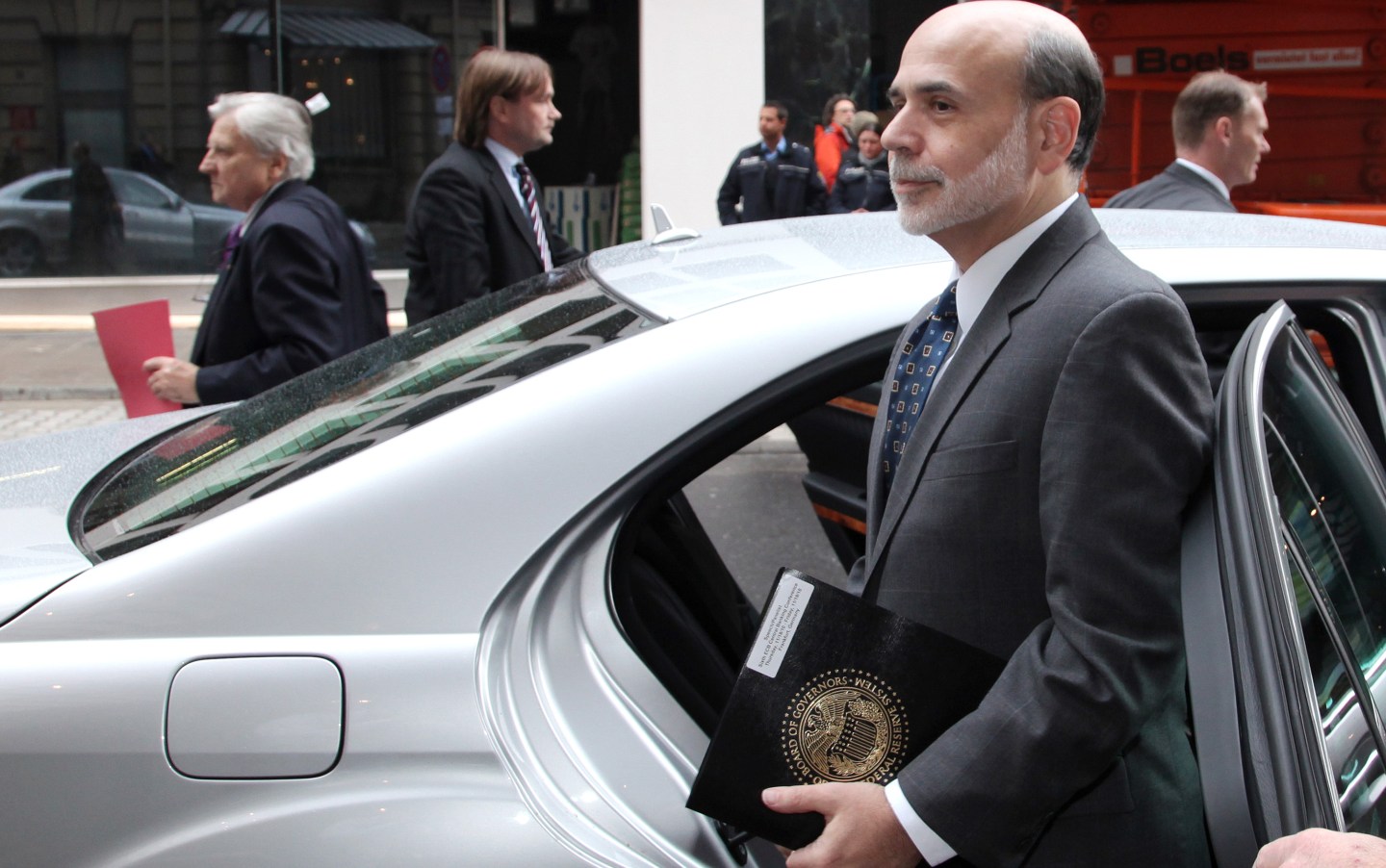
Former Fed Chair Ben Bernanke might have a solution: negative interest rates. In a discussion with Politico’s Ben White at Nasdaq MarketSite on Wednesday morning, Bernanke floated the possibility that the central bank could resort to dropping rates below zero for the first time in history. While the second line of attack against a recession—after reducing interest rates to zero—should be fiscal stimulus, he argued, stimulus is a policy that would not likely receive support from Congress. “If you don’t get that and you get a significant slowdown that requires response, there are things the Fed can do, but none of them are incredibly attractive,” he said.
One of those things is setting interest rates below zero. Economists once believed that a main flaw of using monetary policy to stimulate the economy out of a recession is that rates can’t go below zero, even if the theoretical “market-clearing rate” that gets economy growing again is a negative number. After all, if you start charging people to save money, the thinking goes, people will just start storing cash under their mattresses. But as Bernanke said this morning, “Europe has demonstrated that negative rates are possible.”
Bernanke was referring to recent trials by central banks in Europe, including the European Central Bank, the Bank of Switzerland, and the Danish National Bank, which have all experimented with setting interest rates below what was once thought to be the zero “lower bound.” The Danes have held their overnight rates at negative 0.75% since around 2012, but the effects on the economy have been mixed. According to a recent report in Bloomberg:
Danes have actually been squirreling [money] away. According to central bank data, Danish households’ have added 28 billion kroner ($4.3 billion) to bank deposits since rates shrank to their record low on Feb. 5.
Danish businesses, meanwhile, have barely increased their investments, adding less than 6 percent in the 12 quarters since Denmark’s policy rate turned negative for the first time. At a growth rate of 5 percent over the period, private consumption has been similarly muted.
In other words, negative rates haven’t been the cure-all that some economists had hoped. Then again, 75 basis points below zero isn’t exactly a huge move below where U.S. policy is right now. And banks have been reluctant to pass on the penalties they’ve been paying for keeping their cash parked at the central bank on to consumers and business, although this might be slowly changing.
To engineer interest rates significantly below the rates we’re now seeing, we’d have to change our relationship to paper money. As it stands now, the government guarantees that the nominal return on paper money is at least zero. But if the laws were changed so that paper money was not required to be accepted for “all debts public and private,” and the central bank was allowed to dictate new values of paper money, the Fed could engineer significantly negative interest rates. For instance, if the central bank were able to declare that a person depositing $100 in cash could only be credited $98 when he deposited that money, that would in effect be the same as setting short-term interest rates at negative 2%.
University of Michigan economist Miles Kimball thinks that if governments had the ability to engineer significantly negative interest rates following the recovery, say around negative 4% or more, it would “would have brought robust recovery by the end of 2009.”
These however, are changes that would have to be initiated by Congress and not just the Federal Reserve. But with such figures as Ben Bernanke arguing that the Fed could set rates at least somewhat below zero, it’s not out of the realm of possibility that American consumers and businesses could be charged to save money in the near future.