• Home
  • Latest
  • Fortune 500
  • Finance
  • Tech
  • Leadership
  • Lifestyle
  • Rankings
  • Multimedia
MindCaregiving

A caregivers guide to dementia: How to take care of yourself and support a loved one with dementia

By
Nicole Gull McElroy
Nicole Gull McElroy
Down Arrow Button Icon
By
Nicole Gull McElroy
Nicole Gull McElroy
Down Arrow Button Icon
April 3, 2024, 7:00 PM ET
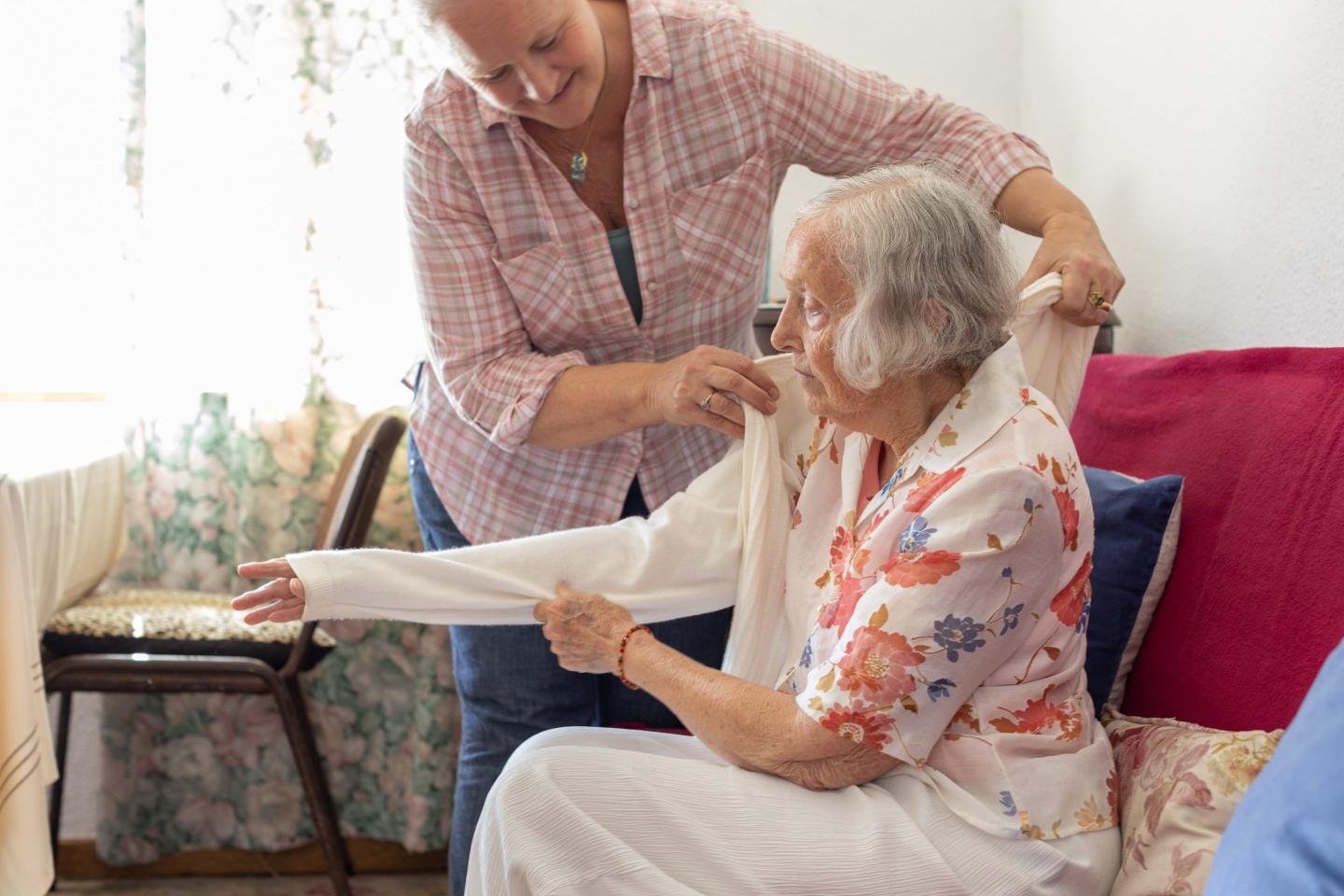
It may not always be intuitive to put yourself first as a caregiver, but self-care is an important part of caring for others.
It may not always be intuitive to put yourself first as a caregiver, but self-care is an important part of caring for others.Getty Images

Every post on AlzConnected, a message board for individuals caring for loved ones with Alzheimer’s and dementia, is heartfelt and authentic. (Is it normal for an Alzheimer’s patient to wave to himself in the mirror? What’s the best way to handle fantastical delusions? Is there a checklist for keeping the household environments safe for a dementia patient? I need to vent a little; I am mentally and physically exhausted and it seems like I have rarely had a moment to myself in years.) 

The board, created by the Alzheimer’s Association and part of a platform to provide support around the disease and the people it affects, has thousands of posts. Some come from spouses and family members of the newly diagnosed, others are questions about various stages of memory loss, and still others are requests for guidance on navigating memory care or how to care for themselves while caring for someone else. These are people experiencing the enormous changes Alzheimer’s and dementia undoubtedly have on patients and their families. And, for those who’ve never experienced a diagnosis like dementia or Alzheimer’s, there’s no real way to know what they don’t know and what lies ahead until they’re living it every day. 

Currently, more than 6 million Americans are living with Alzheimer’s disease. By 2050, that number is anticipated to reach 13 million. The amount of invisible and often unpaid work involved in managing and caring for that population is tremendous. In fact, the Alzheimer’s Association reports that in 2022 alone, an estimated total of 18 billion hours (valued at about $339.5 billion) were spent by unpaid individuals caring for loved ones. Spouses, children, friends and family members tasked with caring for a loved one often struggle to build their own network of support. 

The invisible work of caregiving

Caregivers are often managing their own lives on top of their loved one’s dementia or Alzheimer’s care. This rings especially true for adult children, who might still have children of their own to raise and care for on top of a career. The National Alliance for Caregiving (NAC) and AARP reported in 2020 that roughly 61% of caregivers have jobs and 45% stated they’ve experienced the financial impacts of being a caregiver. Twenty-four percent of the survey respondents said they’re caring for more than one person, while 24% say their own health has declined since taking on the care of their loved one.

Tapping into networks like the one at AlzConnected can remind caregivers that they aren’t alone, help them stay connected to their own needs, or offer valuable perspectives as they manage the later stages of their loved one’s disease. “We have more than 1,000 new members who join AlzConnected every single month,” says Monica Moreno, Senior Director of Care and Support at the Alzheimer’s Association. “It’s a place to share and support one another.”

Educate yourself

As we age, changes normally happen in the brain, says Moreno. At the same time, some changes don’t fall within that normal range and may indicate a more serious diagnosis. Part of Moreno’s job is bolstering awareness of Alzheimer’s and dementia so diagnosis happens early. “It’s not discussed enough,” says Moreno.  “There is a lot of misunderstanding around dementia and Alzheimer’s.” 

Moreno is clear that education and early diagnosis are key factors in helping prepare for the next wave of Alzheimer’s and dementia patients. From open communication within families to accessing doctors with the appropriate tools for diagnosis, many factors ultimately feed into building a support system around the disease. “There are 10 warning signs for Alzheimer’s disease,” says Moreno. “If you even recognize one, we encourage people to go to the doctor. “At the end of the day, families and individuals need to be champions for getting an early and accurate diagnosis.”

Lean on helpful tools

Several organizations offer a wealth of information and research, such as:

  • The Alzheimer’s Association (They have compiled an extensive reading list for caregivers.)
  • National Alliance for Caregiving
  • National Council on Aging
  • Lewy Body Dementia Association 

Podcasts such as Bob’s Last Marathon and Life on Repeat offer up candid perspectives on the ins and outs of dementia caregiving. 

Educate your circle 

The more you can advocate for yourself as a caregiver, the more supported you’ll feel and the better off your loved one will be, too. Sarah Dulaney, Clinical Director at Care Ecosystem at the Memory and Aging Center at University of California, San Francisco, says this is especially important for the sandwich generation, who are often working, raising children and caring for aging parents. 

It’s also important to know the ins and outs of the Family Medical Leave Act. In fact, according to a 2022 paper released by the Rosalynn Carter Institute for Caregivers, one 2019 study showed that nearly 22% of the US work force identified as a caregiver, with 60% working at least 40 hours on top of caregiving. “They have limited time,” says Dulaney. “How can employers support them to remain in the workforce so people don’t have to make those kinds of decisions?” It’s important to talk to your employer about your situation and keep an open line of communication so that when conflicts or emergencies arise, your boss has the opportunity to support you, too.  

Share your experience with close friends and those you trust in your community. It can be so helpful, whether that results in help with occasional childcare or a midweek meal delivered to the house. These small gestures can go a long way to keep caregivers afloat during particularly busy weeks. 

Put yourself first

Assuming the responsibility of someone else’s care is stressful. Overall, reports the Family Caregiver Alliance, individuals caring for others have higher risk of heart disease, an increased likelihood of developing serious illness, and diminished immune response in comparison to those who are not caregivers. It may not always be intuitive to put yourself first as a caregiver, but self-care is an important part of caring for others. Here are a few things to keep in mind as you build a structure for self-care and overall wellness. 

  • Schedule regular sessions with a mental health professional or clinical psychologist to support your mental wellbeing. Work through your insurance to find someone in your area, or ask your primary care physician for a referral. 
  • Make exercise, sleep, and nutrition a priority. 
  • Connect with the people in your life, too. Carve out time to socialize and do some of the things you enjoy. 
  • Plan caregiving breaks, if possible, when you can take a few days to focus on yourself and other important relationships. 

Look for expert advice

As the healthcare industry explores ways to improve care for Alzheimer’s and dementia patients, it is also considering the experience of caregivers, too. In August, the Alzheimer’s Association launched the Dementia Care Navigation Roundtable (DCNR), to build consensus among experts around dementia care as well as support for caregivers navigating the dementia care system.  

Through DCNR, the Alzheimer’s Association has assembled a panel of experts who are building out new ways to not only diagnose dementia early but also guide families through making decisions and accessing appropriate care. In addition, the pilot will address various barriers (financial, linguistic, cultural, logistical, and educational) to ensure patients and their caregivers have access to the support they need. “It can be very isolating and there’s a stigma to it,” says Moreno. “For caregivers who are already overwhelmed it can take a huge burden off their shoulders.”

More on caregiving

  • Caregiver guide to anxiety and depression: Help a loved one improve mental health
  • Caregiver burnout: Signs, prevention, and treatment
  • 7 ways to care for elderly parents who live far away
  • Booming eldercare industry, dizzying choices: 5 things to keep in mind when choosing a retirement home for Mom or Dad
Join us at the Fortune Workplace Innovation Summit May 19–20, 2026, in Atlanta. The next era of workplace innovation is here—and the old playbook is being rewritten. At this exclusive, high-energy event, the world’s most innovative leaders will convene to explore how AI, humanity, and strategy converge to redefine, again, the future of work. Register now.
About the Author
By Nicole Gull McElroy
See full bioRight Arrow Button Icon

Latest in Mind

Finance
Lorem ipsum dolor sit amet, consectetur adipiscing elit, sed do eiusmod tempor incididunt ut labore et dolore magna aliqua. Ut enim ad minim veniam
By Fortune Editors
October 20, 2025
Finance
Lorem ipsum dolor sit amet, consectetur adipiscing elit, sed do eiusmod tempor incididunt ut labore et dolore magna aliqua. Ut enim ad minim veniam
By Fortune Editors
October 20, 2025
Finance
Lorem ipsum dolor sit amet, consectetur adipiscing elit, sed do eiusmod tempor incididunt ut labore et dolore magna aliqua. Ut enim ad minim veniam
By Fortune Editors
October 20, 2025
Finance
Lorem ipsum dolor sit amet, consectetur adipiscing elit, sed do eiusmod tempor incididunt ut labore et dolore magna aliqua. Ut enim ad minim veniam
By Fortune Editors
October 20, 2025
Finance
Lorem ipsum dolor sit amet, consectetur adipiscing elit, sed do eiusmod tempor incididunt ut labore et dolore magna aliqua. Ut enim ad minim veniam
By Fortune Editors
October 20, 2025
Finance
Lorem ipsum dolor sit amet, consectetur adipiscing elit, sed do eiusmod tempor incididunt ut labore et dolore magna aliqua. Ut enim ad minim veniam
By Fortune Editors
October 20, 2025

Most Popular

Finance
Lorem ipsum dolor sit amet, consectetur adipiscing elit, sed do eiusmod tempor incididunt ut labore et dolore magna aliqua. Ut enim ad minim veniam
By Fortune Editors
October 20, 2025
Finance
Lorem ipsum dolor sit amet, consectetur adipiscing elit, sed do eiusmod tempor incididunt ut labore et dolore magna aliqua. Ut enim ad minim veniam
By Fortune Editors
October 20, 2025
Finance
Lorem ipsum dolor sit amet, consectetur adipiscing elit, sed do eiusmod tempor incididunt ut labore et dolore magna aliqua. Ut enim ad minim veniam
By Fortune Editors
October 20, 2025
Finance
Lorem ipsum dolor sit amet, consectetur adipiscing elit, sed do eiusmod tempor incididunt ut labore et dolore magna aliqua. Ut enim ad minim veniam
By Fortune Editors
October 20, 2025
Finance
Lorem ipsum dolor sit amet, consectetur adipiscing elit, sed do eiusmod tempor incididunt ut labore et dolore magna aliqua. Ut enim ad minim veniam
By Fortune Editors
October 20, 2025
Finance
Lorem ipsum dolor sit amet, consectetur adipiscing elit, sed do eiusmod tempor incididunt ut labore et dolore magna aliqua. Ut enim ad minim veniam
By Fortune Editors
October 20, 2025
Fortune Secondary Logo
Rankings
  • 100 Best Companies
  • Fortune 500
  • Global 500
  • Fortune 500 Europe
  • Most Powerful Women
  • World's Most Admired Companies
  • See All Rankings
  • Lists Calendar
Sections
  • Finance
  • Fortune Crypto
  • Features
  • Leadership
  • Health
  • Commentary
  • Success
  • Retail
  • Mpw
  • Tech
  • Lifestyle
  • CEO Initiative
  • Asia
  • Politics
  • Conferences
  • Europe
  • Newsletters
  • Personal Finance
  • Environment
  • Magazine
  • Education
Customer Support
  • Frequently Asked Questions
  • Customer Service Portal
  • Privacy Policy
  • Terms Of Use
  • Single Issues For Purchase
  • International Print
Commercial Services
  • Advertising
  • Fortune Brand Studio
  • Fortune Analytics
  • Fortune Conferences
  • Business Development
  • Group Subscriptions
About Us
  • About Us
  • Press Center
  • Work At Fortune
  • Terms And Conditions
  • Site Map
  • About Us
  • Press Center
  • Work At Fortune
  • Terms And Conditions
  • Site Map
  • Facebook icon
  • Twitter icon
  • LinkedIn icon
  • Instagram icon
  • Pinterest icon

© 2026 Fortune Media IP Limited. All Rights Reserved. Use of this site constitutes acceptance of our Terms of Use and Privacy Policy | CA Notice at Collection and Privacy Notice | Do Not Sell/Share My Personal Information
FORTUNE is a trademark of Fortune Media IP Limited, registered in the U.S. and other countries. FORTUNE may receive compensation for some links to products and services on this website. Offers may be subject to change without notice.


Latest in Mind

A pessimistic looking male worker at his desk
MindWorkplace Wellness
The ‘triple threat’ endangering worker well-being and undermining productivity—especially for Gen Z
By Beth GreenfieldJune 18, 2025
11 months ago
A man alone on a beach wearing a coat, his back to the camera
Mindmental health
Loneliness is bad for your health—but it may not be as deadly as once thought, new research finds
By Beth GreenfieldJune 16, 2025
11 months ago
Man sleeping in bed wearing eye mask
Lifestylesleep
Night owls tend to have more health risks than early birds—including cognitive decline, new study finds
By Beth GreenfieldMay 30, 2025
11 months ago
Young man sitting alone, looking forlorn, in a darkened room
Lifestylemental health
Gen Z and millennial men in the U.S. are among the loneliest in the western world. Here’s why
By Beth GreenfieldMay 21, 2025
11 months ago
What happens to your brain when you work too many hours, according to new research
LifestyleBrain
What happens to your brain when you work too many hours, according to new research
By Alexa MikhailMay 21, 2025
11 months ago
Remote employees are lonelier, sadder, and angrier, survey finds
Lifestylemental health
Remote employees are lonelier, sadder, and angrier, survey finds
By Ani FreedmanMay 15, 2025
1 year ago

Most Popular

Apple cofounder Ronald Wayne—whose stake would be worth up to $400 billion had he not sold it in 1976—says that at 91, he has no regrets
Success
Apple cofounder Ronald Wayne—whose stake would be worth up to $400 billion had he not sold it in 1976—says that at 91, he has no regrets
By Preston ForeApril 27, 2026
2 days ago
‘The cost of compute is far beyond the costs of the employees’: Nvidia executive says right now AI is more expensive than paying human workers
AI
‘The cost of compute is far beyond the costs of the employees’: Nvidia executive says right now AI is more expensive than paying human workers
By Sasha RogelbergApril 28, 2026
2 days ago
‘Take the money and run’: Johns Hopkins economist Steve Hanke on why the UAE quit OPEC
Energy
‘Take the money and run’: Johns Hopkins economist Steve Hanke on why the UAE quit OPEC
By Shawn TullyApril 29, 2026
16 hours ago
Current price of gold as of April 28, 2026
Personal Finance
Current price of gold as of April 28, 2026
By Danny BakstApril 28, 2026
1 day ago
More than two-thirds of U.S. schools say they’re unable to afford the cost of student free lunch—and MAHA’s dietary guidelines may make it worse
Economy
More than two-thirds of U.S. schools say they’re unable to afford the cost of student free lunch—and MAHA’s dietary guidelines may make it worse
By Sasha RogelbergApril 29, 2026
14 hours ago
The U.S. military may have already used up half of its most expensive missiles, and it could take up to 4 years to rebuild its stockpiles
Politics
The U.S. military may have already used up half of its most expensive missiles, and it could take up to 4 years to rebuild its stockpiles
By Sasha RogelbergApril 24, 2026
5 days ago