I will never forget the moment I discovered my own breast cancer.
I was in the shower, rushing to get to work, daydreaming about an upcoming vacation, when I felt it: the tiny pebble lodged firmly in my right breast. I just stood there, not breathing, under the water. Would I lose my breasts? Would I get to see my daughter grow up? Finally, after fearing it for so long—knowing the history of breast cancer on both sides of my family, being hyperaware of the one-in-eight risk for all women—I knew my turn had arrived.
After a battery of tests, a diagnosis, and many decisions, I wound up having a double mastectomy. But at least I had found the cancer early. Because the mammogram I’d had on my dense breasts less than a year before had not.
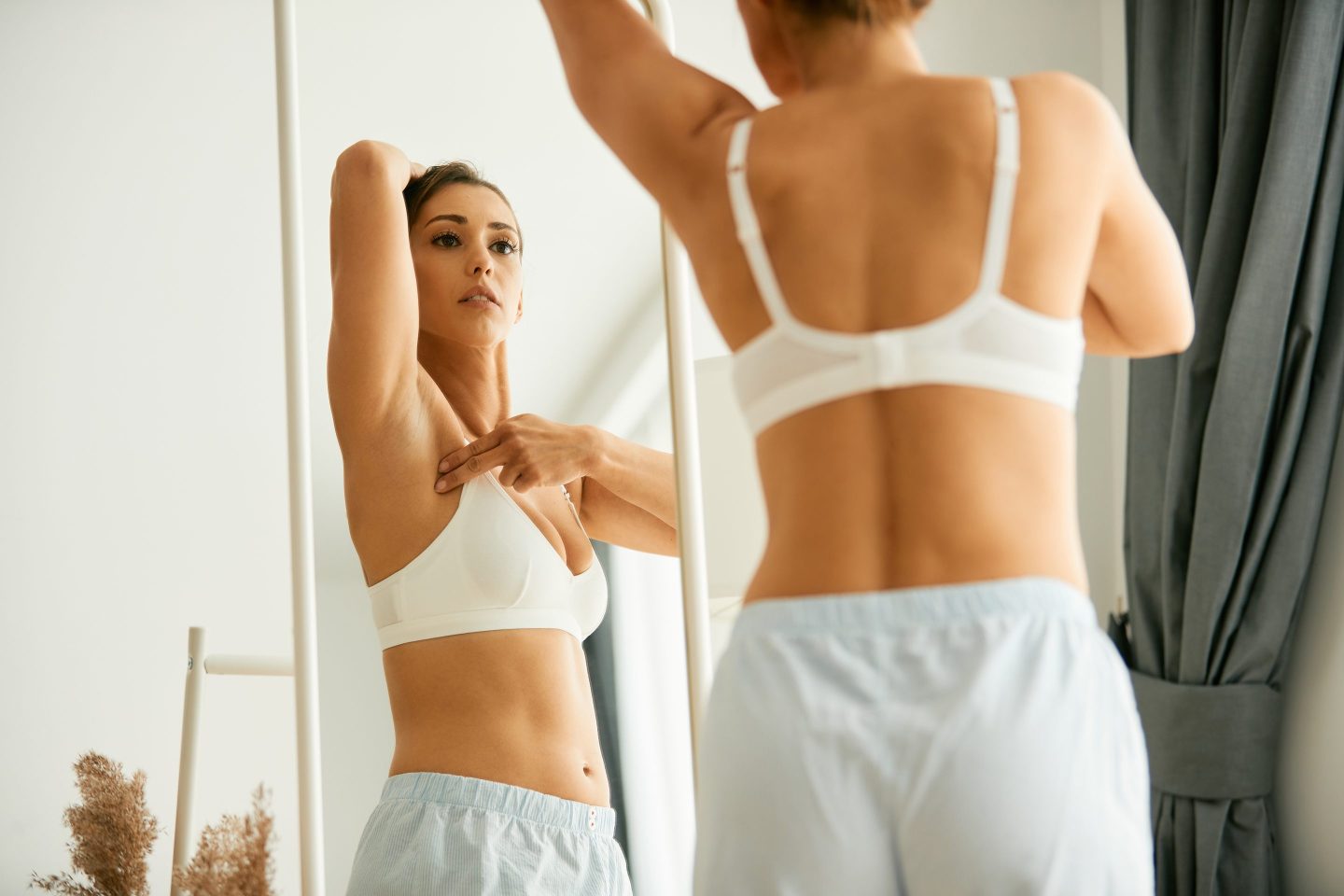
So I was surprised to learn, only recently, that breast self-exams are no longer recommended as a screening tool by most experts—including the National Cancer Institute, the National Comprehensive Cancer Network, the American Cancer Society, and the United States Preventive Services Task Force (USPSTF), the volunteer task force of experts that makes recommendations to Congress, which first urged “against teaching breast self-examination (BSE)” back in 2009 and makes no mention of BSE in its current recommendations.
Still, while I’d technically found my own lump by accident, just like 18% of women diagnosed with breast cancer, plenty of others—anywhere from 25% to 75% of all diagnoses, depending on which study, of several, is cited—have discovered their cancer while consciously conducting a breast self-exam. So what gives?
No benefit in reducing mortality
Research shows that BSE doesn’t offer the early detection and survival benefits of other screening tests, such as mammograms. According to a meta-analysis of large controlled trials comparing women who did routine breast self-exams to those who didn’t, in fact, there was no difference in breast cancer survival. Further, women who did BSE had more false-positive results, prompting nearly twice as many breast biopsies with no cancer found.
“Is it absolutely true that some women find their own lumps, even though they get breast screenings with mammograms? The answer is absolutely yes. We all have anecdotes,” says Dr. Larry Norton, an oncologist with Memorial Sloan Kettering Cancer Center in New York City.
He tells Fortune that it’s important to put the official recommendations into context.
“These sources are not saying that it shouldn’t be done,” he notes. “They are saying that they can’t find randomized, prospective evidence [the gold standard for effective research] that it helps, and that’s a very different statement.” That’s partly because mammograms and other screening techniques, including sonograms and MRIs (both of which are recommended for the vast number of women with dense breasts), are so effective in finding “very, very tiny little lesions” that cannot be felt—and the fact that they’ve been clearly shown to make a difference in terms of both survival and outcome.
“So in that context,” Norton explains, “the incremental advantage on the breast self-exam is very hard to demonstrate… And the rules of the game are that if you can’t demonstrate it through prospective, randomized trials, you can’t recommend it.”
A quick history of breast self-exams
The idea of a breast self-exam first came from the theory, popularized by an American surgeon in the early 1900s, that breast cancer begins as a local disease that’s more curable if discovered early, according to an article in the Canadian Medical Association Journal. One of its first proponents was a New York physician who in 1929—more than 30 years before mammograms would be popularized as a screening tool in the U.S.—wrote that “waiting for a lump to appear made little sense,” propelling the idea of BSE through the U.S., Canada, and Europe, despite the lack of data to back it up.
A 1950 educational film on the topic, Breast Self-Examination, from the American Cancer Society and the National Cancer Institute, would eventually be viewed by more than 13 million women; accompanying material stated that finding smaller cancers by BSE dramatically improved a woman’s chances of survival.
It also placed responsibility on women—which some viewed as empowering and others as a burden—and women began to speak out about how self-exams had saved their lives. The practice received more of a push in the 1970s as a way for women to become less reliant on the medical system.
Still, evidence that BSE lowered breast cancer mortality remained insufficient. And while the move away from it has remained controversial over the years—especially among some breast cancer survivors who believe they would’ve been dead without it—the recommendations have changed.
The shift to breast self-awareness
Encouraging patients to know what their bodies feel like so that they can easily detect change is the current recommendation of the USPSTF, as of 2016, when it noted support for “all patients being aware of changes in their bodies and discussing these changes with clinicians.” It’s what’s largely referred to as cultivating “breast self-awareness.”
“I believe very strongly that people should know what their bodies feel like, men and women, and if they notice something that’s out of the ordinary, they should call it to the attention of a health professional,” says Norton. “So that’s what I tell my patients.”
If they ask for further instructions, he does send them to directions for BSE on Memorial Sloan Kettering’s website, which notes, “MSK does not recommend doing a BSE as part of routine breast cancer screening. This is because studies show they do not help find breast cancer or help people live longer. You may still choose to do a BSE as a way to be familiar with your breasts, however. You can do a BSE once a month, once in a while, or not at all.”
The organization Susan G. Komen, which fuels breast cancer research, focuses its messaging “on the importance of knowing what is normal for you, and then reporting any changes to a doctor,” says Erica Kuhn, the director of health Information and publications. While the organization sees “no real harm” in doing a BSE, Komen, “as an evidence-based organization, wouldn’t promote that behavior,” she says.
Still, not everyone has fully abandoned the idea of BSE as a line of defense.
“We have not wavered so much—and we still distribute the shower cards [with self-exam instructions],” says Ashley Miller, spokesperson for the National Breast Cancer Foundation—the founder of which found her own breast cancer through a self-exam. Still, “it’s not just doing a breast self-exam, although we encourage that. It’s educating women—and men—about that need to know what your breasts look like,” Miller stresses.
“I personally have never found anyone who has done a breast exam and regretted it,” OB/GYN Dr. Kiarra King tells Fortune. And while she wouldn’t necessarily direct anyone to do a BSE every month, as she understands the rationale of not causing harm through anxiety and unnecessary biopsies, “I’m never going to be like, ‘No! That’s silly,’” King says. “People have to be comfortable with the decisions they make for their bodies.”
That idea strongly resonates with 34-year-old Abigail Glavy of Dallas, who tells Fortune she was being vigilant, even at 32, because of the history of breast cancer in her family. That’s when she was in the shower doing a self-exam. “I felt a lump on my right side—and immediately got that, like, punch-to-the-gut panic feeling,” she recalls.
What Glavy found wound up being DCIS—ductal carcinoma in situ, also called stage 0 breast cancer, news she received in a phone call from the doctor who looked at the results of her mammogram and ultrasound, due to her having dense breasts.
She tested positive for a gene mutation that made her more at risk of breast and other cancers, and wound up having a bilateral mastectomy with reconstruction. And she feels grateful that she wound up finding the cancer when she did—especially since the recommended age of a first mammogram, 40, was many years away, despite rates of breast cancer steadily rising in younger women.
“It can be scary to do a self breast exam, and you might feel something that seems scary or might cause panic or anxiety,” she says, even if it’s not cancer. “Of course, in this instance, I did feel something, and it did end up to be cancerous, but I got through it.” Whether you want to do self-exams or not, she stresses, it’s important to know your body—and to advocate for yourself.
“Nobody’s going to care more about you and your health than you,” she says.
More on cancer:
- Women will now be notified about breast density after mammograms. Here’s what should happen next
- 5 lifestyle changes can significantly reduce your cancer risk, from giving up drinking to wearing sunscreen
- Global cancer rates are expected to rise 77% by 2050. From aging to alcohol, here’s why
Subscribe to Well Adjusted, our newsletter full of simple strategies to work smarter and live better, from the Fortune Well team. Sign up for free today.