
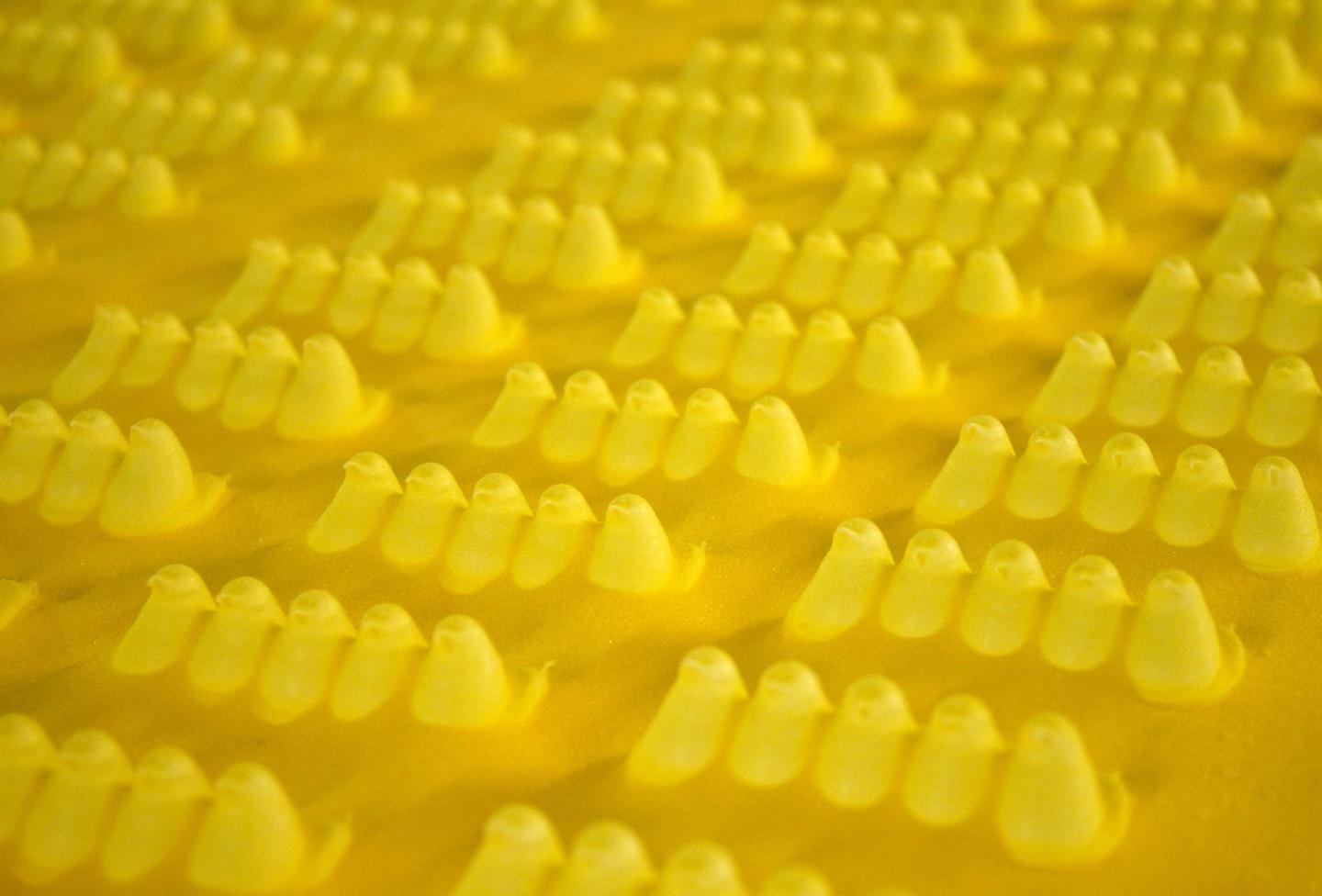
For years every Easter and spring season, Americans stuff their baskets with Peeps, these little neon marshmallow chicks (and sometimes bunnies) coated in petroleum-based synthetic dyes that the FDA has not formally reviewed for safety since (depending on the color) the 1960s, ’70s, or ’80s. For Scott Faber, senior vice president at the Environmental Working Group, that makes the humble Peep something unexpected: a symbol of progress.
“Peeps are a food chemical success story,” Faber told Fortune while trying to stifle a chuckle, before adding: “I’m sure no one has said those words before.”
But he meant it seriously. When California passed Assembly Bill 418 in 2023—the law that opponents incorrectly dubbed the “Skittles bill”—Just Born, the maker of Peeps (which did not respond to Fortune’s requests for comment), was one of the first candy companies to commit to removing Red Dye No. 3, a synthetic color linked to cancer. “They moved faster than any other company,” Faber said, “and showed that companies can quickly reformulate when they’re required to do so.”
Required. That word is doing a lot of work in the food dye debate right now, and it sits at the center of a major argument over whether MAHA’s approach to cleaning up the American food supply is working.
The Peeps paradox
The candy at the center of this policy fight is, by almost any objective measure, controversial on its own, before anyone mentions a single dye.
New Curion research conducted in February 2026 and drawn from three separate polls totaling more than 19,000 U.S. consumers shows the “Peeps paradox.” Nearly half the country (comprising 24.2% who love them and 23.3% who like them) hold positive feelings toward the candy. The other side is equally committed: 17.4% don’t like them; 8.1% actively hate them. However, when Curion surveyed more than 8,000 consumers on why they purchase Peeps, personal taste barely made the list. Nearly one-third (32.9%) cited holiday tradition as their primary motivation. Another 28.4% buy them as basket fillers or gifts. Nostalgia drove 23.4% of purchases, and 25.2% buy them for family members who enjoy them. In short, Peeps are less a snack than a seasonal obligation, purchased out of ritual by people who may not eat a single one.
But it was the color, not the texture or taste, that first made Peeps a public health target. In April 2023, Consumer Reports alerted consumers that pink and purple Peeps contained Red Dye No. 3, a synthetic color it described as a known carcinogen, one that had been banned from cosmetics since 1990 because of cancer effects observed in rats, yet remained permitted in food. By 2024, Just Born had removed Red Dye No. 3 from its formulas. The yellow Peep still contains Yellow No. 5. The blue ones still contain Blue No. 1. The neon palette that defines the brand, and the tradition, and the ritual, and the hate, remains largely intact, for now, and that’s because nothing is required to change.
The FDA is making it voluntary
The Make America Healthy Again movement, led by HHS Secretary Robert F. Kennedy Jr., has called petroleum-based synthetic dyes a public health crisis. But Faber is blunt about what MAHA has actually accomplished at the federal level: nothing. “So far, and I’m underlining so far, the FDA has not banned a single chemical from any of our food,” he said. “It’s been the states that have been leading the way.”
That isn’t entirely a criticism of MAHA. Faber acknowledges that state laws in California, West Virginia, Louisiana, and Texas have created something the food industry privately welcomes: some guidelines. “Food industry leaders are celebrating because someone has finally established a floor,” he said. “Companies aren’t going to create two versions of their food: one for West Virginia and one for the rest of us. In part because other states are starting to follow suit.” Without a floor, he argued, it’s a race to the bottom. Kellogg’s won’t voluntarily drop synthetic colors as long as General Mills still uses them, for example.
The deeper problem, in Faber’s view, is structural. “The FDA has been asleep at the switch for many decades,” he said. “They’ve allowed the vast majority of new food chemicals to enter commerce without being reviewed for safety, and they rarely, if ever, review the chemicals we’re already eating.” Americans eat thousands of chemicals that cannot be added to food in other countries, Faber said, not because the science cleared them, but because no one checked.
At odds with what’s actually safe
Sean McBride, founder of DSM Strategic Communications and former executive vice president of the Grocery Manufacturers Association, sees the same gap but draws the opposite conclusion. If RFK Jr. believes these dyes are poisoning children, McBride argued, the law requires him to act like it.
“If you determine that a certain food ingredient is poison or is poisoning people, you would be obligated to move heaven and earth to somehow take care of that issue,” McBride told Fortune. “But instead, we have this terrible strategy where you essentially beg food companies to do things voluntarily, scare the heck out of consumers, go to a handful of states and say take matters into your own hands, and what you’ve done is created anarchy.”
The contradiction he keeps returning to: The FDA has deemed these dyes safe, and Kennedy is overriding his own agency’s standing guidance without changing a single rule. “Your agency says they’re safe. You’re saying they’re not. What is a person to do?”
His answer to why MAHA won’t pursue formal rule-making is because they can’t win. “The reason you’re begging or bullying companies to drop these ingredients is because you know that if you actually put them through the rigor of the federal rule-making process, the science will not support what you’re trying to do,” McBride said. He referenced the post-Chevron era when the Supreme Court no longer defers to agency expertise in regulatory disputes, meaning any formal dye ban could be immediately challenged and likely struck down. The courts, he noted, have already put temporary injunctions on both West Virginia’s dye ban and Texas’s ultra-processed food labeling bill, with rulings harsh enough that likely mean neither law will survive.
The states are moving anyway
Jennifer Pomeranz, a public health law professor at NYU, splits the difference between Faber and McBride, saying MAHA’s voluntary approach is actually working, not despite the chaos, but through it.
“Kennedy has just proposed voluntary changes, and the states are the ones actually implementing bans,” she told Fortune. “It’s kind of great, because it’s bipartisan and it’s already happened in many states, so that might make the change nationally.” The historical parallel she reaches for is trans fat: Companies were removing it from products well before any federal mandate, because public pressure and state action created enough market momentum. The same dynamic is unfolding now.
Unlike McBride, her concern is not that MAHA is moving too aggressively, but that the federal government might ultimately preempt state dye bans and then fail to act. “That would be contrary to MAHA but consistent with MAGA,” she said. “It’s hard to know what’s going to happen.”
The SNAP problem
This weekend, a SNAP recipient in 22 states cannot use their benefits to buy the same Peeps a non-SNAP shopper can grab off the shelf beside them. For Faber, that reveals MAHA’s true priorities. “If Republicans were really interested in helping poor people build healthy diets, they would have increased the SNAP benefit, not cut it,” he said. “Congressional Republicans are much more interested in punishing poor people than helping make sure they can afford healthy foods.” Eliminating SNAP Ed, the nutrition education funding, while restricting what benefits can buy, he argues, removes the tools people need while also narrowing their choices.
McBride focuses on the practical failure. Retailers in waiver states are going “crazy,” he said; they can’t tag products, can’t determine what counts as a soda or a candy, and some state legislatures are now scrambling to write new bills just to define terms. “What possible good does banning these items actually do? It’s a shift at checkout. A SNAP recipient just moves them out of the EBT part and pays for them with cash.” He points to Chile, where a decade of junk-food taxes and black-label warnings changed the market basket. Consumers bought 8% less of targeted products, but childhood obesity went up 30% anyway. “You’ve proven you can change a market basket,” he said. “But you haven’t changed public health. So what are we doing?”
“People are forgetting history,” Pomeranz said. “Initially, Democrats used to propose these kinds of SNAP restrictions, and there were both Republican and Democratic states that proposed them, all rejected by USDA under both Republican and Democratic presidents. It’s disingenuous for public health to now be up in arms about what was being proposed by public health people not that long ago.” She drew a line at candy and sugary beverages: “There’s no association of health benefits with any of those products,” but says that expanding restrictions further, into snacks or prepared foods, crosses into different territory. “I think a kid deserves a birthday cake.”
Whether it’s dye bans, SNAP restrictions, or labeling mandates, the real question isn’t which lever to pull, it’s whether any lever actually improves health outcomes. Overall, and all three experts agree, the current food safety framework is broken.
“No one is saying, ‘I want more cancer with my candy,’” Faber said. “This is a question of whether things that should be safe are safe, and unfortunately, many of the chemicals that we eat are either unsafe or have never been reviewed for safety by someone we can all trust.”