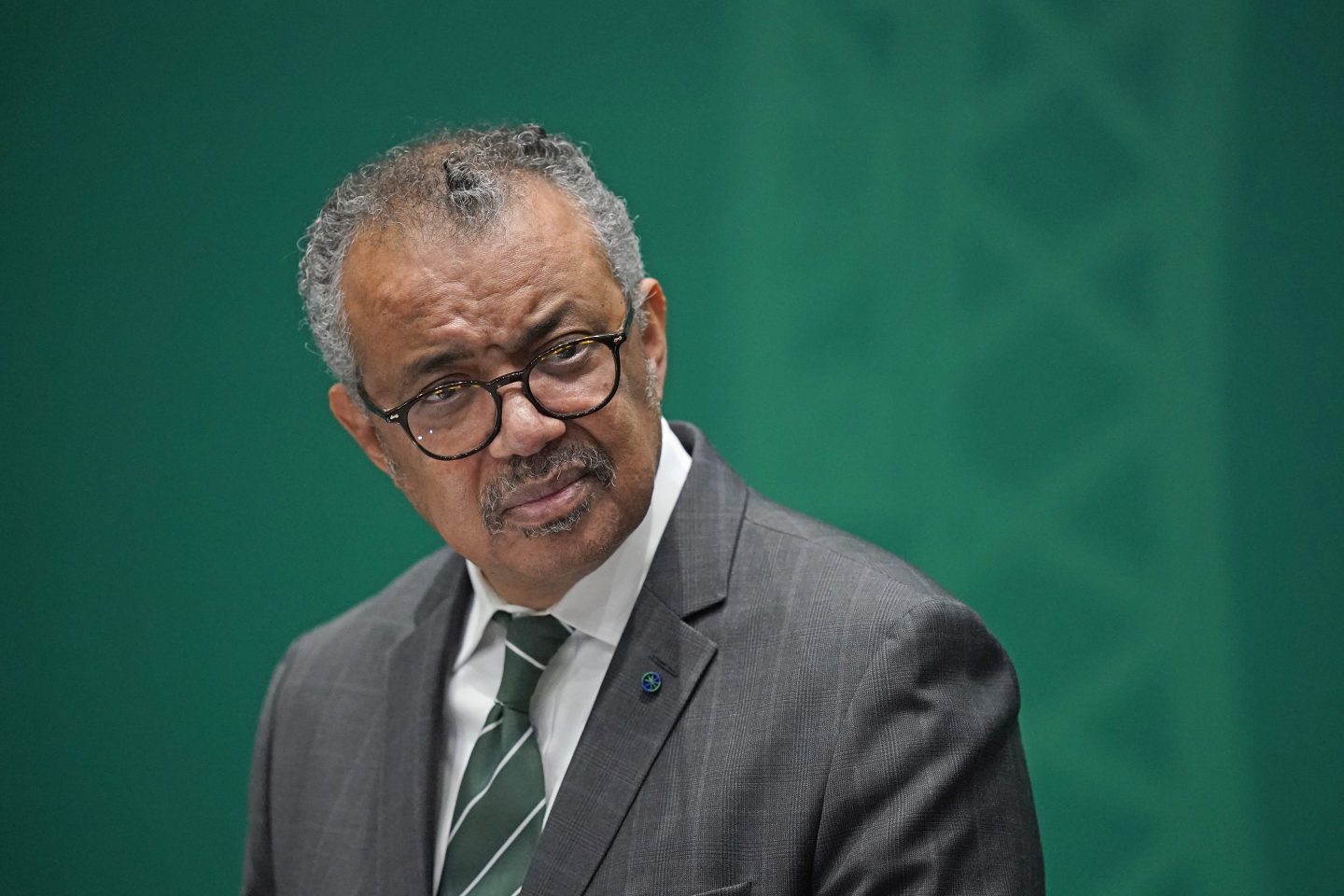
Future generations may not forgive the World Health Organization’s member nations should they fail to agree on a pandemic treaty, the organization’s chief said Saturday at the Warwick Economic Summit, calling the agreement “mission critical for humanity.”
Despite lessons that should have been learned during COVID-19, the world is unprepared for the next pandemic, be it an influenza virus, another coronavirus, or “Disease X”—a term the organization has used since 2018 to refer to a yet-unknown pandemic pathogen, Director General Tedros Adhanom Ghebreyesus said, speaking virtually from Geneva at the summit, held in Coventry, England.
Already, the world was unprepared for the COVID-19 pandemic—and because of this, “the poorest countries were left behind, waiting for scraps,” he said, regarding access to tests, therapeutics, and vaccines.
“We cannot allow the same thing to happen next time—and there will be a next time,” he warned.
WHO member states met in Geneva in 2022, agreeing to develop an international accord on pandemic preparation and response that would become international law, “a legally binding pact between countries working together,” Ghebreyesus said.
A draft has been developed after “extensive consultations” with member states, public health experts, academic groups, and citizens; and public hearings have been held regarding it, he said. Countries have set themselves a deadline to finalize the agreement ahead of the annual World Health Assembly, to be held May 27 through June 1 in Geneva.
Treaty not unprecedented in scope, WHO chief says
But two major obstacles stand in the way of agreement, Ghebreyesus said: one, a group of issues that, though not insurmountable, need further negotiation; the second “a torrent of fake news, lies, and conspiracy theories.”
Among them, he said: that the agreement is a “power grab by the WHO” that would give the international health organization the ability to initiate lockdowns and/or vaccine mandates.
Objections to the pandemic treaty were recently fueled by online rumors regarding “Disease X” ahead of a January session on the topic at the World Economic Forum in Davos, Switzerland, which Ghebreyesus attended.
The run-of-the mill pandemic preparation session was blown out of proportion when right-wing social media accounts slammed it, charging that world leaders were convening to discuss plans to impose vaccine mandates, restrict free speech, and even plan pandemics themselves.
Among concerned parties: former Trump-era Assistant Secretary for Public Affairs for the U.S. Treasury Department, and Fox News analyst, Monica Crowley. Ahead of the January session in Davos, she tweeted a baseless warning that “unelected globalists at the World Elected Forum will hold a panel on a future pandemic 20x deadlier than COVID.”
“Just in time for the election, a new contagion to allow them to implement a new WHO treaty, lock down again, restrict free speech and destroy more freedoms,” she wrote. “Sound far-fetched? So did what happened in 2020.”
Such claims are “completely false,” Ghebreyesus said Saturday, responding not to Crowley in particular, but more broadly. “We don’t have the power to do that. We don’t want it. We’re not trying to get it.”
What’s more, nations who sign onto the agreement would be able to withdraw at any time, he said, adding that the agreement would “affirm nations’ sovereignty.”
He encouraged skeptical parties to review a draft of the treaty on the organization’s website.
Similar international treaties have been formed regarding chemical, nuclear, and biological weapons, in addition to tobacco and climate change, he added.
Public health experts supportive, but not without concerns
The world needs a “robust” pandemic treaty, Dr. Georges Benjamin, executive director of the American Public Health Association, told Fortune on Saturday. He is concerned, however, that when nations finally approve such an agreement, “it will be watered down so it is meaningless.”
“Currently we have difficulty getting nations to comply with the agreements from the international health regulations,” he said. “Accountability is key here, but we will have to see.”
The legally binding treaty would need to have “teeth,” he added, “but they rarely do.”
What’s more, in the U.S., an approved treaty would need to be passed by the Senate to become binding. While the nation signed on to a WHO treaty on tobacco control in 2003, it never ratified it.
Even if an agreement is reached among WHO member states and the Biden administration signs on, “what will the U.S. do with it?” Benjamin asked. “We have not approved the tobacco treaty yet.”
Dr. Amesh Adalja—an infectious disease specialist and senior scholar at the Johns Hopkins Center for Health Security—told Fortune that an international treaty or similar mechanism is critical for optimal preparation and response to future pandemics.
He worries, however, that such a mechanism could be used to “undermine intellectual property rights in the name of pandemic preparedness.”
“It is intellectual property rights that facilitate the development of the tools that are the ultimate solutions to minimizing the impact of a pandemic,” he said.
For such a treaty to make progress, countries “will need to be engaging not only with each other, but also with the private sector that makes medicines and vaccines,” Dr. Tom Inglesby—director of the Johns Hopkins Center for Health Security and former senior advisor to the White House COVID Response Team—told Fortune on Sunday.
While many companies in countries around the world are able to manufacture tests, therapeutics, and vaccines “quickly and at huge scale,” worldwide distribution in a timely manner “requires political commitment from governments to fund at a very large scale, as well as permission for them to be distributed outside of the countries where they are being made,” he said. “The treaty needs to build on these basic fundamentals.”
Bruce Y. Lee—professor of health policy and management at the City University of New York School of Public Health—agreed with both Benjamin and Adalja, saying that “some type of treaty is absolutely necessary.”
“Viruses and other pathogens do not respect country borders,” he said. “Therefore, when another pandemic-threat pathogen emerges, there’s going to be a need for coordinated response across the world. The COVID-19 pandemic showed how a disorganized and uncoordinated response can result in many, many deaths and much suffering that could have been preventable.”
What’s more, the next pandemic could occur at any point, he added, making near-term approval of some kind of agreement crucial.
Those who worry about the possibility of overreach by the WHO may not understand is that the organization “operates at the behest of the member states and not the other way around,” Lee said. What’s more, “anyone who has been to the WHO, and worked with the WHO, will know that the WHO is very short on resources.”
“Some politicians and influencers are trying to make it seem like the WHO has the resources, authority, and capabilities to control countries,” he added. “Instead, the WHO will do what the countries entering such a treaty want it to do.”
Lee also worries that the public health issue of misinformation has risen to the level of affecting politicians, public health officials, and others involved in such discussions, citing masking as an example.
“After misinformation about face masks spread, many politicians and public health officials seemed reluctant to advocate for wearing face masks, even though scientific studies have clearly shown their potential benefit in reducing transmission,” he said, adding that some politicians played a rule in furthering misinformation.
A failure of nations to reach an agreement in a timely manner puts the world “at risk of a repeat of the COVID-19 pandemic, perhaps even worse,” he said, adding that the world was fortunate that COVID “wasn’t even more deadly” and that the mRNA technology used to make the initial vaccines was already available.
“This may not be the case with other pathogens.”
Raj Rajnarayanan—assistant dean of research and associate professor at the New York Institute of Technology campus in Jonesboro, Ark., and a top COVID variant tracker—told Fortune on Saturday that a different paradigm may be helpful in pandemic treaty negotiations.
Just as the “indaba” negotiation tactic of the Zulu people of South Africa was used to encourage consensus in 2015 at the UN Climate Change Conference (COP21) in Paris, the pandemic treaty may benefit from the “Arthashastra” approach, based on an ancient Indian political theory treatise written in Sanskrit, he asserted.
“The need is for a balanced and comprehensive approach that considers diplomatic, cooperative, deterrent, and unifying measures to effectively address global health challenges,” he said.