This fall, North American kids are not alright.
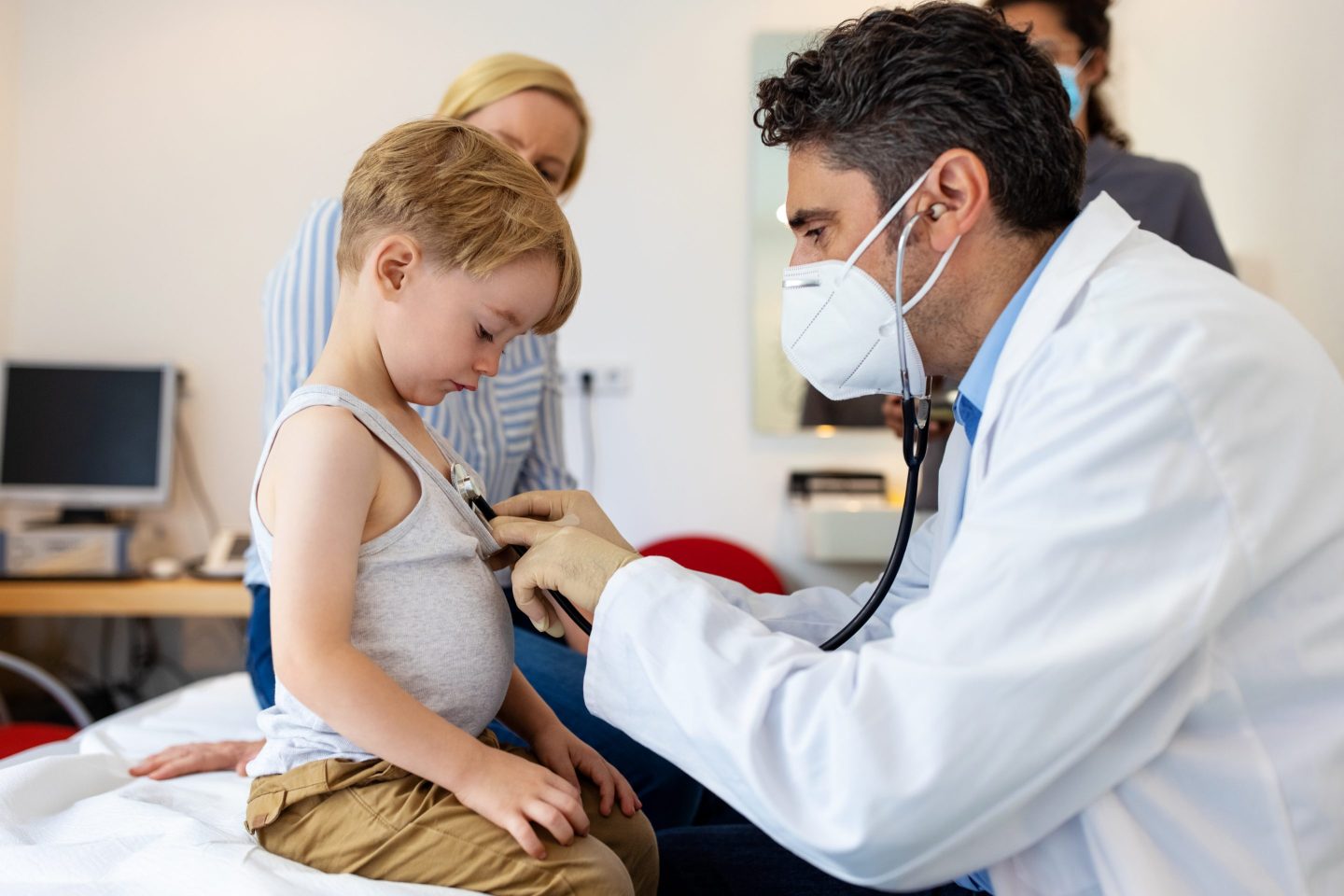
Pediatric hospitals are brimming with an unusually high number of patients who are sick from several different viruses—predominantly RSV, flu, and COVID, but also influenza-like viruses like rhinovirus and enterovirus. Many are at or near capacity, and some are far beyond it, having made room for patient overflow in offices, gift shops, play areas, and parking-lot tents.
Parents, pediatricians, and public health officials alike are asking the same question: How did we get here?
One popular idea that has emerged in the public health community: The surge is due to “immunity debt,” a newly coined term. According to the theory, kids were exposed to fewer germs—COVID and otherwise—over the past three years because of pandemic precautions like masking and social-distancing, and their immune systems atrophied. Now that society has reopened, children are confronting the usual petri dish of viruses with weakened defenses, causing an onslaught of illness—and perhaps greater levels of, and more severe, illness than would have occurred otherwise.
But experts Fortune spoke with say that the theory is unscientific at best and destructive at worst, disagreeing with any argument that COVID precautions damaged immune systems, and emphasizing a wide range of factors resulting in the current “tripledemic.”
What is immunity debt?
When it comes to why kids are getting hit so hard with viruses this fall, immunity debt is “definitely the most popular hypothesis going around,” Dr. Lael Yonker, Harvard Medical System assistant professor of pediatrics at Massachusetts General Hospital, told Fortune.
The general idea is that kids who were born during the pandemic have been protected from viruses that they would have normally been exposed to if they interacted with more people—and that it weakened their defenses.
“These kids are now one year old, two years old, and they haven’t seen prior RSV,” she said. “They haven’t built immunity in general, and now they’re getting really sick.”
The theory of immunity debt was first proposed by French scientists in a 2021 opinion piece in Infectious Diseases Now. Pandemic precautions like masking and social-distancing prevented hospital systems from becoming overwhelmed in the near-term, flattening the so-called COVID curve and significantly reducing the spread of other pathogens. But they increased the likelihood of future epidemics, the authors wrote, “due to a growing proportion of ‘susceptible’ people and a declined herd immunity in the population.”
Since the article’s publication, discussion of the concept has exploded, spilling over from medical journals to Twitter and news outlets.
But some say the debate has morphed from a scientific discussion to a political one, with opponents of masking using the theory in an attempt to prove that covering up caused harm.
Dr. Amesh Adalja, an infectious-disease specialist and senior scholar at the Johns Hopkins Center for Health Security, thinks the term is being “misused and misinterpreted,” and that it’s “creating unnecessary political fighting on social media.”
“I don’t necessarily like ‘immunity debt’ becoming a coined phrase,” Dr. Sarah Combs, an emergency medicine doctor at Children’s National Hospital in Washington, D.C., told Fortune.
“We know a lot of politicization went on during the pandemic, and I have seen some people pick up on [the term] and say, ‘Ah ha! This proves that we were doing all the wrong things, that masking was bad and that we should never do it again.’”
“I will come out and say that this is absolutely wrong. To use this as rhetoric that says, ‘Clearly no public health measures were needed,’ doesn’t work. That is damaging.”
Dr. Jason Catanzaro, a pediatric allergist and immunologist with National Jewish Health in Denver, points out that masking was much less common in some areas of the country—and yet children in those states are struggling just as much right now during the tripledemic.
“As far as I can tell, there’s not a substantial area of the country—red or blue—that’s spared from RSV,” he said.
‘Our immune systems were working just fine’
Several experts that Fortune spoke with say that “immunity debt” is not the reason pediatric wards are being flooded with patients this year.
It’s not actually a scientific term, Dr. John Bradley, medical director of infectious diseases at Rady Children’s Hospital-San Diego and a distinguished professor at UC San Diego School of Medicine, tells Fortune. And children’s immune systems didn’t stop working during the pandemic, Catanzaro contends.
“They were still surveilling cells for cancer, interacting with the trillions of microbiota on a continuous basis to sort out which bacteria were good and bad,” he said. “Our immune systems were working just fine.”
Instead, Bradley and Catanzaro believe the surge is, in large part, driven by a massive cohort of children with healthy immune systems all reentering society around the same time. Their immune systems were not weakened, but they may not have received their usual annual vaccinations, or immunity “boosts” through exposures to viruses without vaccines like RSV, they say.
Catanzaro likens the U.S. pediatric population to a young child who enters daycare for the first time—and spends the next several months catching what seems like every illness under the sun.
“Would that be considered immunity debt?” he asked. He described how his daughter went through the common scenario when transitioning to childcare before the pandemic. “I don’t think her immune system was weak. She just hadn’t seen those things before.”
Lots of potential factors—and even more questions
Experts say there could be a myriad of factors behind the children’s “tripledemic”—and most of them aren’t virological.
Hospitals are short-staffed, and there are relatively few pediatric hospital beds in the U.S. Rates of vaccinations among children have also declined over the past few years, leading to more infections. And this could also be a worse-than-average flu year. The same may be true for RSV, which may have evolved to be more powerful than it once was.
But some experts like Catanzaro and Yonker say more could be at play this fall. Many North American children returned to in-person learning last year, largely unmasked, and the continent didn’t see the same surge of hospitalizations it’s seeing now.
“A ton of people were diagnosed with RSV in the middle of the pandemic, and there weren’t mass hospitalizations,” Catanzaro said.
“We weren’t shutting down ICUs and filling up hospitals,” Yonker added.
Both say it’s possible that COVID—which has infected a majority of the world’s population—has taken a toll on the immune system of those who’ve been previously infected, much as measles can. COVID can alter the production of interferon, a substance the body produces that aids the immune system in fighting off infections and diseases like cancer, according to Catanzaro.
So far there is no evidence to prove this theory. But measles in unvaccinated children can “lead to immune amnesia,” Catanzaro said, citing a 2015 article in Science that “demonstrated that measles wipes out pre-existing immunity to prior viruses.”
Bradley expects viruses like flu and RSV to return to their regular seasonal patterns within a couple of years. And he expects COVID to eventually follow suit.
Still, the question of what caused the tripledemic is—and will remain—more than an academic exercise for the millions affected this winter.
“There are a lot of people out there whose kids are on oxygen with RSV who would like an answer,” Catanzaro said.
Our new weekly Impact Report newsletter will examine how ESG news and trends are shaping the roles and responsibilities of today's executives—and how they can best navigate those challenges. Subscribe here.