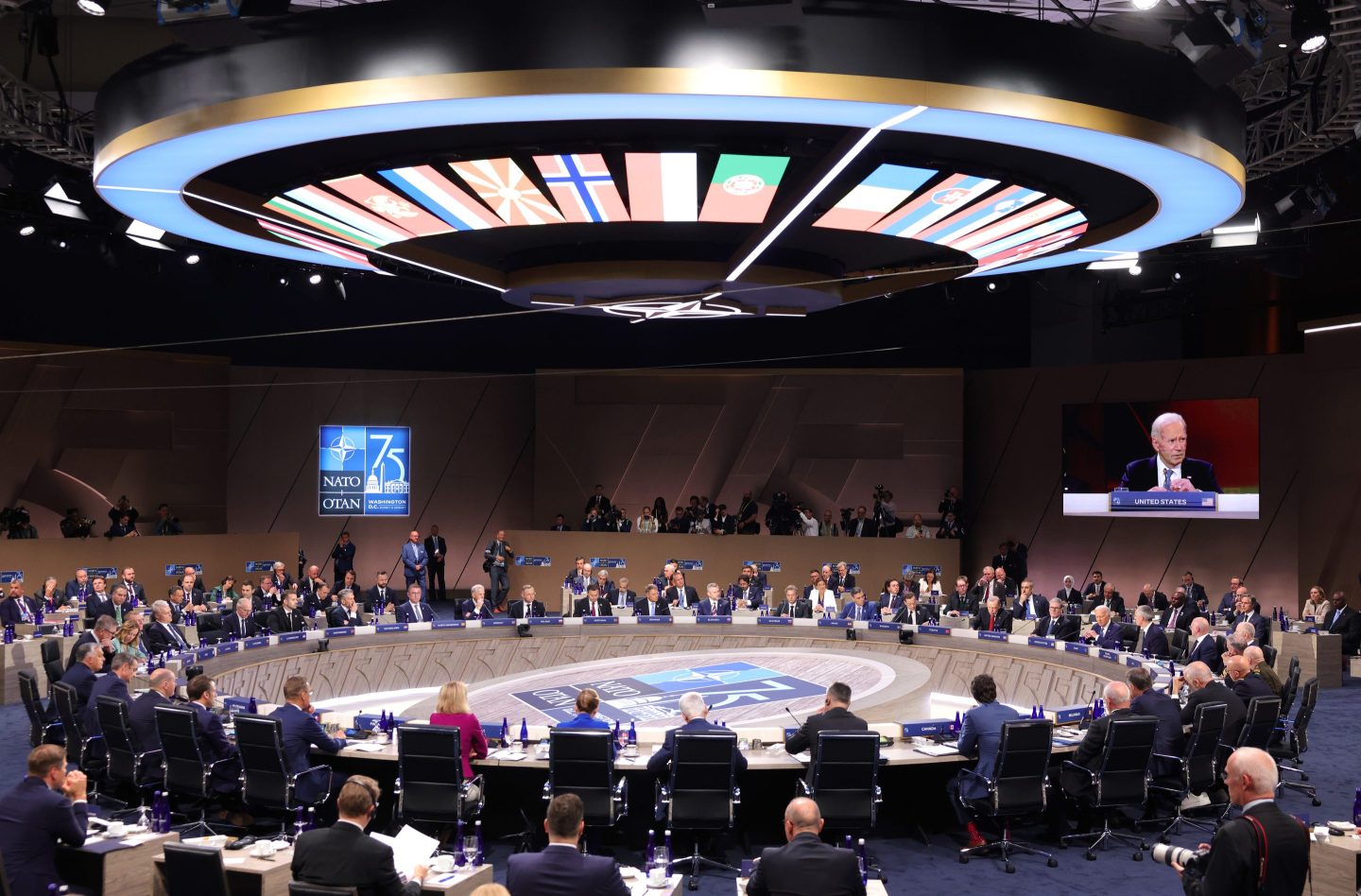
This week’s NATO Summit in Washington, D.C. marking the alliance’s 75th anniversary served as an important reminder of the role that transatlantic venture capital investments can play in boosting cooperation among the member nations.
Staying at the forefront of technological innovation is more important than ever in securing the future of 1 billion citizens of NATO members by boosting the nations’ readiness in these turbulent times. Not only is it necessary for our security, resilience, and ultimately, prosperity but it also makes good business sense.
New domains of conflict have emerged that blur the lines between civilian and military technology. Instead of land, air, and sea, we are seeing strategic competition and conflict in space, the internet, border control, technology, supply chains, and even in our financial system. Technologies that were first developed by the commercial sector are now increasingly being used in defense—a phenomenon that has accelerated on the battlefield in Ukraine, where we have seen the use of off-the-shelf drones, advanced communications systems, and software platforms to deter Russia’s aggression.
Synergies between advanced technologies developed in Europe and North America have the potential to further accelerate this transformation.
Europe’s tech scene has changed dramatically in the last two decades, moving from being a challenger to a global competitor. And while growth over the last year in deep tech venture capital funding decreased in the U.S., the European market noted a continued increase in funding. Investments in deep tech in the 24 nations currently supporting the NATO Innovation Fund (a standalone venture capital investing in defense, security, and resilience technologies) grew by 22,4% between 2018 and 2022, according to Dealroom data. This presents all members of the alliance with powerful advanced technology adoption opportunities, while it offers the fund’s portfolio companies the opportunity to expand their business across multiple markets.
This dramatic change reflects the ambitious rise of European entrepreneurship, ongoing investments in breakthrough technologies, and the availability of great STEM talent. The boom of dual-use technologies in the region presents tremendous commercial and defense opportunities, with certain areas, such as space, biotechnology, novel materials and manufacturing, and artificial intelligence leading the charge in terms of both deal activity and size of investments.
For example, space has become essential in both civilian and military life. Geopolitical competition between NATO countries and other powers has replaced the liberal internationalism of the past decades that framed space as neutral. Instead, it has become a domain of strategic competition. We are in a period reminiscent of when Sputnik, the Moon landing, and the Strategic Defence Initiative defined our approach to space. However, with the line blurring between commercial and military capabilities, governments increasingly rely on private companies to meet space launch requirements. Commercial sensing and communication capabilities complement those of our militaries.
Much like how Desert Storm saw the first major use of earth observation capabilities for the conduct of military affairs in the 1990s, Ukraine’s reliance on satellite comms and new commercial sensor capabilities in its war with Russia has proven that space is an essential pillar of modern warfare.
Space is already vital for transportation, communication, and disaster relief. The commercial market for space services is expected to reach $1.8 trillion by 2035. It’s a fast-growing market as launch costs go down and demand for data, sensing, and software rises. Therefore, as economic ties increase, and space access becomes more affordable, the space economy will impact the value and resilience of almost all industries across the world.
The U.S. will maintain its lead—but China’s bold space program aims to challenge American power militarily, economically, and diplomatically. To counter China and its allies’ growing presence in space, there needs to be a strong transatlantic effort. This must include dual-use technologies to ensure NATO maintains and improves its strategic edge, using its advantage for diplomacy, inter-state relations, and research and development.
The U.S. is driving innovation in space but its rapid growth can be further supported by Europe’s space industry, which has grown more promising in the last decade. European space tech startups have raised $7.1 billion since 2010, a Fondazione E. Amaldi analysis found in 2022. And since 2019, VC investment in space increased by 4.4x to $783 million.
European governments are using their resources to accelerate this trend. The European Space Agency (ESA) has allocated over a billion euros for the development of new capabilities and France has invested 2.5 billion euros into its space sector, including a reusable micro-launcher to make space cheaper and more accessible.
Besides the technological possibilities on the continent, strengthening investments in advanced technologies in Europe could counter adversarial capital in highly strategic technology areas in North America and Europe. Investing in and cooperating more with Europe in dual-use technologies comes with the advantage of countering and curtailing adversaries’ abilities to fund and gain influence over promising startups and markets that present North America and Europe with competitive technological advantages.
The result of greater transatlantic cooperation is not only the combined support for promising, diverse, and revolutionary technologies but also the alliance-wide adoption of these technologies. This is central to defense strategy and military interoperability, weapon systems, industrial procurement, and production policy. Adoption across allies also reduces the burden for governments compared to building sovereign capabilities from scratch. By sharing the burden across the alliance, we can have a greater impact in a capital-efficient way.
The 2024 Washington Summit has been a unique opportunity for NATO leaders to identify opportunities for technology to help secure the future of the alliance and its member states’ citizens. By investing in and adopting emerging dual-use technologies, NATO can leverage the private sector’s innovation power and its transatlantic talent pool, while countering our strategic competitors’ influence and ambitions.
A transatlantic deep-tech, dual-use ecosystem would not only enhance the security and resilience of NATO countries but also foster economic growth and innovation across the Atlantic. The time to act is now, as we are stronger together.
More must-read commentary published by Fortune:
- How U.S.-China competition is benefiting the world—and reshaping the global economy
- ‘A head-in-the-sand approach’: The U.S. strategic drug stockpile is inadequate for a bird flu outbreak
- Gen Z’s enthusiasm for all things touchable is resurrecting the analog economy—and costing parents
- Fearless Fund counsel: The court ruling barring grants to Black women entrepreneurs should terrify CEOs
The opinions expressed in Fortune.com commentary pieces are solely the views of their authors and do not necessarily reflect the opinions and beliefs of Fortune.











