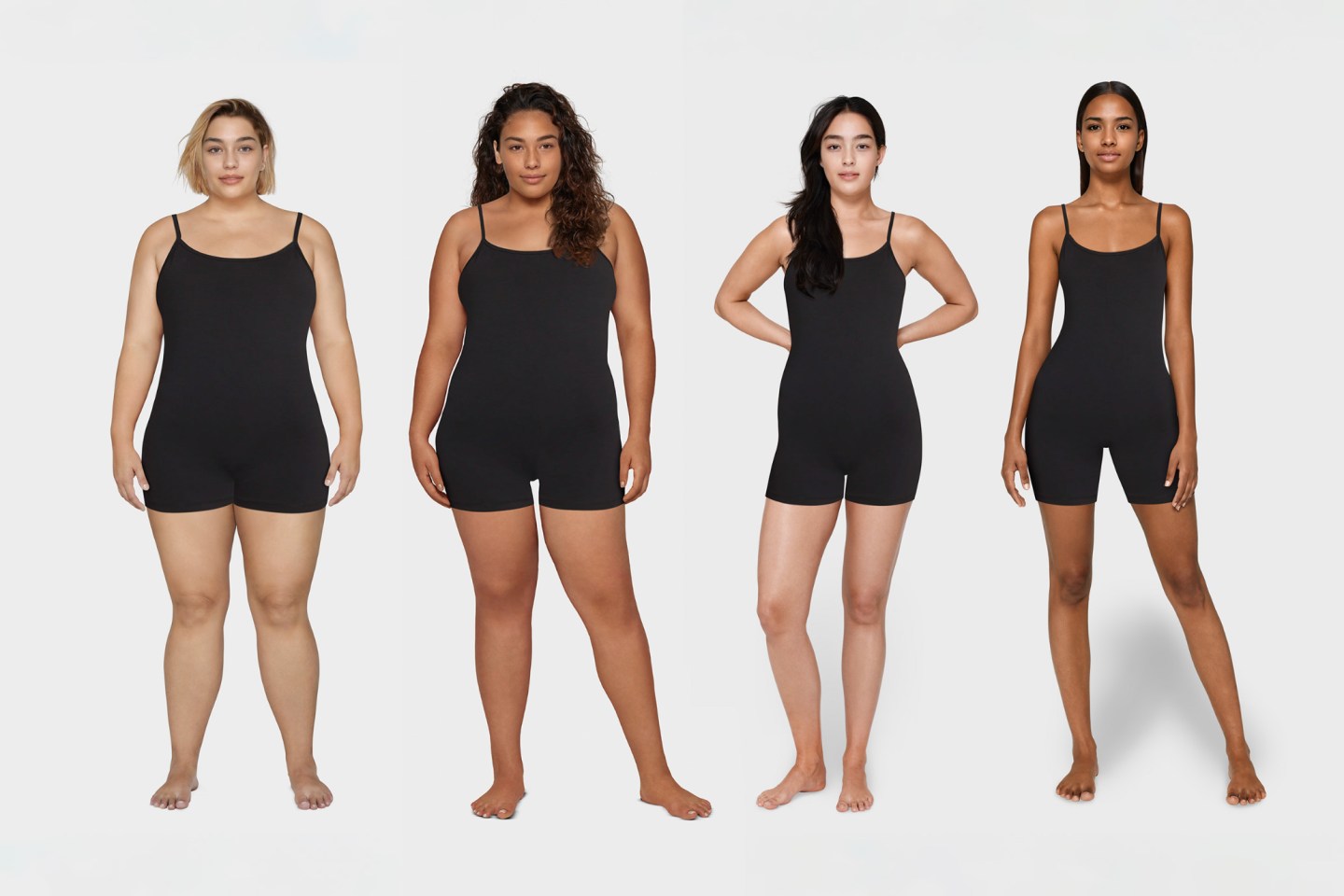
Picture this: You’re shopping online and you can put the clothing you’re eyeing onto models of body and skin types that roughly match your own, thus making the product easier to visualize.
That’s an option Michael Musandu never had while growing up in Zimbabwe. The models on shopping websites never looked like him, even when the audience these brands catered to were diverse.
And that’s what spurred him in 2019 to launch Lalaland, a platform that uses AI to generate human-like fashion models that can be customized for hair, body, and skin types.
With services like those of Netherlands-based Lalaland, brands can display a variety of AI-generated models posing in the same garment in a fraction of the time—and without having to hire models or organize photo shoots.
“We empower both brands and consumers to pluralize the beauty standards by making the web as diverse as the market,” he told Fortune.
For brands, the advantages offered by such services are obvious: By adding AI to the mix, they can curb costs and speed up image production while being more inclusive.
Indeed, big fashion conglomerates like LVMH have also flirted with the idea of working more with generative AI to “enhance customer experiences.”
But these services also elicit worry—if not dread—in parts of the industry.
For photographers, models, and others involved in creating images today, they sound like a recipe for eliminating professional humans from the picture.
And others have more existential worries: Will AI, they ask, end up not furthering diversity, but turning it into a joke?
Rebecca Valentine, who runs London-based Grey Modeling Agency, believes that using AI to advocate for diversity is counterproductive.
“The entire point of diversity representation is to celebrate the authentic, the cultural, the unique, and the lifestyle,” Valentine said, adding that AI “does not celebrate diversity but parodies it.”
The next few years will demonstrate whether AI can be instrumental in making the fashion industry inclusive—and if brands know when and where to draw the line when working with this cutting-edge tech.
Working with humans, without humans
Lalaland is one of many companies that are bringing generative AI to fashion in a push for greater diversity and innovation, but companies have been experimenting with digitally made avatars for several years now.
Shudu, a Black, 3D creation with over 240,000 followers who has modeled for established brands like Balmain and Ellesse, is one example.
For San Antonio–based Blissfully Brand, an online retail website specializing in women’s clothing, these AI tools have unlocked a huge opportunity, says Jacob Flores, the brand’s owner.
“It streamlines our process of creating on-model photography, getting our visual content to our audience efficiently, and providing these visuals of new products to be available to our clientele quicker,” Flores told Fortune.
For the small business with just two employees, cost was an important consideration when launching the brand in 2019.
Models’ hourly rates start at roughly $35 and can soar to thousands of dollars, Bloomberg reported in January.
But agencies offering AI-rendered models can start at $29 an hour. Lalaland offers a paid subscription with access to “unlimited models” starting at €600 ($651) a month.
Flores, who uses other AI-powered platforms OnModel, Pincel, and Botika, offered an example of how he uses tech to target different groups of shoppers: If a certain style of clothing would resonate more with women aged between 30 and 45 years, he uses AI to help generate a model that’s fitting for that product.
“We believe [AI] assists in representing a diverse range of ethnicities, body types, and ages,” Flores said, although he admitted that, despite the ease of use, the body language and expressions of human models were hard to replicate.
AI models can be especially attractive in e-commerce, which puts out thousands of new products and images each day, says Cameron-James Wilson, the founder of British digital modeling agency The Diigitals, which first debuted Shudu, the Black 3D visual avatar, in 2017.
Creating AI fashion models without bias
The experience of jeans maker Levi’s highlights the complicated path that brands must navigate when integrating AI.
Last year, Levi’s announced that it would partner with Lalaland to launch AI-generated models with the aim of “increasing the number and diversity of models” for their products.
But backlash quickly followed, as people questioned the use of virtual creations over humans to further diversity and raised the frequent concern surrounding AI: whether actual models will be replaced by AI counterparts. (Levi’s later clarified that its partnership with Lalaland didn’t mean it would scale back its use of human models.)
Another common concern about using AI is over its inherent ability to perpetuate biases.
Image-generation platforms have been found to exacerbate race and gender biases, owing to the datasets they’ve been trained on. That adds to concerns about misrepresenting minority communities, Mhairi Aitken, an ethics research fellow at the Alan Turing Institute, told Fortune.
While bias can take various forms, in the context of image-generation platforms, that could mean leaning into tropes based on gender, race, religion, and more.
For instance, a Washington Post report found that when prompted to generate images of an “attractive person,” text-to-image tools would default to generating fair-skinned, light-eyed, and thin people.
The issue of bias is one that Lalaland’s Musandu has been aware of since the get-go.
As a company with diversity front and center, Lalaland has tried to do things differently to help tackle some of the challenges that come with using AI to help amplify diversity.
Musandu explained to Fortune that the Dutch company starts by training its algorithm on actual photos of people from underrepresented communities to create a strong database on hair, skin, and body types of different ethnicities.
The company then licenses these images to create a revenue stream and help these communities while ensuring the AI-made models look lifelike.
“Because our whole mission is to show more representation, it was not possible for us to just scrape the internet because there’s so many biases that exist within misrepresentation online,” Musandu said.
And Musandu argues that the influence human models bring to fashion campaigns is not something that AI-made avatars can re-create—which is why human models are hard to replace: “Lalaland just aims to work alongside human models to actually make fashion more inclusive,” he said.
There’s more to it than creating AI models
In October, Taiwanese American model Shereen Wu walked the ramp for fashion designer Michael Costello, who later uploaded a photo of her on his Instagram account—except the photo had been tampered with to change Wu’s face. The model detailed her shock via TikTok later that month, when she saw that the designer had shared a fake photo that had been tweaked using AI.
It can be hard to control how images are used once they enter the digital realm—and laws surrounding the use of models’ images when it comes to AI are still a work in progress, Valentine said.
“The main issue with AI and modeling is with copyright laws,” the Grey Model Agency boss told Fortune. “If photographers and illustrators can have their work and assets protected by copyright then there is no argument that a person should not have the same copyright over their own features and image.”
The Turing Institute’s Aitken also highlighted how transparency plays an important role when using AI tools to generate or enhance images in fashion.
“At the moment, it’s not hard to recognize something as AI-generated,” she said, but “these technologies are getting more sophisticated and it is getting harder to reliably identify what is AI-generated.”
EU’s AI Act, which has been passed but not yet implemented, will regulate a comprehensive list of the tech’s use cases, and is an important next step in ensuring that models and consumers are aware of what they’re getting into and are protected in the process.
But while there are still moving parts to the conversation surrounding AI’s role in promoting diversity in fashion, the demand for these tools is already soaring.
“You’ll be surprised to understand just how much is being adapted,“ Musandu said. “I have to reiterate that we really need real models. This is not something that’s going to go away at all.”