• Home
  • Latest
  • Fortune 500
  • Finance
  • Tech
  • Leadership
  • Lifestyle
  • Rankings
  • Multimedia
CommentaryAI
Europe

The EU A.I. Act can get democratic control of artificial intelligence–but only if open-source developers get a seat at the table

By
Shelley McKinley
Shelley McKinley
Down Arrow Button Icon
By
Shelley McKinley
Shelley McKinley
Down Arrow Button Icon
July 17, 2023, 11:06 AM ET
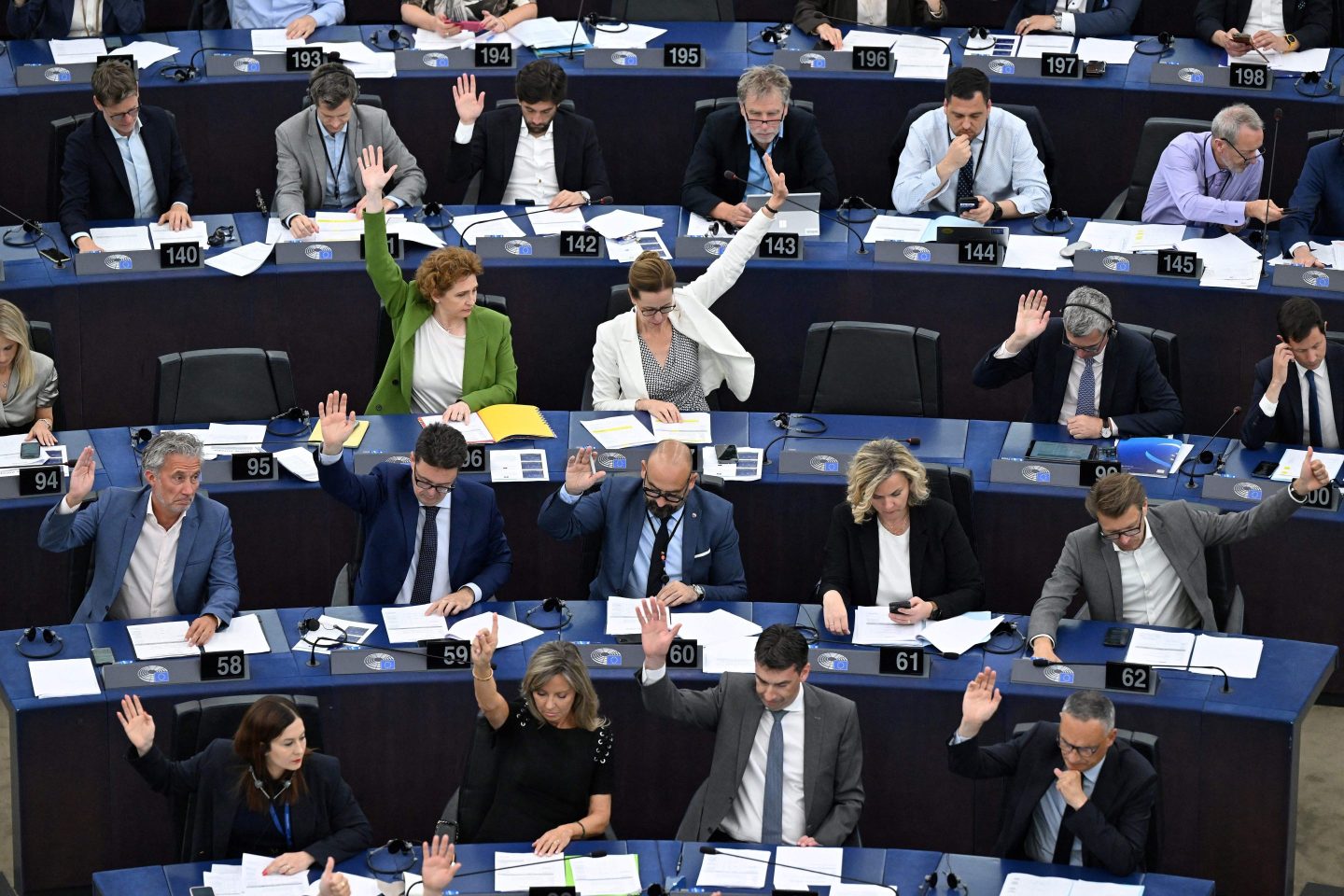
Members of the European Parliament take part in a voting session about the Artificial Intelligence Act during a plenary session at the European Parliament in Strasbourg on Jun. 14.
Members of the European Parliament take part in a voting session about the Artificial Intelligence Act during a plenary session at the European Parliament in Strasbourg on Jun. 14.Frederick Florin—AFP/Getty Images

Policymakers in the EU are taking final steps towards the world’s first comprehensive A.I. regulation. In the years to come, the A.I. Act will shape how artificial intelligence is built, deployed, and regulated globally. The EU established itself as a trendsetter for tech regulation with the GDPR which spread around the world in what became known as the “Brussels Effect.” This track record means policymakers around the world are taking note–as are open-source software developers.

The A.I. Act presents an opportunity to get democratic oversight of A.I. right by encouraging responsible A.I. innovation while mitigating the technology’s risks. The need is clear: Without responsible development, deployment, and use, A.I. systems can result in real harm, ranging from biased algorithmic decisions that impact access to important life opportunities to the proliferation of misinformation. The Act provides a risk-based approach to regulating A.I. across all sectors: Before systems can be sold or deployed, they must meet a series of risk-management, data, transparency, documentation, oversight, and quality requirements. These requirements vary depending on the system and use-case. Using A.I. in sensitive areas like critical infrastructure, determining access to life opportunities in education and employment, and more is deemed high-risk. Generative A.I., which made its way into mainstream culture with the launch of ChatGPT, is likely to be subject to regulation too, with the EU Parliament expressly including new provisions to address it. The next step is to finalize the law in negotiations–among the three EU policymaking bodies, the Parliament, Council, and Commission–that are expected to conclude by the end of the year.

The Act reflects many tools for responsible A.I. that have been pioneered in the open-source community for years, including model cards and datasheets for datasets. These are invaluable tools for documenting the capabilities, limitations, and design decisions that went into building a particular A.I. system. Developers are continuing to drive A.I. innovation, with contributions ranging from maintaining open source frameworks (like PyTorch and TensorFlow) essential to train A.I., to creating plugins that unlock new capabilities for ChatGPT.

In the last year, the global developer community has rallied around open-source A.I. models, which contribute to the sustainability, inclusivity, and transparency of A.I.–for example by making useful models efficient enough to run on a phone, supporting neglected languages, and allowing academic researchers access to study the innards of A.I. models. The A.I. Act must recognize this open innovation on A.I. and how it can encourage the responsible development of A.I. products offered in the single market.

Encouragingly, the A.I. Act may well recognize these important contributions of the open-source developer community. The Parliament text includes a risk-based exemption for open-source developers. Collaborating and building A.I. components in the open is protected. While open source developers are encouraged to implement documentation best practices such as model and data cards, compliance is appropriately the responsibility of entities that incorporate open source components in A.I. applications. The global open source ecosystem has powered widespread software innovation, and we share Parliament’s excitement about what open source can contribute to A.I. These provisions offer important clarity for developers and should be adopted in the final law.

Further steps could also improve the Act. Reasonably, policymakers wished to respond to the rise of generative A.I. The Commission proposed its text in 2021 and the Council adopted its position in December 2022, one week after the launch of ChatGPT. The Parliament has adopted provisions for providers of foundation models that underpin generative A.I. systems. However, it is unclear how open-source developers, academics, and non-profits will be able to comply with obligations tailored for products. As the final negotiations begin, these questions should be considered as EU policymakers set the rules of the road so that any requirements created for foundation models are calibrated to model risk level and are capable of being implemented.

These rules may well reach beyond the single market. Countries from Canada to Brazil and the United States to China have proposed or are considering A.I. regulation. There is increasing recognition of the value that open-source innovation brings. In 2018, it was estimated to contribute up to €95 billion to EU GDP–and that figure will only rise with the development of A.I.

The EU’s experience can be an important example for others to learn from, particularly how rules can be tailored to support open-source developers. U.S. Senate Majority Leader Schumer has unveiled a bipartisan framework for comprehensive A.I. regulation and plans forums to hear from a wide range of stakeholders in the fall. This is promising, and we encourage organizers to include open-source developers in these discussions.

Since last year, Canadian policymakers have been hard at work on legislation to create an A.I. regulator that takes a similarly risk-based approach as the EU while protecting developers collaborating on A.I. development.

As A.I. technology and policy evolve rapidly around the world, one unifying thread will be a risk-based approach that allows us to responsibly collaborate on A.I. development.

Shelley McKinley is GitHub’s chief legal officer.

The opinions expressed in Fortune.com commentary pieces are solely the views of their authors and do not necessarily reflect the opinions and beliefs of Fortune.

Join us at the Fortune Workplace Innovation Summit May 19–20, 2026, in Atlanta. The next era of workplace innovation is here—and the old playbook is being rewritten. At this exclusive, high-energy event, the world’s most innovative leaders will convene to explore how AI, humanity, and strategy converge to redefine, again, the future of work. Register now.
About the Author
By Shelley McKinley
See full bioRight Arrow Button Icon

Latest in Commentary

Finance
Lorem ipsum dolor sit amet, consectetur adipiscing elit, sed do eiusmod tempor incididunt ut labore et dolore magna aliqua. Ut enim ad minim veniam
By Fortune Editors
October 20, 2025
Finance
Lorem ipsum dolor sit amet, consectetur adipiscing elit, sed do eiusmod tempor incididunt ut labore et dolore magna aliqua. Ut enim ad minim veniam
By Fortune Editors
October 20, 2025
Finance
Lorem ipsum dolor sit amet, consectetur adipiscing elit, sed do eiusmod tempor incididunt ut labore et dolore magna aliqua. Ut enim ad minim veniam
By Fortune Editors
October 20, 2025
Finance
Lorem ipsum dolor sit amet, consectetur adipiscing elit, sed do eiusmod tempor incididunt ut labore et dolore magna aliqua. Ut enim ad minim veniam
By Fortune Editors
October 20, 2025
Finance
Lorem ipsum dolor sit amet, consectetur adipiscing elit, sed do eiusmod tempor incididunt ut labore et dolore magna aliqua. Ut enim ad minim veniam
By Fortune Editors
October 20, 2025
Finance
Lorem ipsum dolor sit amet, consectetur adipiscing elit, sed do eiusmod tempor incididunt ut labore et dolore magna aliqua. Ut enim ad minim veniam
By Fortune Editors
October 20, 2025

Most Popular

Finance
Lorem ipsum dolor sit amet, consectetur adipiscing elit, sed do eiusmod tempor incididunt ut labore et dolore magna aliqua. Ut enim ad minim veniam
By Fortune Editors
October 20, 2025
Finance
Lorem ipsum dolor sit amet, consectetur adipiscing elit, sed do eiusmod tempor incididunt ut labore et dolore magna aliqua. Ut enim ad minim veniam
By Fortune Editors
October 20, 2025
Finance
Lorem ipsum dolor sit amet, consectetur adipiscing elit, sed do eiusmod tempor incididunt ut labore et dolore magna aliqua. Ut enim ad minim veniam
By Fortune Editors
October 20, 2025
Finance
Lorem ipsum dolor sit amet, consectetur adipiscing elit, sed do eiusmod tempor incididunt ut labore et dolore magna aliqua. Ut enim ad minim veniam
By Fortune Editors
October 20, 2025
Finance
Lorem ipsum dolor sit amet, consectetur adipiscing elit, sed do eiusmod tempor incididunt ut labore et dolore magna aliqua. Ut enim ad minim veniam
By Fortune Editors
October 20, 2025
Finance
Lorem ipsum dolor sit amet, consectetur adipiscing elit, sed do eiusmod tempor incididunt ut labore et dolore magna aliqua. Ut enim ad minim veniam
By Fortune Editors
October 20, 2025
Rankings
  • 100 Best Companies
  • Fortune 500
  • Global 500
  • Fortune 500 Europe
  • Most Powerful Women
  • Future 50
  • World’s Most Admired Companies
  • See All Rankings
Sections
  • Finance
  • Leadership
  • Success
  • Tech
  • Asia
  • Europe
  • Environment
  • Fortune Crypto
  • Health
  • Retail
  • Lifestyle
  • Politics
  • Newsletters
  • Magazine
  • Features
  • Commentary
  • Mpw
  • CEO Initiative
  • Conferences
  • Personal Finance
  • Education
Customer Support
  • Frequently Asked Questions
  • Customer Service Portal
  • Privacy Policy
  • Terms Of Use
  • Single Issues For Purchase
  • International Print
Commercial Services
  • Advertising
  • Fortune Brand Studio
  • Fortune Analytics
  • Fortune Conferences
  • Business Development
About Us
  • About Us
  • Editorial Calendar
  • Press Center
  • Work At Fortune
  • Diversity And Inclusion
  • Terms And Conditions
  • Site Map
  • Facebook icon
  • Twitter icon
  • LinkedIn icon
  • Instagram icon
  • Pinterest icon

Latest in Commentary

depa
CommentaryConsulting
Adaptability is the new job security and 4 more future AI trends from EY’s global chief innovation officer
By Joe DepaJanuary 16, 2026
22 hours ago
verma
CommentaryGoogle
Google Meet exec on the knowledge engine hiding in your calendar: meetings become IP
By Awaneesh VermaJanuary 16, 2026
22 hours ago
sharma
CommentaryTraining
AI will infiltrate the industrial workforce in 2026—let’s apply it to training the next generation, not replacing them
By Kriti SharmaJanuary 15, 2026
2 days ago
CommentaryBusiness
Using AI just to reduce costs is a woeful misuse of a transformative technology
By Nigel VazJanuary 15, 2026
2 days ago
powell
CommentaryMiddle class
Forget the K-Shape: We have a barbell economy—and the middle class is buckling under the weight
By Katica RoyJanuary 14, 2026
3 days ago
engineer
Commentaryengineering
China graduates 1.3 million engineers per year, versus just 130,000 in the U.S. We need AI to bridge the gap
By Paul Eremenko and Ashish SrivastavaJanuary 14, 2026
3 days ago

Most Popular

placeholder alt text
Economy
America’s $38 trillion national debt is so big the nearly $1 trillion interest payment will be larger than Medicare soon
By Shawn TullyJanuary 15, 2026
2 days ago
placeholder alt text
Europe
Americans have been quietly plundering Greenland for over 100 years, since a Navy officer chipped fragments off the Cape York iron meteorite
By Paul Bierman and The ConversationJanuary 14, 2026
3 days ago
placeholder alt text
Health
The head of marketing at Slate posted on LinkedIn requesting cleaning services as a benefit at her company. The next day, HR answered her call
By Sydney LakeJanuary 15, 2026
2 days ago
placeholder alt text
Politics
Anthony Scaramucci thinks Trump's 'hard-left' move to cap credit-card fees is because he's 'texting back and forth with Mayor Mamdani'
By Nick Lichtenberg and Eva RoytburgJanuary 16, 2026
19 hours ago
placeholder alt text
Politics
The Nobel Prize committee doesn't want Trump getting one, even as a gift—but they treated Obama very differently
By Nick LichtenbergJanuary 16, 2026
15 hours ago
placeholder alt text
Politics
Ford CEO Jim Farley says the White House will 'always answer the phone,' but needs Trump to do more to curtail China’s threat to America's autos
By Sasha RogelbergJanuary 16, 2026
1 day ago

© 2025 Fortune Media IP Limited. All Rights Reserved. Use of this site constitutes acceptance of our Terms of Use and Privacy Policy | CA Notice at Collection and Privacy Notice | Do Not Sell/Share My Personal Information
FORTUNE is a trademark of Fortune Media IP Limited, registered in the U.S. and other countries. FORTUNE may receive compensation for some links to products and services on this website. Offers may be subject to change without notice.