Boy wonder Sam Bankman-Fried plundered billions of dollars of customer money from his crypto exchange—an act that has brought him to a New York courtroom, where he is now on trial for fraud. In anticipation of the spectacle, the publishing industry has rushed out a series of titles, including Number Go Up (Crown Currency) and Easy Money (Abrams Press), that shed light on the FTX founder and his role in the crypto madness that swept the world before it came crashing down in late 2022.
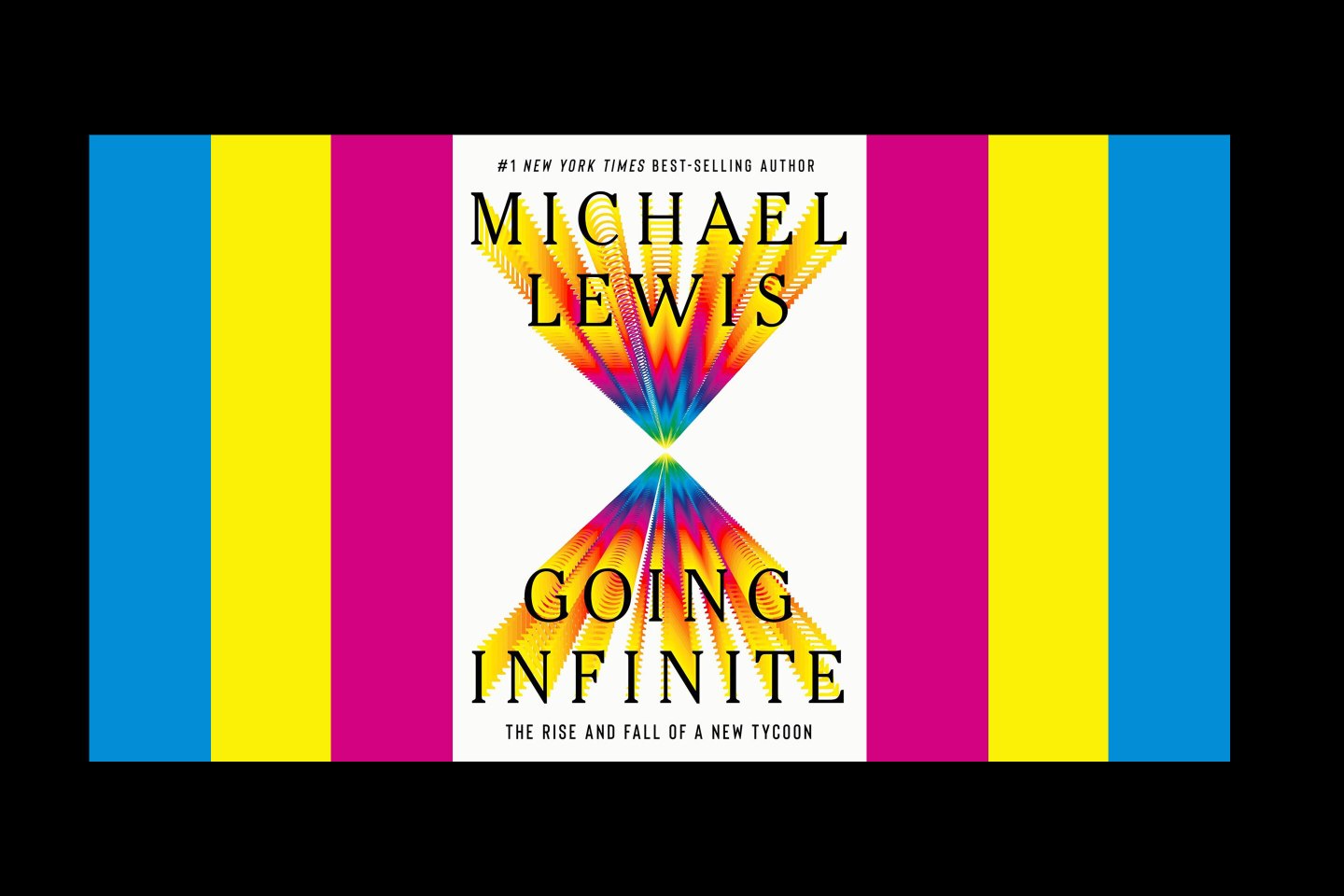
Now comes Michael Lewis, the big dog of business journalism, to weigh in on the subject with Going Infinite: The Rise and Fall of a New Tycoon (W.W. Norton & Co.). Unlike the other authors, Lewis enjoyed hundreds of hours of access to Bankman-Fried, viewing firsthand his out-of-nowhere ascent, up until the miserable final hours preceding his arrest in the Bahamas last November. This access, combined with Lewis’s masterful storytelling powers, put him in position to write the best and most authoritative book of the bunch. Unfortunately, Going Infinite is not that book. Lewis has instead put out a maddening and distorted work that threatens to undercut his towering literary reputation.
The fundamental problem with Going Infinite is that Lewis had initially set out to write another book, one that followed the template for his earlier masterpieces, Moneyball and The Big Short. In those and his other works, Lewis used his formidable writing skills to take esoteric topics—such as mortgage-backed securities or advanced baseball analytics—and turn them into satisfying page-turners. His device for doing this involves latching on a brilliant outsider as a central protagonist, and showing how they use superior intellect and steely conviction to buck convention and emerge victorious.
So how does Bankman-Fried fit into this mold? He doesn’t. While the bulk of the book hews to the familiar Lewis model—we encounter Sam the bored math genius as he effortlessly conquers the hedge fund world and gets into crypto—there is the inconvenient fact that his protagonist is not just unconventional, but a criminal sociopath. Lewis has tried to adapt the text accordingly, but it makes for a strange read. It’s as if Oakland A’s general manager Billy Beane, the hero of Moneyball, had turned his small-market baseball team into a champion not with analytic wizardry but by bribing the umpires and stuffing the players full of steroids. The result is a Frankenstein of a book.
Still, Lewis’s astonishing access to Bankman-Fried makes Going Infinite an essential read for anyone hankering for a close-up view of what the hell happened to FTX and billions of dollars of customer money. A lot of the best details are front-loaded into the first chapter (much of which was published as a Washington Post excerpt), including the hilarity of the schlubby Bankman-Fried suffering through a Zoom call with the most powerful woman in fashion:
As Anna Wintour began to speak, he clicked a button, and she vanished from his screen. In her place popped his favorite video game, Storybook Brawl. He had only a few seconds to choose his character…He just needed to keep the Hoard Dragon alive long enough to enjoy the future gargantuan payoffs from the treasures he was accumulating. Anna Wintour was making that difficult. She wanted so much attention! And she was arriving at the reason for the call: the Met Gala. Organized by Vogue magazine. But rather than simply explain it to him and leave him in peace, she asked Sam what he knew about it.
The answer, of course, is that Bankman-Fried didn’t know a damn thing about the Met Gala. As the book reveals, he agrees to Wintour’s request to attend and sponsor it if only to get back to his video games, and then blows her off shortly before the event—earning the undying wrath of the fashion queen’s retinue.
Passages like this are vintage Lewis, and the book contains plenty of them. Here is some of the author’s account of Bankman-Fried getting ready for a meeting with then Senate leader Mitch McConnell, a polio survivor who he hoped would promote one of FTX’s unrealized initiatives related to public health:
Instead of a suitcase, he carried what appeared to be a small pile of old laundry. As he drew closer, I saw that it was a blue suit and a button-down Brooks Brothers shirt. “This is my D.C. suit,” he said, almost apologetically…He’d been briefed that McConnell would be offended if he arrived in shorts. “McConnell really cares about what you wear,” said Sam, as he walked up the steps of the private plane and plopped the suit ball onto a spare seat. “Also, you need to call him ‘Leader.’ Or ‘Leader McConnell’ or ‘Mister Leader.’ I rehearsed it to make sure I didn’t fuck it up. Especially since it’s so tempting to say ‘Dear Leader.’”
In addition to these peppery anecdotes, Going Infinite also contains valuable and previously unreported details about the black hole of FTX’s corporate operations, including its surreal balance sheet and the secret lines of computer code written into the exchange’s trading software that let Bankman-Fried use his hedge fund to loot customers. Meanwhile, the book’s final chapters are stuffed with new information about the scrambling by regulators and FTX’s caretaker CEO to locate and claw back missing assets. This coda also contains pitiful vignettes about the suddenly friendless Sam—who had only recently claimed Tom Brady as a good pal after agreeing to pay him $55 million—alone in a luxury condo in the Bahamas with a stuffed animal from his childhood.
This wealth of details notwithstanding, Lewis’s book amounts to journalistic malpractice on a number of levels. He frequently comes across as an apologist for Bankman-Fried, portraying his con-man behavior as somehow rooted in a higher calling. Lewis also fails to probe the role of his Stanford law professor parents in the FTX debacle. A recent Bloomberg Businessweek report exposed how his father employed his expertise as an international tax expert to create FTX’s byzantine offshore tax structure and to help design the funny-money token known as FTT that helped facilitate the fraud. Lewis barely mentions the father or Bankman-Fried’s mother (ironically a scholar of ethics) who used her influence in the Democratic Party to help open doors in Washington, D.C., where her son spent millions in an effort to bribe a good portion of the U.S. government.
Worse, in recounting the activities and lucrative fees charged by FTX’s caretaker CEO and its former lawyers, Lewis implies they are somehow equally or more complicit in the company’s downfall than Bankman-Fried himself. This reasoning has been pushed repeatedly by Bankman-Fried’s defense, and, subtly, by his parents in recent sympathetic profiles of the family in the New Yorker and New York Times. A jury has yet to rule on Bankman-Fried’s guilt or innocence, but, by all accounts, his attempts to deflect blame will fail badly.
Lewis also goes easy on the bankrupt philosophy of effective altruism that drove Bankman-Fried, his friends, and his girlfriend—an unsympathetic figure but one subjected to repeated cruelty by her partner—to behave as they did at FTX. The author does expose how a movement that is nominally about eschewing wealth in the name of helping humanity devolved into greed and misanthropy. But when it comes to Bankman-Fried and his pals, Lewis continually invokes their academic pedigrees—Ivy League schools, valedictorian titles, math camp for gifted kids—to somehow treat them and their warped worldview as some form of special morality or genius. As Businessweek noted in its trenchant profile: “Coming from a place such as Stanford and having parents of high achievement changes how the world sees your shortcomings. What might be perceived as a sign of unseriousness—playing video games during a meeting, say—becomes unmistakable evidence of brilliance.”
The book’s ultimate failing is that Lewis, the master of narrative, could not surrender the narrative he had initially woven around his latest subject. Ironically, Bankman-Fried had provided Lewis with a direct warning, telling him at one point: “I read people pretty well…They just didn’t read me.” If only Lewis had listened.