Why smart money is betting on agriculture as the next big asset class
As Agroz Inc. goes public on Nasdaq, investors gain access to a rapidly expanding sector where technology, sustainability, and food security converge into a compelling asset class.
For decades, agriculture remained largely inaccessible to public market investors—dominated by conglomerates, commodity trading, and privately held farmland. That’s changing rapidly, and Agroz Inc.’s (NASDAQ: AGRZ) successful $5 million IPO, which closed October 1, 2025, signals a new era: agriculture as a distinct, investable asset class powered by technology and driven by global megatrends.
Three converging forces are transforming agriculture from a traditional industry into a sophisticated investment opportunity:
1. The world must feed 10 billion people by 2050—a 70% increase in food production from current levels.
2. Climate change is making conventional farming increasingly unpredictable and resource-intensive.
3. Advances in AI, automation, and controlled-environment systems are enabling entirely new production models.
The numbers are compelling. The global vertical-farming market, valued at roughly $5.6 billion in 2023, is projected to reach $33 billion by 2033—a compound annual growth rate of 19.5%.
A pure-play public market entry
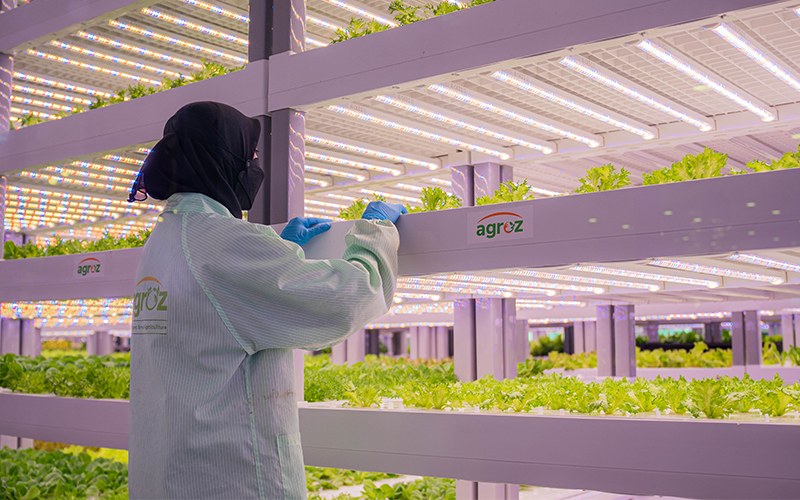
Agroz represents something rare in public markets: a pure-play vertical-farming company offering investors direct exposure to controlled-environment agriculture technology. Unlike diversified food conglomerates, Agroz’s business model centers entirely on the design, construction, operation, and management of AI-powered vertical farms.
The company’s proprietary Agroz Farm Operating System (Agroz OS) integrates sensors, data analytics, connectivity, and automated hardware to create what CEO Gerard Lim Kim Meng calls “agriculture as a fully data-driven industry.”
This positions Agroz at the intersection of multiple high-growth sectors—agtech, AI, sustainability infrastructure, and food-security solutions.
Multiple revenue streams reduce risk
Agroz has engineered a diversified model with four distinct revenue streams:
1. Design & construction of vertical farms for clients (capital projects)
2. Operations & management of farms (recurring revenue)
3. Technology licensing of complete farm systems
4. Produce sales to retail and wholesale markets
Capital projects offer high margins and scalability. Operations generate predictable recurring income. Produce sales provide immediate cash flow and validate the technology’s commercial viability.
The company currently operates two vertical farms in Malaysia, including the nation’s largest indoor facility—more than 5,000 square feet—recognized by the Malaysia Book of Records. Through retail partnerships, Agroz delivers more than 20 varieties of certified pesticide-free vegetables, demonstrating both B2B and B2C market penetration.
Technology moats and competitive positioning
Agroz OS represents proprietary intellectual property that combines operational technology with advanced analytics. The system’s integration of digitally automated hardware and intelligent software creates switching costs for clients while generating valuable agricultural data—an increasingly important asset in precision farming.
Additionally, Agroz holds myGAP.PF certification from Malaysia’s Ministry of Agriculture and Food Security, covering 20 vegetable varieties—a regulatory moat validating its food safety and quality standards.
ESG credentials in a sustainability-focused market
Environmental, Social and Governance (ESG) considerations are increasingly shaping institutional capital flows. Agroz scores strongly across multiple ESG metrics: Its farms use up to 95% less water than traditional agriculture, require zero pesticides, and reduce food miles by locating production near consumption centers. The company’s EduFarm model furthers social impact through public education and community engagement.
For ESG-focused funds and impact investors, Agroz offers measurable sustainability outcomes alongside financial returns—addressing UN Sustainable Development Goals related to zero hunger, clean water, sustainable cities, and climate action.
The investment thesis: Scarcity meets innovation
Agricultural production must rise sharply even as arable land and freshwater decline. Traditional methods alone cannot bridge this gap. Technology-enabled solutions are essential.
Agroz’s next-generation AI system aims to enable vertical farms to operate autonomously, lowering costs and increasing output. The company intends to channel IPO proceeds into capital expenditure, research and development, marketing, and strategic acquisitions, targeting expansion across Southeast Asia and the Middle East—regions facing acute food-security challenges and rapid urbanization.
Risks and considerations
Agroz’s $5 million raise is modest for a growth-stage technology company, which could limit near-term expansion. The vertical-farming sector has witnessed setbacks when unit economics failed to scale. Energy costs for lighting and climate control remain significant.
However, for investors seeking exposure to the agricultural-technology revolution, Agroz provides something rare: a publicly traded, pure-play opportunity in a field historically dominated by private capital.
A new chapter for agricultural investing
“Agroz’s Nasdaq listing is more than a financial milestone; it marks the start of our global journey to transform agriculture through AI and advanced vertical-farming technologies,” said Lim. “Food security is one of the defining challenges of our time, and we are ready to scale our pesticide-free farming model to deliver fresh, safe, and sustainable produce to communities worldwide.”
For investors, Agroz’s public debut represents agriculture’s evolution from a traditional industry into a modern asset class—one in which innovation, sustainability, and necessity form the foundation for long-term value creation.
As institutional investors increasingly allocate capital toward sustainable infrastructure and food security solutions, companies such as Agroz may mark the early innings of a broader transformation—when feeding the world becomes not just a humanitarian imperative but rather a sophisticated investment opportunity.
Note: This content was created by Agroz Inc.