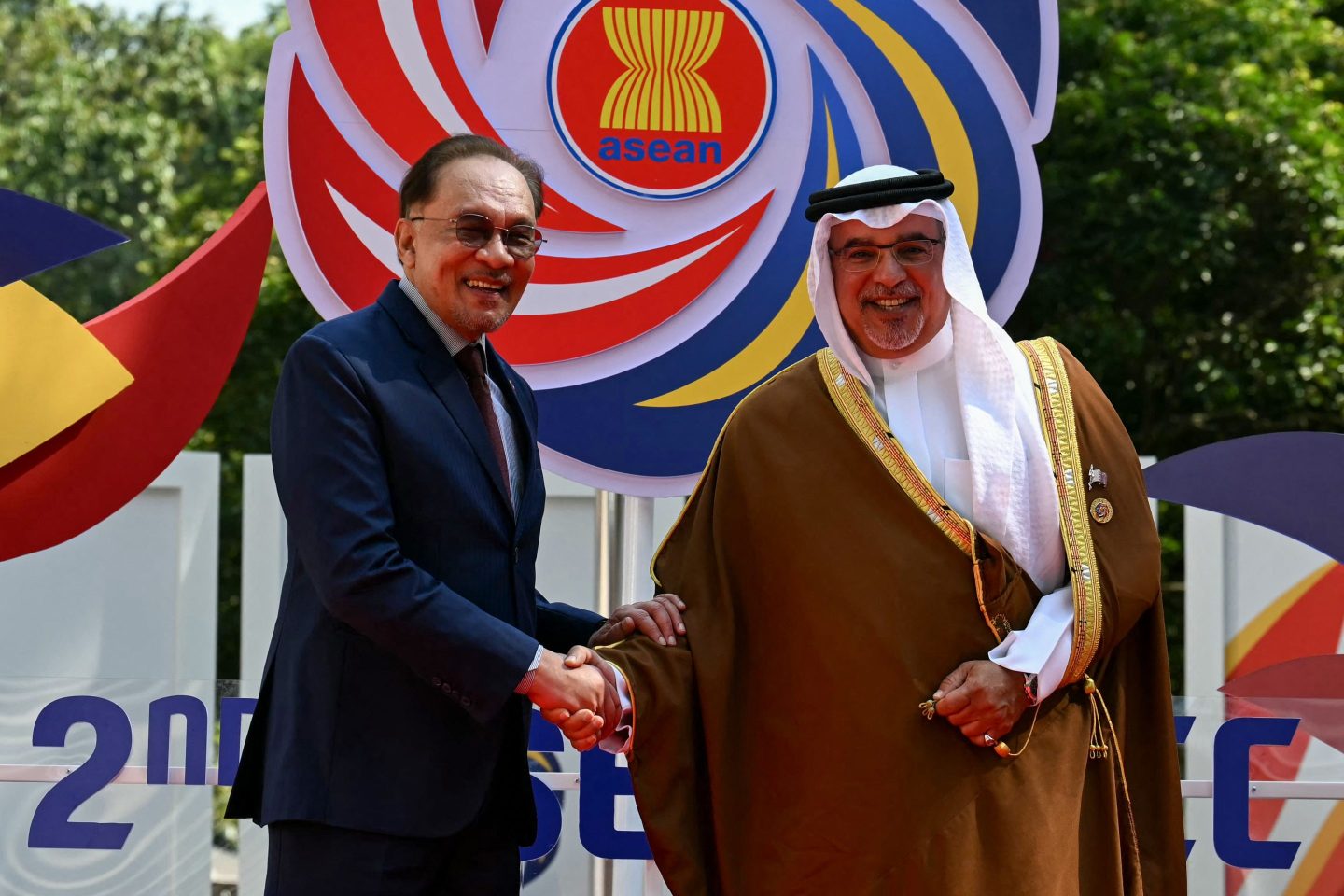
Leaders from the Middle East and Southeast Asia are holding their second summit in the Malaysian capital of Kuala Lumpur. The two regional blocs, the Gulf Cooperation Council (GCC) and the Association of Southeast Asian Nations (ASEAN), will also hold another, trilateral meeting that includes China for the first time as world regions start to hedge their bets in a more geopolitically unpredictable world.
The flurry of meetings involving leaders of the GCC, the ASEAN, and China is being held a day after the biannual ASEAN summit.
Malaysia’s Prime Minister, Anwar Ibrahim, said Monday at the ASEAN summit that he’s written to U.S. President Donald Trump, seeking to organize a meeting between Trump and Southeast Asian nations over concerns about U.S. tariffs.
Several Southeast Asian economies were hit hard by “Liberation Day” tariffs, and while these economies have already reached out individually to Washington, Anwar is pushing to have a meeting between the U.S. and the ASEAN as a bloc. Malaysia is ASEAN’s rotating chair this year.
Beyond the outreach, Malaysia is also keen to leverage its leadership position to build links with the GCC, a bloc of six Middle Eastern countries including Saudi Arabia and the United Arab Emirates, as well as China.
“A transition in the geopolitical order is underway, and the global trading system is under further strain with the recent imposition of U.S. unilateral tariffs,” Anwar said in his opening address at the ASEAN summit. “Protectionism is resurging as we bear witness to multilateralism breaking apart at the seams.”
This disintegration of the old order may be forcing regions like the Gulf and the ASEAN to forge new trading links, both with each other and with external parties.
“The declining influence of the U.S. in the Global South, coupled with increasingly polarizing U.S. policies in the Middle East, has opened space for alternative South-South alignments,” wrote Joanne Lin, senior fellow and co-coordinator of the ASEAN Studies Centre at the ISEAS–Yusof Ishak Institute, in the think tank’s publication Fulcrum ahead of the ASEAN-GCC-China summit.
Southeast Asia and the Middle East have quite a bit in common—including young populations with growing incomes. Both are also keen to climb up the value chain and move away from traditional, resource-extraction models of economic growth and invest in strategic industries.
Both regions have long looked to the U.S. as an important provider of security and economic growth. But China is also emerging as an important trading partner for both the GCC and the ASEAN—forcing both organizations to balance their relationships with Washington and Beijing.
An Asia pivot
Malaysia’s summit comes shortly after U.S. President Donald Trump made a high-profile visit to Saudi Arabia, the United Arab Emirates, and Qatar. During his trip, the three nations promised hundreds of billions of dollars in U.S. investments and purchases of U.S.-made products.
The White House attributed the announcements to Trump’s dealmaking prowess. Yet the Gulf’s sovereign wealth funds have been enmeshed in U.S. financial markets for decades, and want access to U.S. technology.
Host countries also charmed Trump with gifts like a Boeing 747 from Qatar.
But despite the large sums of money and huge deals, the GCC is engaging in a quiet pivot to Asia—or, at least, is diversifying its portfolio. Developing economies in Southeast Asia need the Gulf’s energy; those oil revenues, in turn, can be invested by Middle Eastern countries into their own economies.
Lin, from the ISEAS–Yusof Ishak Institute, told Fortune that the GCC’s pivot to the East is a “pragmatic move” even as it still maintains strong security ties with the West.
“The GCC’s pivot to the East isn’t about abandoning the U.S., but about diversifying its economic partnerships in Asia; especially China, India, and ASEAN are driving global energy demand and investment growth, so Gulf states see strategic value in deepening ties with the region,” Lin says.
Southeast Asia also needs funding for infrastructure projects, new industries, tech startups, and more. And the GCC has a lot of funding to offer. Saudi Arabia’s Public Investment Fund alone has over $900 billion in assets under management.
Trump’s Gulf visit is unlikely to halt “an eastward shift in the region’s center of gravity,” Alana Li, an analyst at U.K. think tank Asia House, wrote in a report ahead of the president’s Gulf trip.
It’s not just a search for new markets. The GCC wants to build stronger relationships outside of the U.S. in order to avoid relying too much on any one partner. “Gulf countries have become adept at aligning with Washington, Beijing, and other Asian capitals,” Li wrote.
ASEAN
The ASEAN, too, is trying to avoid leaning too close to either Washington or Beijing. As a bloc, the 10-member group has long tried to stick to a policy of nonalignment when it comes to geopolitical contests.
Still, several countries in Southeast Asia have benefited from exporting to the U.S., particularly as supply chains started to shift away from China following Trump’s first trade war and the COVID-19 pandemic.
Now, Southeast Asia’s role as a key node in global supply chains is under threat from the current-day Trump administration, which has threatened steep tariffs on traditional “China plus one” destinations like Vietnam, Cambodia, and Thailand. These trading partners are now trying to negotiate trade agreements with the U.S. to ward off these new taxes.
But Southeast Asian countries are also worried that they might become a dumping ground for cheap goods from China, which can no longer enter the U.S. as easily.
Some ASEAN economies are now courting the GCC as a source of capital and investment. Malaysia and Indonesia, as Muslim-majority countries, also have religious and cultural ties to the Middle East.
Indonesia won a $10 billion pledge from the UAE in February for a new renewable-energy joint venture that’s backed by Indonesia’s new Danantara sovereign wealth fund.
China
China, too, is engaging with both Southeast Asia and the Middle East—and arguably for similar reasons.
Lin highlights that China Premier Li Qiang’s attendance at the ASEAN-GCC-China summit in Malaysia is “quite significant.”
First, it signals China’s continued strategic intent to deepen economic and diplomatic engagement with the Global South, especially with the ASEAN and the GCC, two key trade partners for China.
“Coming together in a trilateral format allows China to reinforce its role as a central economic player in Asia and the Middle East,” Lin says.
Cementing its role as a central player in the region also allows China to advocate for a more multipolar economic order, and the presence of China’s premier, who is nominally in charge of the economy, reinforces that Beijing is willing to work with like-minded partners to offer alternative development and trade partnerships beyond traditional Western frameworks.
Apart from China looking to the Gulf for its energy demands, both Southeast Asia and the Middle East are attractive as consumer markets for Chinese companies.
Chinese EVs, which are not sold in the U.S. owing to high tariff barriers, can be seen in countries like Thailand, Malaysia, Singapore, and even Cambodia. Chinese smartphone brands like Honor and Transsion dominate the region’s markets.
Chinese companies are expanding into the Middle East as well, hoping to sell EVs, smartphones, and other goods to the region’s young, wealthy consumers. Chinese internet companies like Meituan are also launching in the region.
Fortune and the Government of Malaysia, led by the Ministry of Investment, Trade, and Industry are jointly hosting the ASEAN-GCC-China and ASEAN-GCC Economic Forums in Kuala Lumpur, Malaysia, on May 27 and May 28 respectively. Stay tuned for insights from the forums’ high-powered lineup of heads of state, ministers, top policymakers, experts, and investors.