• Home
  • Latest
  • Fortune 500
  • Finance
  • Tech
  • Leadership
  • Lifestyle
  • Rankings
  • Multimedia
PoliticsChina
Asia

Xi Jinping’s jaunt through Southeast Asia is ‘a reassurance and a warning’ to trading partners as the region is caught between the U.S. and China

By
Lionel Lim
Lionel Lim
Asia Reporter
Down Arrow Button Icon
By
Lionel Lim
Lionel Lim
Asia Reporter
Down Arrow Button Icon
April 22, 2025, 4:20 AM ET
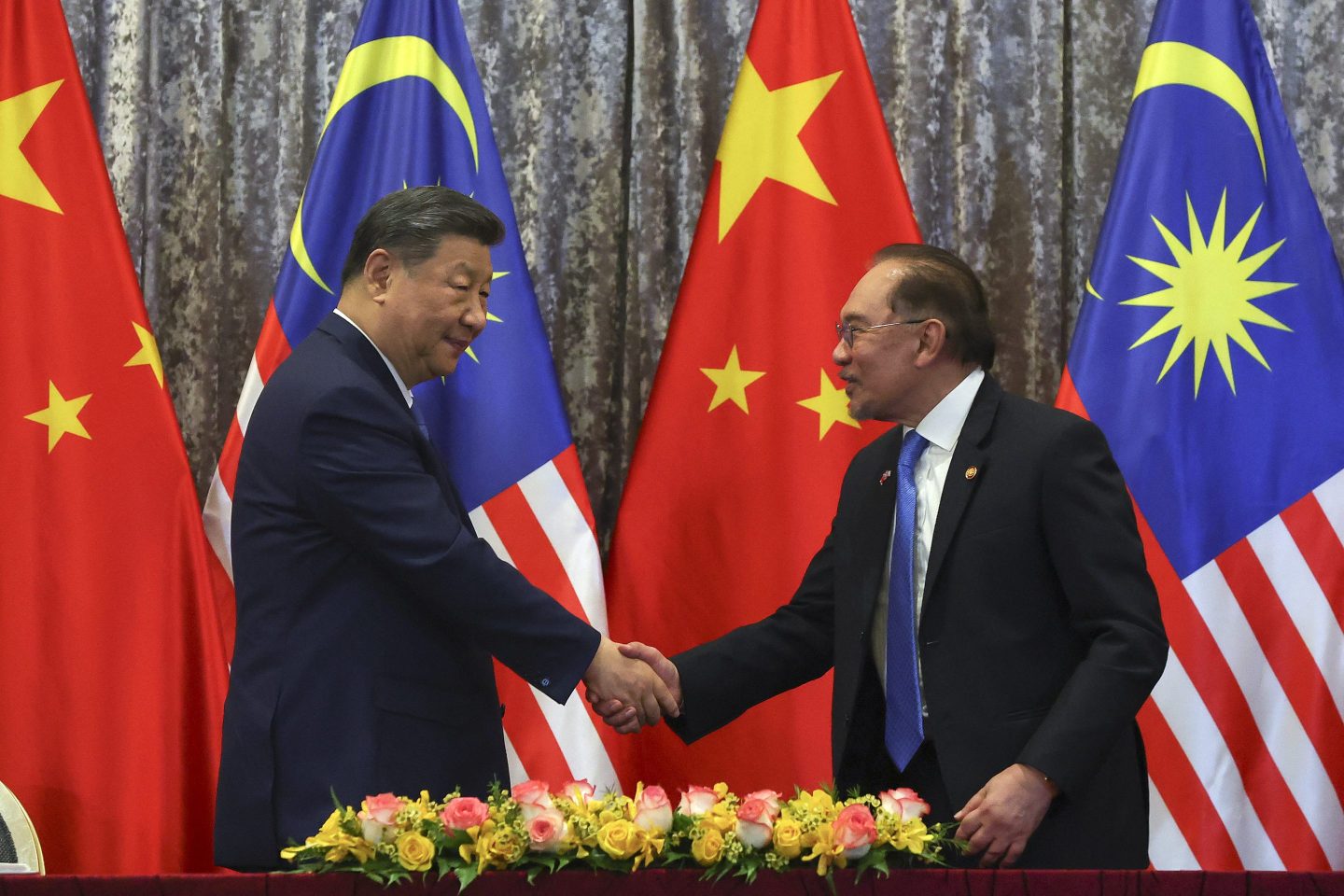
Chinese President Xi Jinping (left) and Malaysian Prime Minister Anwar Ibrahim shake hands at the end of an Exchange of Agreement session at the official residence of the prime minister in Putrajaya, outside Kuala Lumpur, on April 16, 2025.
Chinese President Xi Jinping (left) and Malaysian Prime Minister Anwar Ibrahim shake hands at the end of an Exchange of Agreement session at the official residence of the prime minister in Putrajaya, outside Kuala Lumpur, on April 16, 2025.Fazry Ismail—AFP/Getty Images

As the U.S. presses its trading partners to cut ties with China, Beijing is reminding neighbors in Southeast Asia that doing Washington’s bidding will come at a cost. 

Recommended Video

On Monday, Beijing said it “resolutely opposes any party reaching a deal [with the U.S.] at the expense of China’s interest,” and threatened retaliation in the event that a country did try to sacrifice trade with China. 

China’s warning comes after a weeklong visit by President Xi Jinping to Vietnam, Malaysia, and Cambodia, against the backdrop of global trade uncertainty emanating from the White House. 

Xi’s trip “was a reassurance and a warning,” says Trinh Nguyen, senior economist for emerging Asia at Natixis. She suggests the trip was a reminder to Southeast Asian economies that China wants to be seen as a responsible actor, and open to engaging with neighbors on trade. 

China is trying to “remind Asia that there’s always an alternative [to the U.S.],” says Sheana Yue, a Singapore-based economist at Oxford Economics, adding that Southeast Asian economies want to be able to maintain access to China’s large market. 

Chinese economic heft and Trump policy uncertainty could allow Beijing to promote the “Asia moment,” where the dominant global order shifts to Asia, says Alfred Wu, an associate professor at the Lee Kuan Yew School of Public Policy at the National University of Singapore. 

For years, Beijing has tried to present itself as an alternative to the U.S., particularly to neighboring Southeast Asia, a large trading partner. “Over the past two years, they’re using these [ideas] to counter the dominant global order,” Wu says, noting that China has increasingly referred to these ideas since 2022. 

Southeast Asia in the middle

Southeast Asian economies like Vietnam, Thailand, and Malaysia have benefited from supply-chain diversification, as companies adopted a “China plus one” strategy. That helped boost their exports, particularly to the U.S.

Some of that boost has come from China. Nguyen, from Natixis, notes that Vietnam’s northern region has benefited from Chinese investment in infrastructure and manufacturing. 

Yet surging exports led Trump to threaten higher tariffs on these countries, including a 46% tariff on Vietnam. The White House’s tariff calculations suggest the purpose of the “Liberation Day” taxes was to drive the U.S. trade deficit down to zero.

The U.S. has paused the implementation of these tariffs for 90 days, setting off a scramble among Southeast Asian countries to negotiate some kind of deal. Vietnam, Indonesia, Malaysia, Thailand, and Singapore are all engaging with the Trump administration. 

The U.S. is reportedly pressuring trading partners to decouple with China, suggesting that countries control trade with the world’s second-largest economy as a condition of open, tariff-free trade with the U.S.

Vietnam is also reportedly offering to scrutinize inbound trade from China as part of a deal with the U.S.

China signed several agreements and MOUs (memorandums of understanding) with Southeast Asian partners during Xi’s visit. While there were few concrete details of those announcements, Yue, from Oxford Economics, thinks these agreements allow Southeast Asian economies to continue juggling relations between the world’s two largest economies. 

Southeast Asian countries “still want access to the China market, and they also want the investments China is willing to give,” Yue explains. “But they also have to ensure they aren’t seen as too friendly to China, because that’s going to complicate their negotiations with the U.S.” 

Many Southeast Asian countries say they want to remain neutral between Washington and Beijing. And running afoul of China, the region’s largest trading partner, could have serious consequences.

China still supplies many of the inputs that are used in Southeast Asian manufacturing, which in turn are exported all over the world. 

The country is also one of the largest sources of tourists to countries like Thailand, Malaysia, and Singapore. Beijing could potentially discourage its citizens from traveling to those countries, thus hitting their respective tourism sectors, something which has happened before.

In 2017, China barred group travel to South Korea in response to the U.S. deployment of the THAAD antimissile system. The ban had an almost immediate effect on travel, with tourist numbers from China falling by nearly 20%. It took until 2023 for Beijing to lift the ban.

Join us at the Fortune Workplace Innovation Summit May 19–20, 2026, in Atlanta. The next era of workplace innovation is here—and the old playbook is being rewritten. At this exclusive, high-energy event, the world’s most innovative leaders will convene to explore how AI, humanity, and strategy converge to redefine, again, the future of work. Register now.
About the Author
By Lionel LimAsia Reporter
LinkedIn icon

Lionel Lim is a Singapore-based reporter covering the Asia-Pacific region.

See full bioRight Arrow Button Icon

Latest in Politics

North AmericaMexico
U.S., Mexico strike deal to settle Rio Grande water dispute
By Fabiola Zerpa and BloombergDecember 13, 2025
48 minutes ago
Danish military forces participate in an exercise with hundreds of troops from several European NATO members in the Arctic Ocean in Nuuk, Greenland, Monday, Sept. 15, 2025.
PoliticsDonald Trump
Danish intelligence report warns of U.S. economic leverage and military threat under Trump
By The Associated PressDecember 13, 2025
2 hours ago
Ukrainian President Volodymyr Zelensky gives a joint press conference in Kyiv, Ukraine in 2023 as European leaders visit the country 18 months after the start of Russia's invasion.
EuropeUkraine invasion
EU indefinitely freezes Russian assets to prevent Hungary and Slovakia from vetoing billions of euros being sent to support Ukraine
By Lorne Cook and The Associated PressDecember 13, 2025
2 hours ago
Spanish Prime Minister Pedro Sánchez often praises the financial and social benefits that immigrants bring to the country.
EuropeSpain
In a continent cracking down on immigration and berated by Trump’s warnings of ‘civilizational erasure,’ Spain embraces migrants
By Suman Naishadham and The Associated PressDecember 13, 2025
3 hours ago
Politicsdavid sacks
Can there be competency without conflict in Washington?
By Alyson ShontellDecember 13, 2025
7 hours ago
PoliticsAffordable Care Act (ACA)
With just days to go before ACA subsidies expire, Congress is about to wrap up its work with no consensus solution in sight
By Kevin Freking, Lisa Mascaro and The Associated PressDecember 13, 2025
8 hours ago

Most Popular

placeholder alt text
Economy
Tariffs are taxes and they were used to finance the federal government until the 1913 income tax. A top economist breaks it down
By Kent JonesDecember 12, 2025
2 days ago
placeholder alt text
Success
Apple cofounder Ronald Wayne sold his 10% stake for $800 in 1976—today it’d be worth up to $400 billion
By Preston ForeDecember 12, 2025
1 day ago
placeholder alt text
Success
40% of Stanford undergrads receive disability accommodations—but it’s become a college-wide phenomenon as Gen Z try to succeed in the current climate
By Preston ForeDecember 12, 2025
1 day ago
placeholder alt text
Economy
The Fed just ‘Trump-proofed’ itself with a unanimous move to preempt a potential leadership shake-up
By Jason MaDecember 12, 2025
1 day ago
placeholder alt text
Economy
For the first time since Trump’s tariff rollout, import tax revenue has fallen, threatening his lofty plans to slash the $38 trillion national debt
By Sasha RogelbergDecember 12, 2025
1 day ago
placeholder alt text
Success
Apple CEO Tim Cook out-earns the average American’s salary in just 7 hours—to put that into context, he could buy a new $439,000 home in just 2 days
By Emma BurleighDecember 12, 2025
1 day ago
Rankings
  • 100 Best Companies
  • Fortune 500
  • Global 500
  • Fortune 500 Europe
  • Most Powerful Women
  • Future 50
  • World’s Most Admired Companies
  • See All Rankings
Sections
  • Finance
  • Leadership
  • Success
  • Tech
  • Asia
  • Europe
  • Environment
  • Fortune Crypto
  • Health
  • Retail
  • Lifestyle
  • Politics
  • Newsletters
  • Magazine
  • Features
  • Commentary
  • Mpw
  • CEO Initiative
  • Conferences
  • Personal Finance
  • Education
Customer Support
  • Frequently Asked Questions
  • Customer Service Portal
  • Privacy Policy
  • Terms Of Use
  • Single Issues For Purchase
  • International Print
Commercial Services
  • Advertising
  • Fortune Brand Studio
  • Fortune Analytics
  • Fortune Conferences
  • Business Development
About Us
  • About Us
  • Editorial Calendar
  • Press Center
  • Work At Fortune
  • Diversity And Inclusion
  • Terms And Conditions
  • Site Map

© 2025 Fortune Media IP Limited. All Rights Reserved. Use of this site constitutes acceptance of our Terms of Use and Privacy Policy | CA Notice at Collection and Privacy Notice | Do Not Sell/Share My Personal Information
FORTUNE is a trademark of Fortune Media IP Limited, registered in the U.S. and other countries. FORTUNE may receive compensation for some links to products and services on this website. Offers may be subject to change without notice.