• Home
  • Latest
  • Fortune 500
  • Finance
  • Tech
  • Leadership
  • Lifestyle
  • Rankings
  • Multimedia
PoliticsTariffs
Asia

Trump advisors argue steep tariffs on countries like Vietnam and Cambodia are needed to erase trade deficits and rework supply chains. The economics say that’s going to be a long shot

By
Lionel Lim
Lionel Lim
Asia Reporter
Down Arrow Button Icon
By
Lionel Lim
Lionel Lim
Asia Reporter
Down Arrow Button Icon
April 8, 2025, 10:05 AM ET
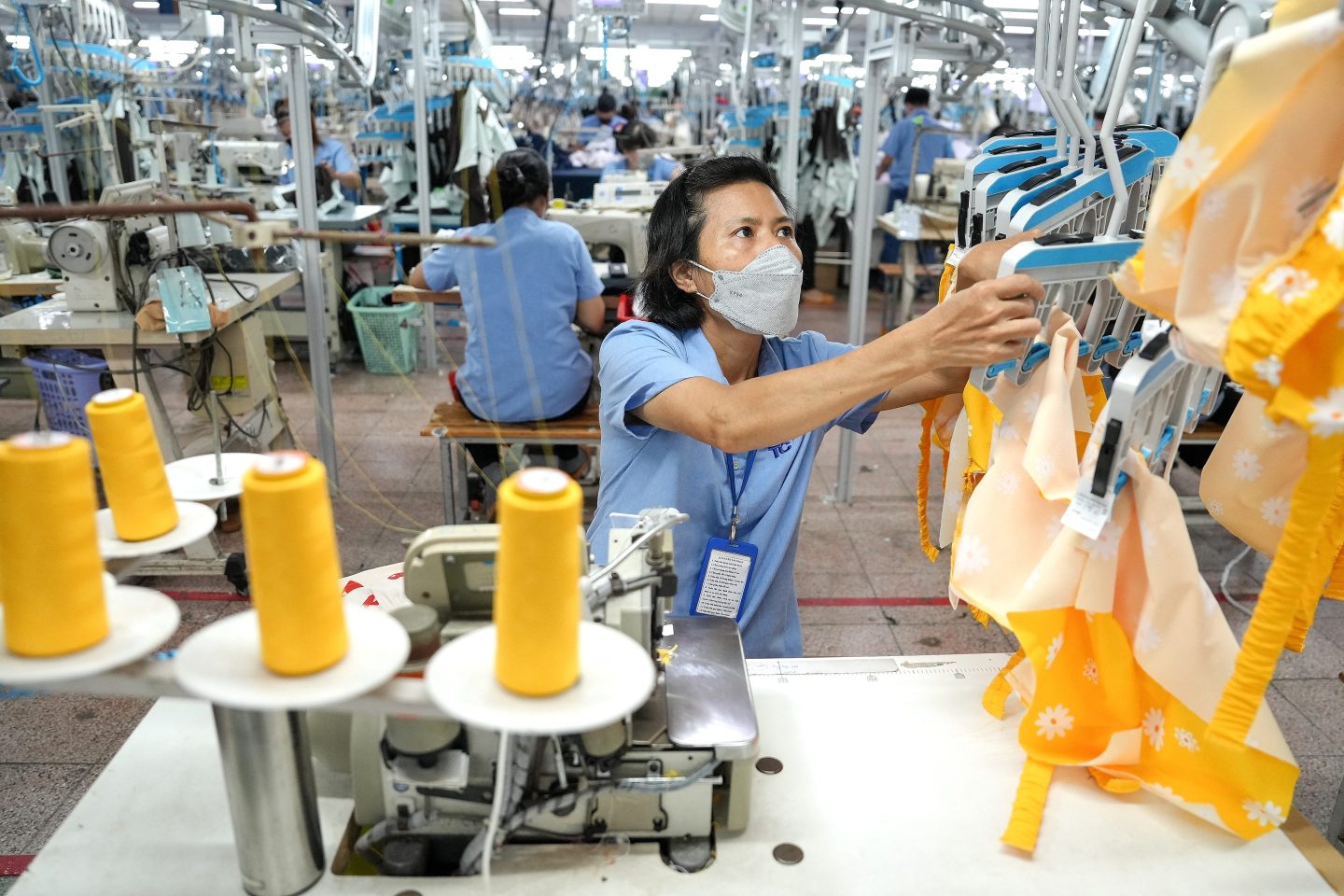
Vietnamese garment workers at a factory in Ho Chi Minh City on April 3, 2025.
Vietnamese garment workers at a factory in Ho Chi Minh City on April 3, 2025.Huu Kha—AFP/Getty Images

U.S. President Donald Trump, on “Liberation Day,” reserved some of his highest tariff rates for Southeast Asia. Economists expected to see some targets, like manufacturing hub Vietnam, on Trump’s tariffs list. Other targets, like neighboring Cambodia, were more surprising—and all were shocked by the steep tariffs imposed on the region, often extending into the 40% range. 

Recommended Video

April 2 set off a scramble in Southeast Asia, which has relied on exports for growth. Both Vietnam and Cambodia have already offered to cut their tariffs on U.S. imports. But that’s unlikely to mollify everyone in the Trump administration. Trade advisor Peter Navarro has accused Vietnam of “non-tariff cheating,” pointing to the country’s value-added tax and its use by Chinese manufacturers to evade U.S. tariffs. Commerce Secretary Howard Lutnick also argues Vietnam’s large trade surplus means it’s ripping off the U.S.

Yet what Navarro, Lutnick, and Trump want—completely balanced trade with countries like Vietnam—is a tall order. These countries have promised to buy more U.S. goods, like aircraft or energy. But, in truth, these Southeast Asian countries are just not wealthy enough to buy enough U.S. consumer goods to balance out their exports. 

According to the World Bank, Cambodia’s GDP per capita was just slightly over $2,400 in 2023, compared with $82,800 for the U.S.

That raises the possibility that there is nothing Vietnam or Cambodia could offer that would make the Trump administration happy, making steep tariffs a permanent part of U.S. trade to Southeast Asia. 

Why did Donald Trump impose such steep tariffs on countries like Vietnam, Cambodia and Laos? 

Vietnam, Cambodia, and Laos all export far more to the U.S. than they import. Given the straightforward way the Trump administration calculated its “Liberation Day” tariffs—at its core, the trade surplus divided by total imports—these emerging manufacturing hubs like Vietnam were always going to get high tariffs.

“What ended up happening was that reciprocal tariffs were defined as the estimated tariff rate needed to drop the trade balance to zero,” said Adam Ahmad Samdin, a Singapore-based economist covering Asian economies at Oxford Economics.

That means Trump’s tariffs have nothing to do with what barriers Vietnam or Cambodia imposed on the U.S. For example, data from the World Trade Organization showed Vietnam’s simple average tariff rate was just 9.4%.

Both Vietnam and Cambodia export tech products to the U.S. Vietnam exports electronics like laptops, mobile phones, and video-game consoles; Cambodia exports solar panels. Both also export fast-moving consumer goods like apparel, footwear, and bags. Laos, a neighbor to Cambodia and Vietnam, exports both solar cells and fast-moving consumer goods like footwear and textiles. (Laos got a 48% tariff rate from Trump last week, while Vietnam and Cambodia got 46% and 49%, respectively).

“The reason why Southeast Asian economies have been a prime destination [for manufacturing] is really because of the relatively low labor cost relative to the amount of skills the workforce there has,” Samdin said. “The average American worker’s income is many times higher.”

What happens next?

High U.S. tariffs are a major threat to growth in Southeast Asia, which has benefited from “China plus one” approaches to supply-chain diversification.

DBS, in a recent report, suggests U.S. tariffs could reduce Vietnam’s economic growth by as much as 2.5 percentage points; the Singaporean bank initially forecast 6.8% growth for the Southeast Asian country this year. 

Economists think most Asian economies will try to negotiate with the U.S., in contrast to China’s more aggressive retaliation to Trump tariffs. “U.S. exports to Asia are small in quantum, which gives the region less leverage” to retaliate, Nomura wrote in a recent report. The Japanese financial firm thinks countries will offer to buy more U.S. goods, increase investments in the U.S., and expand market access to U.S. firms.

As of now, Vietnam has offered to eliminate tariffs on U.S. imports, while Cambodia has already slashed tariffs on a range of U.S. products down to 5%. 

But that’s unlikely to solve the underlying trade imbalance, as these countries don’t import much from the U.S. 

Vietnam imported $13.1 billion worth of goods from the U.S. last year. In contrast, Vietnam sent $136.6 billion the other way, more than 10 times what it bought.

Vietnam’s biggest purchases from the U.S. were computers and electronic products, and machinery and instruments, according to Vietnam’s government data. The country likely imported these products in order to support its electronics manufacturing. 

In a statement released late Monday, Hanoi urged the U.S. to delay the imposition of tariffs for at least 45 days to allow time for bilateral negotiations. Vietnamese Prime Minister Pham Minh Chinh signaled the country was ready to increase purchases related to defense and security, and will also look to address monetary policy concerns raised by Washington.

Cambodia and Laos, two largely agrarian economies, import even less from the U.S. Cambodia imported $321.6 million worth of products from the U.S. last year; it’s even smaller for Laos, which only imported $40.4 million worth of products from the U.S. 

Conversely, Cambodia exported $12.7 billion worth of goods to the U.S. while Laos exported $803.3 million. 

Cambodia’s and Laos’s top U.S. imports aren’t consumer goods like cars or electronics. Instead, it’s fuel and mechanical equipment.

“These economies don’t really have a lot of purchasing power,” Samdin said. He added these countries may not need or want what the U.S. is offering—and even if they did, it might not be “at a price point that U.S. producers would be willing to sell at.”

Join us at the Fortune Workplace Innovation Summit May 19–20, 2026, in Atlanta. The next era of workplace innovation is here—and the old playbook is being rewritten. At this exclusive, high-energy event, the world’s most innovative leaders will convene to explore how AI, humanity, and strategy converge to redefine, again, the future of work. Register now.
About the Author
By Lionel LimAsia Reporter
LinkedIn icon

Lionel Lim is a Singapore-based reporter covering the Asia-Pacific region.

See full bioRight Arrow Button Icon

Latest in Politics

Finance
Lorem ipsum dolor sit amet, consectetur adipiscing elit, sed do eiusmod tempor incididunt ut labore et dolore magna aliqua. Ut enim ad minim veniam
By Fortune Editors
October 20, 2025
Finance
Lorem ipsum dolor sit amet, consectetur adipiscing elit, sed do eiusmod tempor incididunt ut labore et dolore magna aliqua. Ut enim ad minim veniam
By Fortune Editors
October 20, 2025
Finance
Lorem ipsum dolor sit amet, consectetur adipiscing elit, sed do eiusmod tempor incididunt ut labore et dolore magna aliqua. Ut enim ad minim veniam
By Fortune Editors
October 20, 2025
Finance
Lorem ipsum dolor sit amet, consectetur adipiscing elit, sed do eiusmod tempor incididunt ut labore et dolore magna aliqua. Ut enim ad minim veniam
By Fortune Editors
October 20, 2025
Finance
Lorem ipsum dolor sit amet, consectetur adipiscing elit, sed do eiusmod tempor incididunt ut labore et dolore magna aliqua. Ut enim ad minim veniam
By Fortune Editors
October 20, 2025
Finance
Lorem ipsum dolor sit amet, consectetur adipiscing elit, sed do eiusmod tempor incididunt ut labore et dolore magna aliqua. Ut enim ad minim veniam
By Fortune Editors
October 20, 2025

Most Popular

Finance
Lorem ipsum dolor sit amet, consectetur adipiscing elit, sed do eiusmod tempor incididunt ut labore et dolore magna aliqua. Ut enim ad minim veniam
By Fortune Editors
October 20, 2025
Finance
Lorem ipsum dolor sit amet, consectetur adipiscing elit, sed do eiusmod tempor incididunt ut labore et dolore magna aliqua. Ut enim ad minim veniam
By Fortune Editors
October 20, 2025
Finance
Lorem ipsum dolor sit amet, consectetur adipiscing elit, sed do eiusmod tempor incididunt ut labore et dolore magna aliqua. Ut enim ad minim veniam
By Fortune Editors
October 20, 2025
Finance
Lorem ipsum dolor sit amet, consectetur adipiscing elit, sed do eiusmod tempor incididunt ut labore et dolore magna aliqua. Ut enim ad minim veniam
By Fortune Editors
October 20, 2025
Finance
Lorem ipsum dolor sit amet, consectetur adipiscing elit, sed do eiusmod tempor incididunt ut labore et dolore magna aliqua. Ut enim ad minim veniam
By Fortune Editors
October 20, 2025
Finance
Lorem ipsum dolor sit amet, consectetur adipiscing elit, sed do eiusmod tempor incididunt ut labore et dolore magna aliqua. Ut enim ad minim veniam
By Fortune Editors
October 20, 2025
Rankings
  • 100 Best Companies
  • Fortune 500
  • Global 500
  • Fortune 500 Europe
  • Most Powerful Women
  • Future 50
  • World’s Most Admired Companies
  • See All Rankings
Sections
  • Finance
  • Leadership
  • Success
  • Tech
  • Asia
  • Europe
  • Environment
  • Fortune Crypto
  • Health
  • Retail
  • Lifestyle
  • Politics
  • Newsletters
  • Magazine
  • Features
  • Commentary
  • Mpw
  • CEO Initiative
  • Conferences
  • Personal Finance
  • Education
Customer Support
  • Frequently Asked Questions
  • Customer Service Portal
  • Privacy Policy
  • Terms Of Use
  • Single Issues For Purchase
  • International Print
Commercial Services
  • Advertising
  • Fortune Brand Studio
  • Fortune Analytics
  • Fortune Conferences
  • Business Development
About Us
  • About Us
  • Editorial Calendar
  • Press Center
  • Work At Fortune
  • Diversity And Inclusion
  • Terms And Conditions
  • Site Map
  • Facebook icon
  • Twitter icon
  • LinkedIn icon
  • Instagram icon
  • Pinterest icon

Latest in Politics

CryptoCryptocurrency
Landmark crypto bill on knife’s edge as Coinbase CEO pulls support ahead of key Senate vote
By Leo SchwartzJanuary 14, 2026
16 hours ago
greenland
PoliticsGreenland
Denmark and Greenland agree to form working group over the future of the territory
By Emma Burrows, Claudia Ciobanu, Ben Finley and The Associated PressJanuary 14, 2026
17 hours ago
taylor
Politicsphilanthropy
Rural America is getting a bailout, but not from Trump—billionaires are riding to the rescue
By Nick LichtenbergJanuary 14, 2026
17 hours ago
greenland
EuropeGreenland
Americans have been quietly plundering Greenland for over 100 years, since a Navy officer chipped fragments off the Cape York iron meteorite
By Paul Bierman and The ConversationJanuary 14, 2026
17 hours ago
Gates
PoliticsGates Foundation
One year after Bill Gates surprised with the choice to close his foundation by 2045, he’s cutting staff jobs
By Stephanie Beasley and The Associated PressJanuary 14, 2026
18 hours ago
deportation
LawImmigration
Trump is sorry for deporting college student who flew home to surprise her family for Thanksgiving, but is still deporting her
By Michael Casey and The Associated PressJanuary 14, 2026
18 hours ago

Most Popular

placeholder alt text
Personal Finance
Peter Thiel makes his biggest donation in years to help defeat California’s billionaire wealth tax
By Nick LichtenbergJanuary 14, 2026
22 hours ago
placeholder alt text
AI
'Godfather of AI' says the technology will create massive unemployment and send profits soaring — 'that is the capitalist system'
By Jason MaJanuary 12, 2026
3 days ago
placeholder alt text
AI
Being mean to ChatGPT can boost its accuracy, but scientists warn you may regret it
By Marco Quiroz-GutierrezJanuary 13, 2026
2 days ago
placeholder alt text
Success
Despite his $2.6 billion net worth, MrBeast says he’s having to borrow cash and doesn’t even have enough money in his bank account to buy McDonald’s
By Emma BurleighJanuary 13, 2026
2 days ago
placeholder alt text
Economy
Jamie Dimon warns $38 trillion national debt is going to 'bite': 'You can't just keep borrowing money endlessly'
By Eleanor PringleJanuary 14, 2026
1 day ago
placeholder alt text
Future of Work
'Microshifting,' an extreme form of hybrid working that breaks work into short, non-continuous blocks, is on the rise
By Nick LichtenbergJanuary 13, 2026
2 days ago

© 2025 Fortune Media IP Limited. All Rights Reserved. Use of this site constitutes acceptance of our Terms of Use and Privacy Policy | CA Notice at Collection and Privacy Notice | Do Not Sell/Share My Personal Information
FORTUNE is a trademark of Fortune Media IP Limited, registered in the U.S. and other countries. FORTUNE may receive compensation for some links to products and services on this website. Offers may be subject to change without notice.