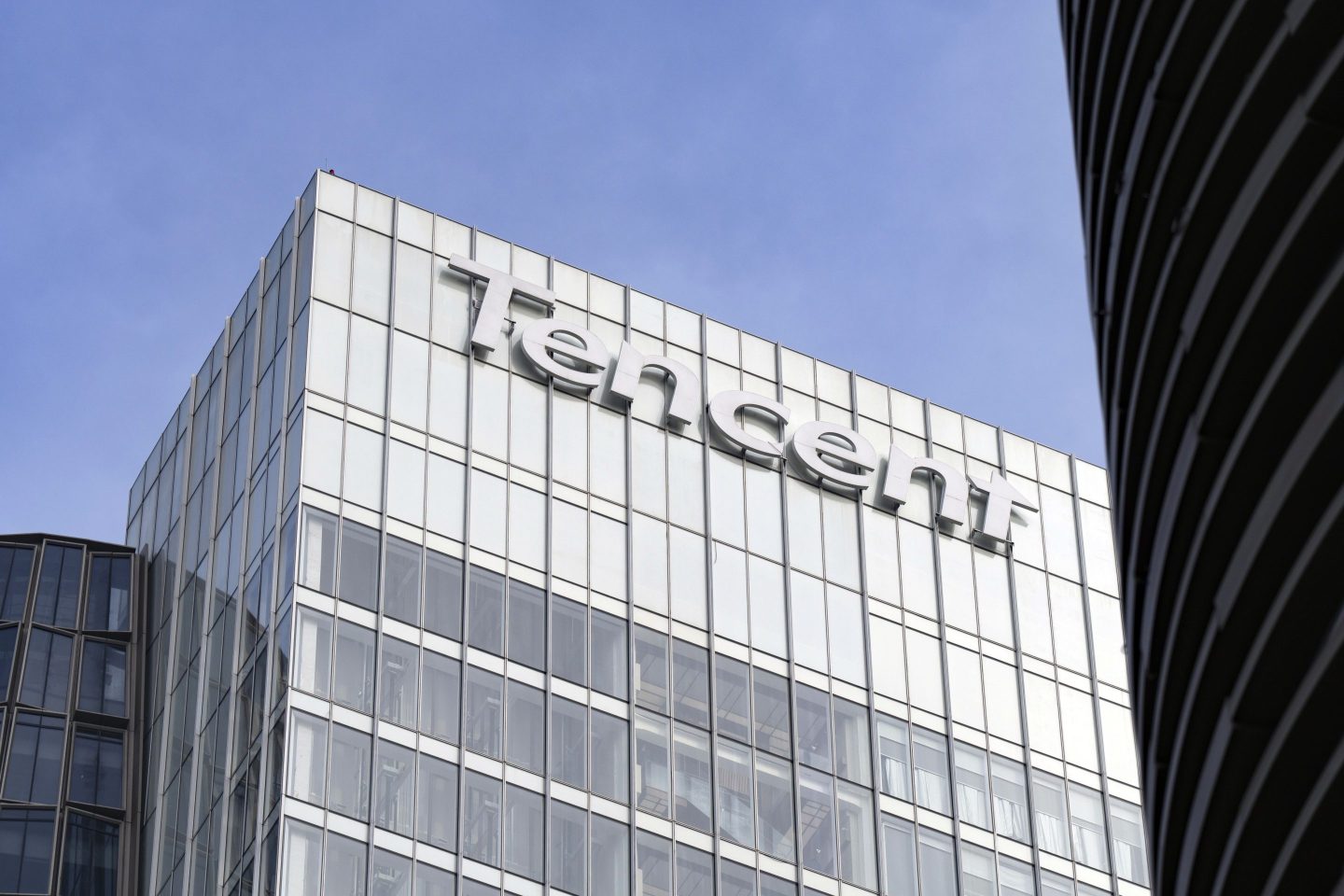
A surprise, last-minute decision by the Biden administration to designate Tencent as a firm with ties to China’s military has erased billions in market value from the world’s largest video game company.
Tencent shares in Hong Kong dropped by around 7.3% on Tuesday, following news that the Department of Defense included the tech giant on a list of “Chinese military companies.”
The plunge erased over $35 billion in market value from the Global 500 company. (The Hang Seng Tech Index, which tracks technology companies traded in Hong Kong, fell 0.9%.)
The U.S. also alleged that Contemporary Amperex Technology Co. (CATL), the world’s largest producer of electric car batteries, had ties to China’s military. CATL shares, traded in the Chinese city of Shenzhen, dropped 2.8%.
The Department of Defense blacklist, first compiled in 2021, designates companies that the Pentagon believes are helping China’s military to modernize.
Other companies on the list include Chinese tech giant Huawei, chipmakers SMIC and YMTC, and drone manufacturer DJI.
The blacklist doesn’t place any specific sanctions on designated companies beyond barring them from serving the U.S. military.
Yet Morningstar equity analysts Ivan Su and Vincent Sun warned that the designation could lead to “reputational damage,” and dissuade companies from working with Tencent and CATL.
Nominations are now open:
Fortune is now accepting nominations for the 2025 Southeast Asia 500—the definitive ranking of the region’s largest companies. Start your nomination here.
A Tencent spokesperson called the firm’s inclusion on the blacklist “clearly a mistake,” and noted the listing will have “no impact” on its business.
“We are not a military company or supplier … We will nonetheless work with the Department of Defense to address any misunderstanding,” the spokesperson said.
“CATL has never engaged in any military-related business or activities, so this designation by the Department of Defense is a mistake,” a CATL spokesperson said.
The battery maker will “proactively engage with DOD to address the false designation, including legal action if necessary.”
China’s foreign ministry blasted the decision on Tuesday.
“China is always firmly opposed to the U.S. side’s generalization of the concept of national security, the establishment of various discriminatory lists, the unreasonable suppression of Chinese enterprises, and the curbing of China’s high-quality development,” said spokesperson Guo Jiakun to reporters.
How big are Tencent and CATL?
Tencent is China’s largest firm by market capitalization and the world’s largest video game company by revenue. It also operates WeChat, the ubiquitous messaging platform in China, and WeChat Pay, one of China’s most widely used payment services.
The company has a significant footprint in the global gaming industry. It owns Riot Games, the developer of League of Legends, and Supercell, the developer of the Clash of Clans mobile game.
It also owns a significant minority stake in Epic Games, the developer of both Fortnite and the widely used Unreal Engine.
CATL, No. 250 on the Fortune Global 500, is the world’s leading supplier of batteries for electric vehicles, supplying foreign carmakers like Tesla, Stellantis, Volkswagen, and Honda.
One in three EVs use a CATL battery, according to Bloomberg.
CATL and BYD, which produces batteries for its own cars, make up about half the global battery market. (Korea’s LG Energy is in third place.)
In early 2023, Ford announced that it would work with CATL to invest $3.5 billion in a new Michigan-based battery plant. However, lawmakers criticized the deal as potentially funneling U.S. funds to a Chinese company. Stellantis announced a new joint venture with CATL in mid-December to build a $4.3 billion battery plant in Spain.
Sun, at Morningstar, notes that U.S. carmakers were already shifting away from CATL following U.S. rules that denied subsidies to EVs with components from “countries of concern”—namely, China.
Can Tencent and CATL get off the list?
Chinese companies have successfully persuaded the U.S. to take them off similar blacklists.
Chinese phone maker Xiaomi was briefly placed on a different blacklist at the tail end of the first Trump administration, which barred U.S. investment in the company.
Xiaomi then launched an aggressive lawsuit, calling the designation “unlawful and unconstitutional.” Four months later, the U.S. Department of Defense removed Xiaomi.
Su, at Morningstar, predicts that Tencent has “a good chance” of reversing the designation in the courts, citing that its business model primarily revolves around social media and video games.
Washington vs. Beijing
The move against Tencent and CATL is part of a flurry of final acts by the Biden administration ahead of Donald Trump’s return to the presidency.
The White House has also launched a trade investigation into China’s dominance of mature chips, and is considering a rule that would restrict or ban Chinese-made drones in the U.S. Any policy changes would need to be implemented by the incoming Trump administration.
This follows years of new rules targeting China’s tech sector, including export bans on advanced chips and chipmaking equipment, steep tariffs on Chinese EVs, and a ban on U.S. investment into strategic technologies in China.
Beijing has responded with its own sanctions, putting U.S. defense companies on its own “unreliable entities” blacklist, and imposing export controls on critical minerals and certain battery technologies.