Bandra Kurla Complex, Mumbai’s commercial hub, oozes luxury. Affluent shoppers stroll in and out of stores like Emporio Armani, Satya Paul, and Swarovski. The corporate headquarters of tech giant Amazon towers over the upscale shops. The large plaza in the BKC, as it’s known, hosts concerts and sports events. The Backstreet Boys performed there recently.
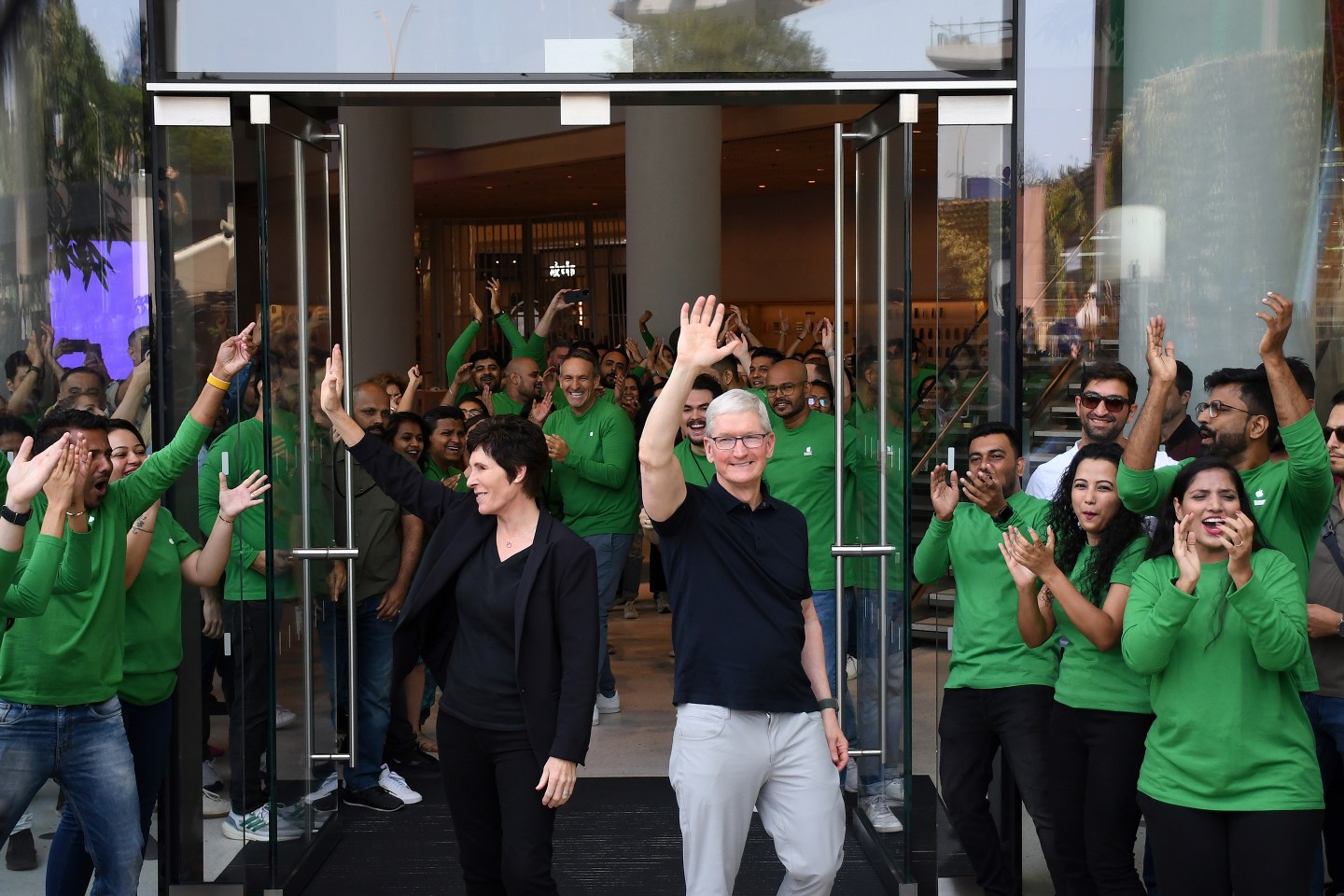
On a Tuesday in April, swarms of Indians streamed into the plaza to glimpse a pop star of a different kind: Apple CEO Tim Cook, who was there to open one of the tech giant’s first two stores in India. After a brief countdown, Cook thrust open the doors of the 22,000-square-foot BKC location. Surrounded by cheering, green-clad Apple associates, the chief executive high-fived and posed for selfies with some of the first visitors.
Cook was all smiles. Rightfully so. The Indian market presents an unprecedented opportunity for growth: Only half of India’s 1.4 billion people own a smartphone, and Apple is only now gaining a real, direct foothold in the retail market.
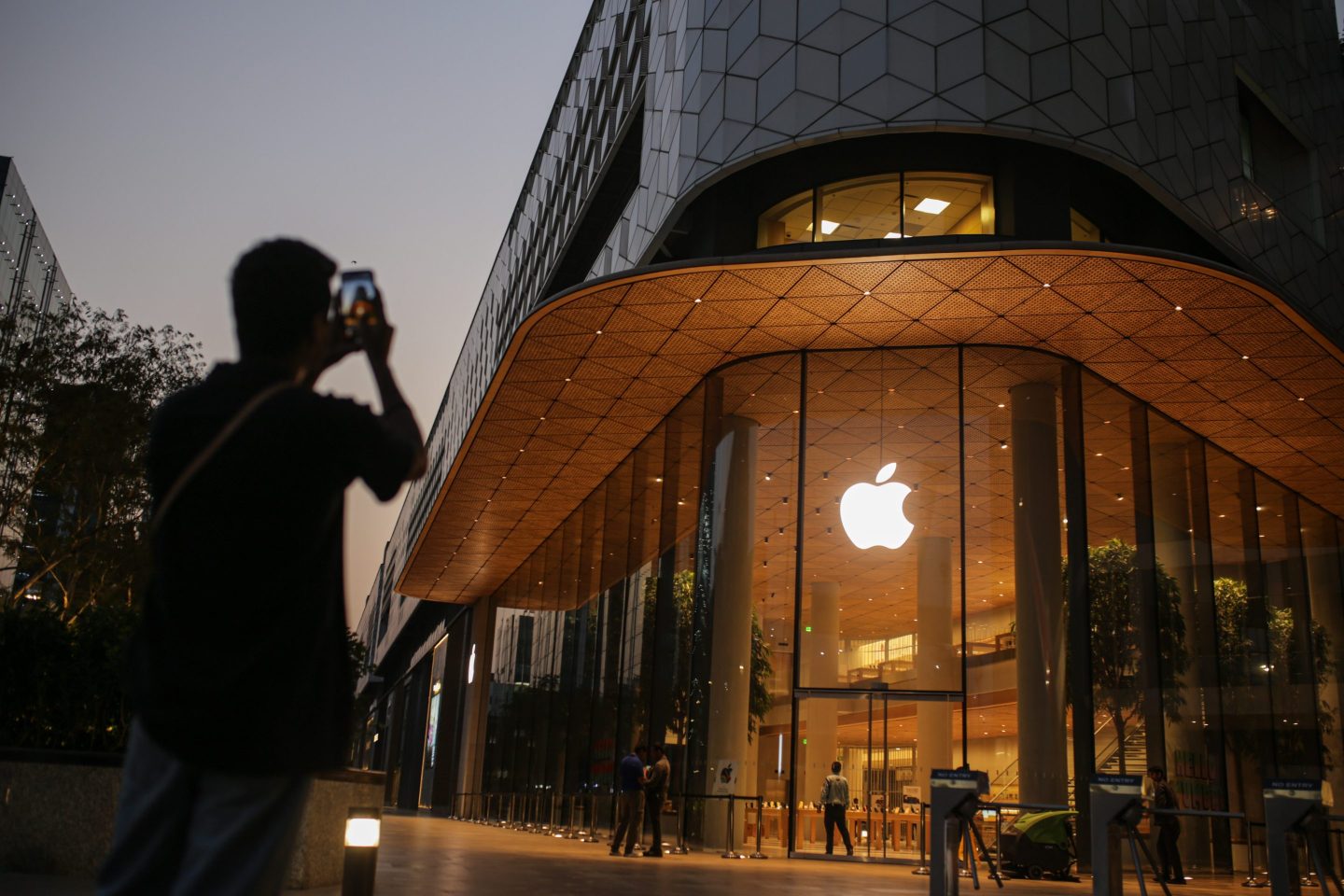
Months later, Cook was gone, but the BKC Apple Store still buzzed. Its triangle shape resembles New York City’s Flatiron Building; two sides are eight-meter-high glass windows; its stone wall is sourced from India’s Rajasthan state. A ceiling of 1,000 handcrafted oak tiles arranged in a lattice pattern pays tribute to the rattan weavers of Mumbai. A few dozen customers browsed its displays.
Preeti Shah, a jewelry designer from Ahmadabad, has owned an iPhone for a decade, a rarity in Android-dominated India. “When I saw that they had opened an Apple Store here, I just had to visit,” she said. Shah, 69, first visited an Apple flagship store in New York in 2018 and said the Mumbai store was just like it. Now she hopes Apple opens a store in her hometown.
Most customers are like Shah; they “walk in out of curiosity,” a store worker told Fortune. The signature Apple retail experience is finally available to them. They fiddle with Apple’s latest iPhone, demo MacBooks, or sit in on complimentary training sessions.
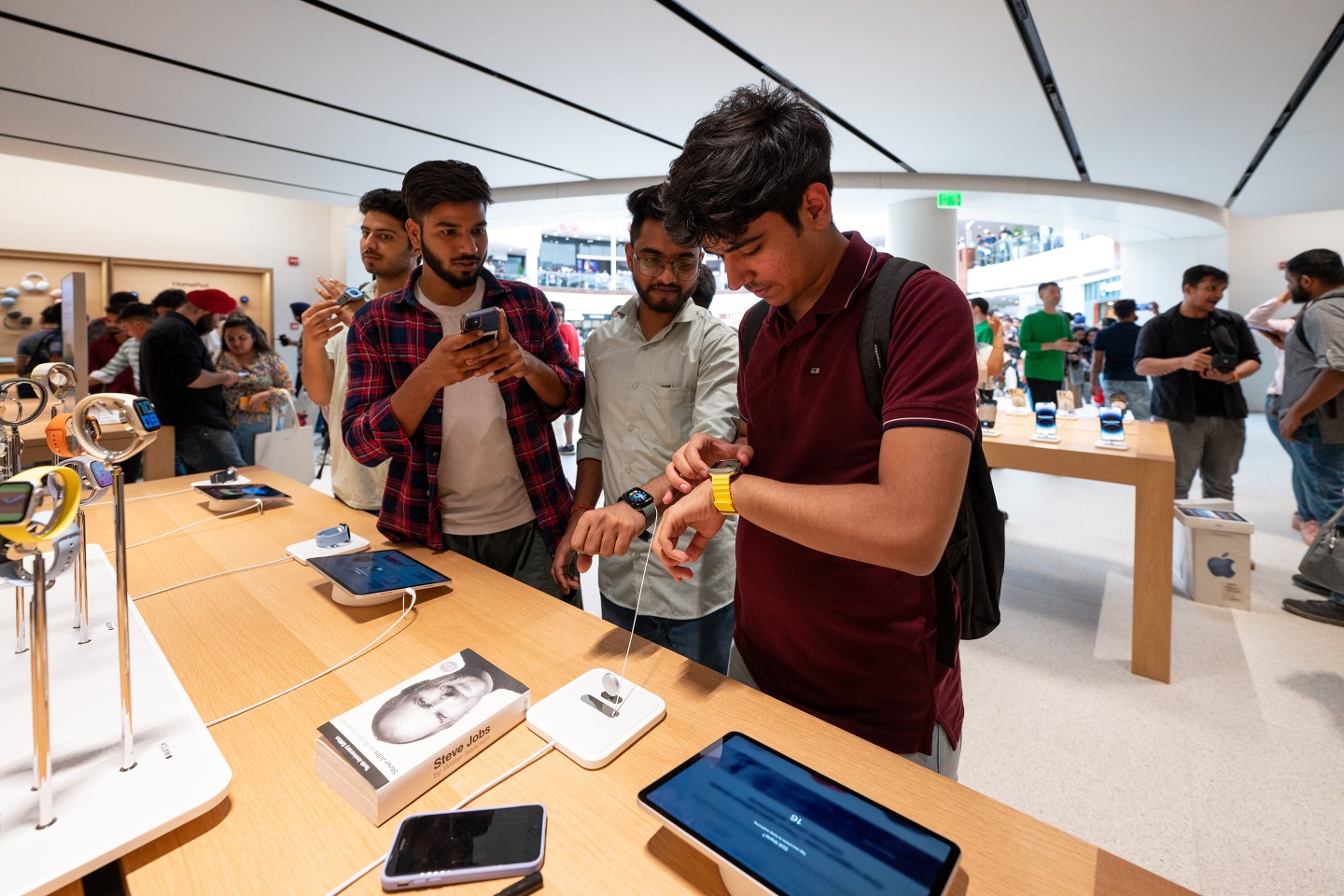
If Apple customers are walking in out of curiosity, they’re walking out with new purchases. Apple sales in India are soaring. The Mumbai store alone reportedly conducted $1.2 million in sales on its opening day. In its first month of operation, the store reportedly generated $2.6 million, as did Apple’s second India store in New Delhi.
“We had an all-time revenue record in India. We grew very strong double digits,” Cook said during Apple’s fourth-quarter earnings call in early November. Apple does not disclose India-only sales in its earnings, but research firm International Data Corporation (IDC) said the company sold around 6.7 million iPhones in 2022. That amounts to an estimated $5.6 billion, a sum equal to roughly 1.5% of Apple’s 2022 revenue of $394 billion. In a filing with India’s Ministry of Corporate Affairs, Apple reported $5.9 billion in revenue from April 2022 through March 2023.
Apple had tried to expand its retail presence in India for years, but the country’s stringent local-sourcing rules for foreign retail firms barred Apple—and other international companies like Ikea—from selling directly to customers. Even Apple.com, the company’s e-commerce site, was unavailable in India until September 2020. Instead, Apple relied on third-party outlets and websites as well as a network of mom-and-pop retailers to get its devices into the hands and onto the desks of Indian consumers.
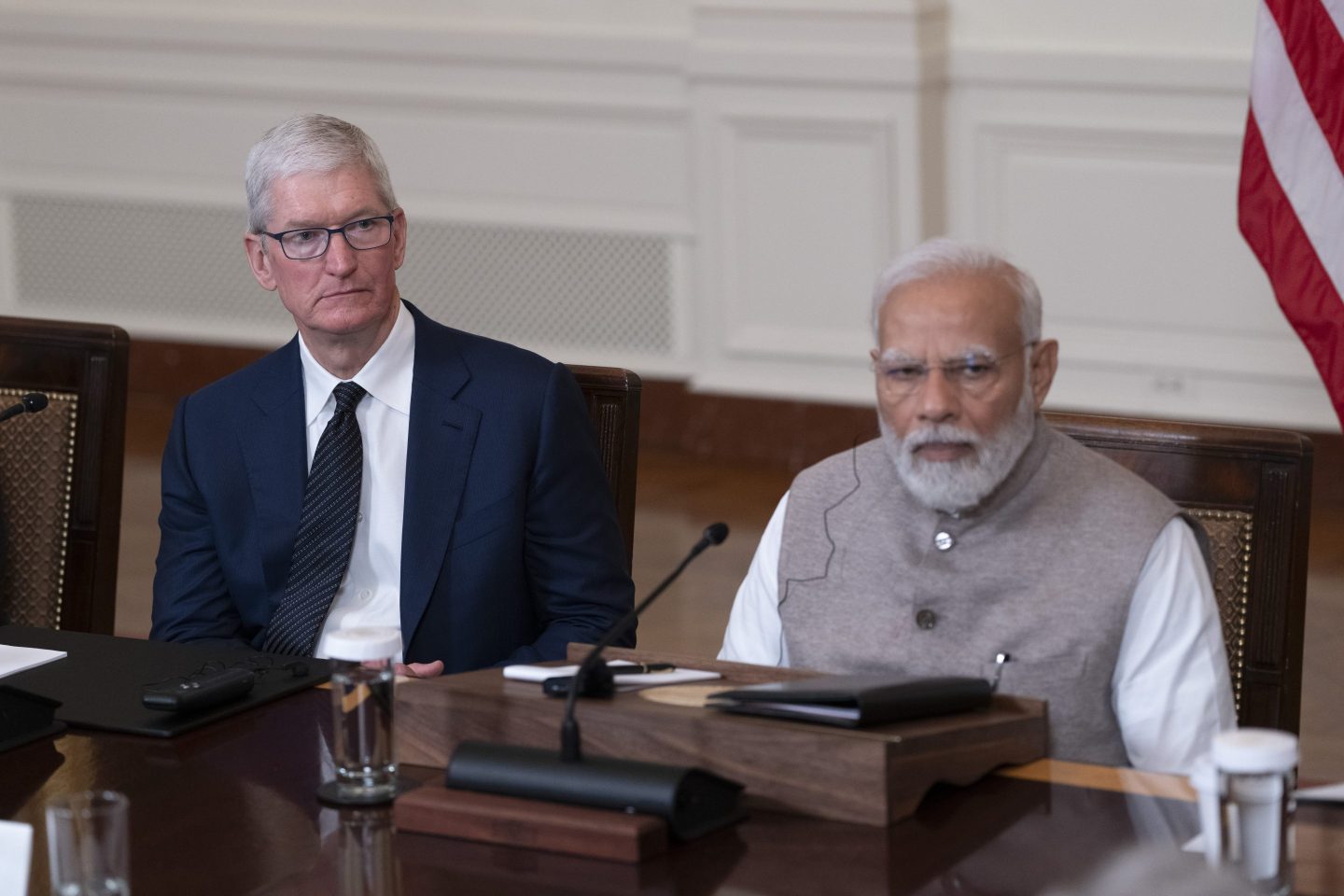
That finally changed in 2019, when the government of Prime Minister Narendra Modi updated India’s foreign direct investment rules, paving the way for Apple’s long-awaited, full-blown entry into the country’s retail scene.
Two decades ago, it was China that helped Apple stage a turnaround that ultimately put it on a path to becoming a multitrillion-dollar company. And while China and Apple are still deeply intertwined—on the tech giant’s balance sheet, in its supply chain, and in the public imagination—Apple’s ties to India are growing rapidly, giving the company a boost that it desperately needs right now.
Global smartphone growth is stalling: In the second quarter of 2023, 268 million smartphones were shipped globally, a 9% decline from the 294 million shipped in the second quarter of 2022, according to research firm Counterpoint. The slowdown has hit Apple hard. In November, the company reported that revenue had declined for the fourth straight quarter. On the earnings call, Cook framed India, as well as other emerging markets, as bright spots in an otherwise tough environment.
Apple’s timing has been advantageous on other fronts, too. Its broader entry into the country coincides with a boom in India’s middle class and Indian consumers’ budding allegiance to Apple, a noticeable shift in a country where 90% of smartphones are Android.
“India has been a tough nut to crack for Apple over the last five to six years. But there’s been a clear shift within India over the last few years,” said Daniel Ives, an Apple analyst and a managing director at financial advisory firm Wedbush Securities. “We think the retail stores built in India are the first step on a much broader and aggressive strategy of focusing on expanding their footprint with consumers in the Indian market.”
Apple did not provide answers to Fortune’s questions for this story.
To Apple, India doesn’t just present an opportunity to sell iPhones and AirPods. Apple is also turning to India to manufacture its products. The tech giant started manufacturing iPhones in India in 2017, and in recent years its contract manufacturers like Foxconn, Wistron, Pegatron, and Tata Group have expanded their presence in the country. India currently makes 7% of iPhones for Apple, according to Bloomberg. That share is expected to hit 18% by 2025, according to a report by Bank of America. For the first time, the iPhone 15 was being manufactured in India at the time of its launch in September.
Apple is expanding production in India as it faces challenges in its main manufacturing hub, China. But there’s another upside: Manufacturing more iPhone parts in India could make it easier for Apple to lower the price of the device in India over time, making it more affordable in a country where the average citizen earns $2,000 per year.
“There’s a huge part of the Indian population that now wants to move on to iPhones,” Ives says. “Apple recognizes it, which is why now they’re betting big on India.”
One of the more expensive iPhones in the world
Four miles from Apple’s new store in New Delhi, Sunil Motwani sits on a stool behind a counter at Excel Communications, the mobile phone shop he’s run for the past 20 years. The 450-square-foot store is plastered with ads for the iPhone, but the small shop sells all Apple products.
For years, Indian consumers bought their Apple goods through approved retailers like Motwani. The 47-year-old was one of the earliest; he began selling the iPhone 3G, the first product Apple launched in India, in 2008.
At the time, Motwani could only sell iPhones as part of a bundle with India carrier Airtel. That changed two years later when Apple set up a network that allowed authorized dealers like Motwani to sell devices on their own. For years, his shop would sell between 150 and 200 iPhones a quarter; that total would spike to 300 when Apple launched a new version.
But during its first decade selling iPhones in India, Apple’s share of the smartphone market never surpassed 1%, according to Counterpoint. The iPhone had one big strike against it: It was—and still is—expensive. It cost the equivalent of $850 in 2016, and upstart rivals like China’s OnePlus and Xiaomi were developing reliable models for roughly $350 or less. India slaps import tariffs up to 20% on fully assembled smartphones and component parts, making the country one of the more expensive places to buy an iPhone. Today, the basic version of the iPhone 15 costs roughly $960 in India versus $799 (excluding taxes) in the U.S.
On an earnings call in 2018, Cook told analysts he expected the Indian government to allow Apple to open stores in the country “at some point.” That moment arrived the next year. In July 2019, India relaxed its local sourcing rules, allowing single brand retailers to launch an e-commerce store, provided they open brick-and-mortar shops within two years.
“If you look at Apple retail stores [worldwide], less than 10% of sales come from actual retail stores; the vast majority of sales come from e-commerce,” said Ives. “[But] the retail stores are how consumers come in; they feel the products. That’s been the key DNA of Cook-Cupertino, and why Apple is where they are today.” He expects Apple to open eight more stores in India by 2025, up from the current two.
Apple’s new retail stores have stoked interest in Apple products, Motwani says, but that buzz hasn’t translated to sales for retailers like him, partly because customers can now buy directly from the company. He’s starting to diversify his stock in recent months, adding brands such as OnePlus, Motorola, and Honor. “We haven’t been able to benefit from the company’s growth in India, despite being one of their earliest authorized retailers,” he says.
Capitalizing on India’s maturing smartphone market
Apple has caught another break in recent years: India’s middle class, whose annual household income is between $6,000 and $37,000, more than doubled from 2005 to 2021, and now accounts for one-third of India’s population. What’s more, the smartphone market has matured to the point that consumers in emerging countries like India are upgrading their devices from their introductory models, a trend that Apple will benefit from as a “premium aspiration brand,” says Anil Gupta, a professor at the University of Maryland’s Smith School of Business and author of several books on India and China.
IDC expects Apple to notch another 35% in iPhone sales growth in India this year, reaching 9 million devices sold. Last year, Apple led the market in smartphones that cost more than $500 with a 60% share. And its share of the overall smartphone market had grown to 4% in 2022, up from 2% in 2020, per Counterpoint.

Morgan Stanley estimates that India could account for 15% of Apple’s revenue growth in the next five years, up from the 2% revenue growth the bank estimates India has accounted for over the past five years. The bank expects Apple’s India business to contribute $40 billion in revenue growth over the next decade, the equivalent of “Apple ramping [up] an entirely new product category.”
Diversifying away from China
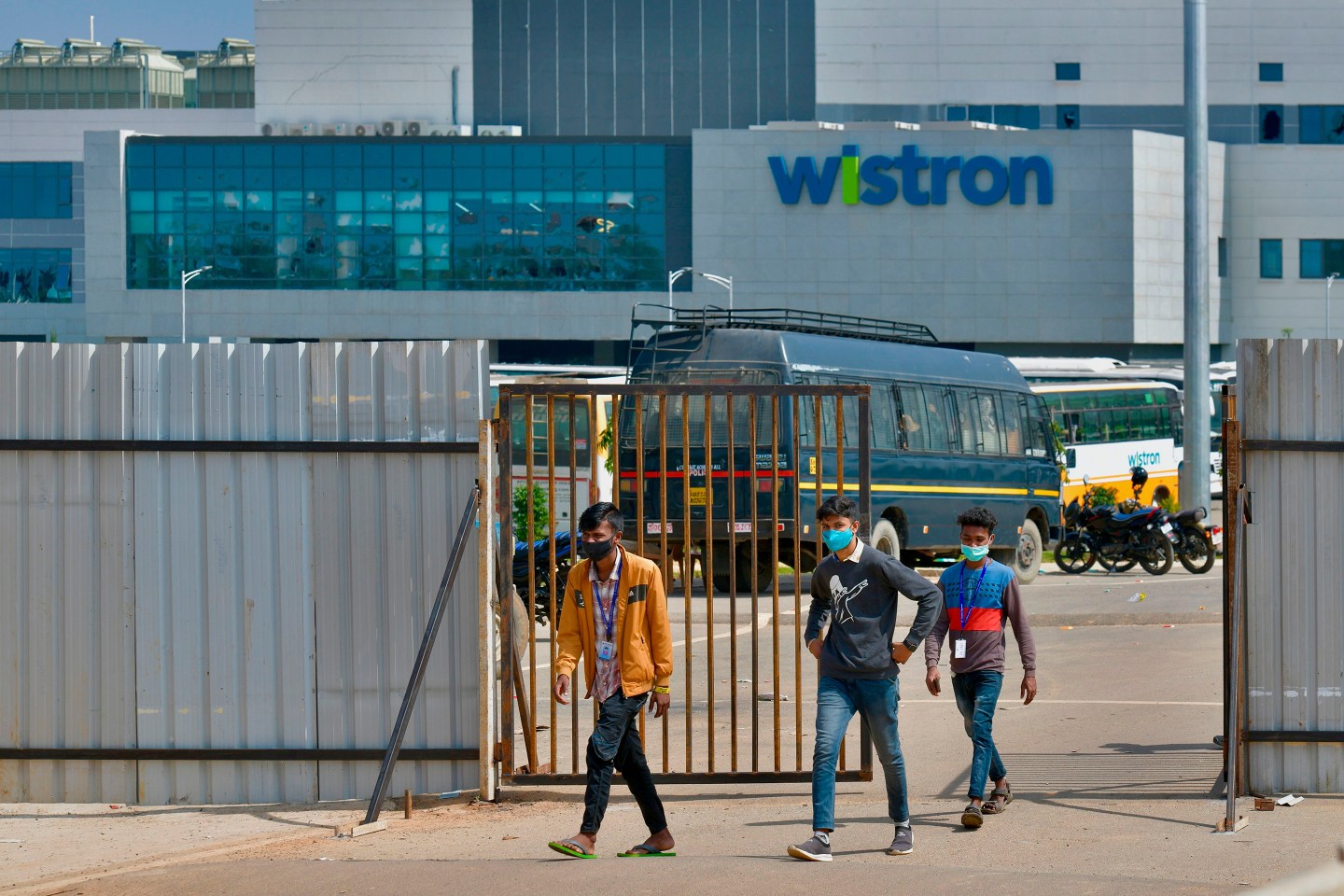
Sixteen miles northwest of Bengaluru is the sprawling industrial area of Narasapura. Factories here churn out all sorts of goods, from pressure cookers to planes. Forty-three acres of the area are occupied by a stark white factory with blue windows. Inside, over 10,000 Indian workers fill three shifts each day assembling iPhone 14s and iPhone 12s.
Wistron, a Taiwanese manufacturer and one of Apple’s biggest suppliers, opened the factory—the first in India to manufacture iPhones—in 2017. Since then, Apple’s largest contract manufacturer, Foxconn, has opened an iPhone factory in India, as has another supplier, Pegatron. Foxlink makes cables for iPhone chargers. And India’s 150-year-old Tata Group runs a factory that makes iPhone chassis. None of the Apple suppliers responded to requests for comment.
Foxconn, Tata, and Pegatron all have plans to expand their Apple manufacturing in India. In fact, Tata in November bought Wistron India, including the Narasapura plant, and is planning to construct one of India’s largest iPhone facilities in Tamil Nadu to be operational in 12 to 18 months, Bloomberg reports. All the action reflects Apple’s growing dependence on India.
Moving more production to India will help Apple hedge against the risks posed by China, whose factories still manufacture nearly 90% of all iPhones, according to Counterpoint Research. Beijing’s strict COVID lockdowns jammed up Apple’s supply chain, underscoring the downside of over-relying on a single supply source. Escalating U.S.-China tensions are also fueling business uncertainty. In September, media reports that Beijing planned to expand a ban on iPhones at government-backed agencies and companies shaved $200 billion off Apple’s share price. (Beijing denied the existence of new bans but cited unsupported claims of security flaws in the iPhone.) “They didn’t want to put all their eggs in one basket,” said Tarun Pathak, a senior analyst from Counterpoint Research.
What’s more, labor costs have risen in China. The minimum wage there now ranges from $190 to $360 per month, significantly higher than India’s rates, which vary from one state to another but hover between $84 to $250 for skilled workers. In fact, Foxconn chairman Young Liu touted India’s labor cost advantage on an earnings call in May.
The Indian government has also sweetened the deal for brands that are considering expanding their manufacturing in the country. A 2020 program to boost India’s “self-sufficiency” promises small payouts based on the sales of goods manufactured in India.
Then there’s an incentive that’s farther down the line: Selling iPhones manufactured in India would enable Apple to lower the tariffs of up to 20% that India applies to imported handsets and component parts, making them that much cheaper.
Yet a 100% made-in-India iPhone is years away. Apple’s manufacturing venture in China has been especially successful because China has established tier-2 and tier-3 level suppliers that feed into the Foxconn and Wistron factories in China that assemble iPhones, says Amitendu Palit, a senior research fellow and research lead at the Institute of South Asian Studies. For now, factories in India are assembling iPhones from parts shipped into the country from elsewhere.
Two factors holding back that type of production in India are labor laws and the country’s manufacturing skills gap.
In China, workers can log shifts as long as 12 hours a day. For years, workers in the Indian state of Karnataka, for instance, could only work eight hours at a time, and women were barred from working night shifts. Earlier this year, the state passed a new law that let workers log as many as 12 hours at once (up to 48 hours per week), and dropped the ban on women’s night shifts. (The law has not yet taken effect.) Apple and Foxconn reportedly lobbied for these changes, which India’s labor unions and other politicians opposed. Labor rights activists staged protests and filed a complaint with the International Labor Organization. The backlash was so severe that neighboring Tamil Nadu has put similar legislation on hold.
Then there’s the manufacturing skills gap. Lior Susan, managing partner at Eclipse Ventures, holds up his Apple AirPods to demonstrate the gulf. “To get into the finishing from a plastic point of view, from the shininess [point of view], you need mechanical engineers and process manufacturing engineers.” Those types of workers “have been working in China for three decades,” he says.
India doesn’t have enough of this type of skilled worker yet. Last year, India was short 30 million skilled workers compared with demand, according to a report from the National Skill Development Corporation. “The most critical challenge is likely to be on the supply side, in terms of availability of appropriately trained labor. I’m doubtful if such labor is in ample supply in India,” said Palit. Most blue-collar jobs in India are centered around construction, outsourcing, customer care, and data entry.
Karnataka’s Minister for Information Technology, Priyank Kharge, is optimistic that India can pivot, citing government training initiatives. “Ramping up that skill set will not be difficult. We have the demography with us,” Kharge said.
Expanding India’s Apple ecosystem
Forty miles west of Bengaluru, a green billboard greets drivers on National Highway 75: “Welcome to Milk and Silk City Kolar.” A few blocks from Kolar’s main transit hub, dozens of workers, most of them women, gather three times a day for a bus that will ferry them the 12 miles from Kolar to the Narasapura iPhone factory. There, they will assemble the devices for eight hours a day.
Kolar’s proximity to Narasapura has made the hub of 2 million a kind of company town. You can easily spot the iPhone factory workers by the green ID cards dangling around their necks.
Narayani was one of them. She started there after completing her bachelor’s degree in business administration in 2021. As an “operator” at the plant, it was her job to give assembled iPhones a final inspection. “I would take it, check the screen for scratches, and the camera for any damage, and then send it,” said Narayani, 21, who requested to use a pseudonym since she is not allowed to speak with the media. During an average shift, she’d check 600 iPhones. She earned $180 a month. She lives with her parents—her dad is a farmer, her mom a homemaker. They were grateful to have the extra income. Narayani was happy for the camaraderie of her colleagues.
“It felt like college because everyone around me was my age, and I became friends with them,” she said.
For young residents of rural Karnataka, the state where Kolar is located, the iPhone factory and other industrial plants have provided better pay than the region’s agricultural jobs. Pankaj Mohindroo, head of the India Cellular and Electronics Association (of which Apple is a member), estimates that India has added 1 million jobs in phone manufacturing in the past six or seven years. The country’s biggest iPhone manufacturing facility is still to come. According to reports, Foxconn has invested $700 million to build an iPhone factory near Bengaluru that will employ 60,000 people.
Workers like Narayani are one cog in Apple’s larger India ecosystem that could one day feed itself. “A large installed base of iPhones in India will also create a large and growing market for Apple to capture revenues from services consumed by iPhone users on apps downloaded from the App Store,” says Gupta. “Given India’s economic growth, I consider it highly probable that, within 10 years, iPhones could have a 15% market share in India.”
But that is still some years off. “Right now, we are assembling iPhones, and R&D, and everything is happening elsewhere,” says Navkendar Singh, associate vice president at IDC India. “It’s not happening in India.”
Narayani from Kolar doesn’t plan on being part of Apple’s India push going forward. Assembling iPhones was, in her view, a dead-end job. She quit the iPhone plant earlier this year to hunt for a software engineering job that “adds more value.” She recalled all this while talking on her smartphone from Vivo, a Chinese company. She can’t afford an iPhone.